
Knowledge and Moderation: The Shared Vision of the Ummah
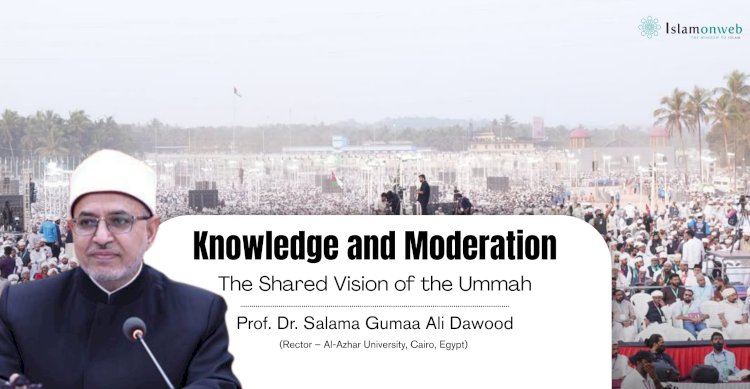
(The following is the translation of Arabic speech delivered by Prof. Dr. Salamah Dawud, representing His Eminence the Grand Imam of Al-Azhar, Prof. Dr. Aḥmad al-Ṭayyib, at the concluding session of the Samastha Kerala Jamʿiyyathul ʿUlamāʾ Centenary Conference held in Kuniya, Kasaragod, Kerala on Sunday 8 February 2026.
Addressing a distinguished gathering of scholars and leaders, he reflected on the shared commitment of Al-Azhar and Samastha to wasatiyyah (moderation). He highlighted Samastha’s vast educational network, serving thousands of institutions and educators, and noted Al-Azhar’s global role, hosting over seventy-five thousand international students from around one hundred and twenty countries. Marking the centenary, he announced Al-Azhar’s readiness to increase admissions from this blessed association, underscoring a shared commitment to knowledge, unity, and service to the Ummah.)
The centenary celebration of Samastha Kerala Jamʿiyyathul ʿUlamāʾ, in truth, is a celebration of the spread of wasatiyyah—the balanced and moderate Islamic methodology upon which Al-Azhar stands and upon which this noble association stands. It is the methodology that unites the Ummah and does not divide it.
Allah says:
“Indeed, this Ummah of yours is one Ummah, and I am your Lord, so fear Me.” (Al-Anbiyāʾ 21:92)
This is the essence of the moderate path: it gathers Muslims together and excludes none. It is the path described by Imām Abū al-Ḥasan al-Ashʿarī (raḥimahuLlāh), who affirmed that Islam accommodates all—Islam embraces all within its fold.
This is the path upon which Al-Azhar was built, from which scholars of the Muslim world have graduated, and upon which this blessed association (Samastha) has nurtured and produced thousands upon thousands of students and scholars.
The Messenger of Allah ﷺ said:
“Whoever equips a warrior in the path of Allah has himself fought.” (Ṣaḥīḥ al-Bukhārī, Ṣaḥīḥ Muslim)
In our context, preparing and supporting a student of knowledge—so that he or she may become a strength for the Muslims—is akin to striving in the path of Allah. Knowledge is strength; scholarship is protection.
Islam, Al-Azhar, and this association all stand upon respect for the plurality of Islamic schools of thought. At Al-Azhar, we teach the four Sunni madhāhib: the Ḥanafī, Mālikī, Shāfiʿī, and Ḥanbalī traditions. Likewise, within this association, these schools are studied without exclusion and without fanaticism. We do not marginalise one school in favour of another, nor do we nurture sectarian loyalty. We honour them all, because our scholars taught us to do so.
Imām Aḥmad ibn Ḥanbal (raḥimahuLlāh), though himself a great jurist and a student of Imām al-Shāfiʿī (raḥimahuLlāh), would say of his teacher: “Al-Shāfiʿī was like the sun for the world and like well-being for the people.” Such was the mutual respect among the great imams.
It was even said of Imām al-Bayhaqī—who preserved and spread the Shāfiʿī school—that while many owed a debt to al-Shāfiʿī, in one sense al-Shāfiʿī owed a debt to al-Bayhaqī for disseminating his madhhab so widely. This illustrates how scholarship flourishes through respect, gratitude, and service—not rivalry.
In essence, we are the Ummah of Iqraʾ—the Ummah of “Read.” The first revelation sent to the Prophet ﷺ was:
“Read in the name of your Lord who created—created man from a clinging clot. Read, and your Lord is Most Generous—who taught by the pen—taught man what he did not know.” (Al-ʿAlaq 96:1–5)
Between Two Commands to Read
When Allah revealed the first verses of the Qurʾān, He commanded: “Read.” Then He mentioned the creation of the human being. Then again He commanded: “Read, and your Lord is al-Akram.”
It is as though the creation of the human being was placed between two commands to read—between one Iqraʾ and another—so that this Ummah might live with knowledge from the cradle to the grave, from beginning to end.
Allah is described in the Qurʾān as al-Karīm (the Most Generous), as in His saying:
“O mankind, what has deceived you concerning your Lord, al-Karīm?” (Al-Infiṭār 82:6)
Yet He is described as al-Akram—the Most Generous in the superlative form—only in the context of knowledge:
“Read, and your Lord is al-Akram.” (Al-ʿAlaq 96:3)
It is as though Allah is telling us that His most generous gift is the gift of knowledge, because it is a gift that endures and does not perish.
When Allah commanded us to seek knowledge, He did not confine it to one specific field. He said:
“Say: Are those who know equal to those who do not know?” (Al-Zumar 39:9)
He did not restrict this to knowledge of fiqh, Sharīʿah, medicine, aviation, physics, or chemistry. The verse remains general.
Islam uplifts the Ummah through knowledge that leads to khashyah (reverent fear) of Allah and to its advancement.
Consider the verse:
“Do you not see that Allah sends down rain from the sky, and We produce thereby fruits of varying colours…” (Fāṭir 35:27)
Here we are reminded of those who study plants and agriculture.
“…And in the mountains are streaks white and red, of varying colours…”
Here are the scholars of geology and earth sciences.
“…And among people and creatures and grazing livestock are various colours likewise.”
Here are the scholars of humanity, zoology, and the natural sciences.
Then Allah concludes:
“Only those of His servants who have knowledge truly fear Allah.” (Fāṭir 35:28)
Thus, botanists, geologists, anthropologists, and zoologists are included—so long as their knowledge leads to reverent fear of Allah. Such knowledge is recognised and honoured.
The late Shaykh Muḥammad al-Ghazālī (raḥimahuLlāh) beautifully expressed this reality when he said: “A lesson in chemistry can be an act of humble worship to Allah.”
Knowledge as Striving in the Path of Allah
In truth, Islam strongly urges the pursuit of knowledge. Scholars of Sharīʿah have drawn evidence from the comprehensive verse in which Allah likens the departure of scholars in search of knowledge to mobilisation in His path:
“˹However,˺ it is not necessary for the believers to march forth all at once. Only a party from each group should march forth, leaving the rest to gain religious knowledge then enlighten their people when they return to them, so that they ˹too˺ may beware ˹of evil˺.” (Al-Tawbah 9:122)
The term nafirah (going forth) is commonly used in the context of jihād and striving in battle. Yet Allah applied it to those who dedicate themselves to studying His Book and the Sharīʿah. Thus, the departure of scholars and the devotion of jurists to sacred knowledge is regarded as a form of striving in the path of Allah.
Our Prophet ﷺ also equated the ink of scholars with the blood of martyrs:
“The ink of the scholars will be weighed on the Day of Resurrection against the blood of the martyrs.”
The ink—by which scholars write and preserve knowledge—will be weighed alongside the blood of those who gave their lives. Both defended the same cause: the Ummah and Islam. One defended it with weapon and sword; the other with thought, intellect, and pen. For this reason, the ink of scholars is given such honour.
We are the Ummah of Iqraʾ—the Ummah of reading. This is a call to read.
Abū al-Ṭayyib al-Mutanabbī said:
“The noblest place in this world is the saddle of a swift horse,
And the best companion in time is a book.”
As the Ummah of Iqraʾ, we must read. We must learn how to read properly, and we must cultivate sound and guided reading.
Two Kinds of Reading
In reality, there are two kinds of reading.
The first is reading to acquire knowledge—to learn what one did not know before and to gather the information contained in a book. This is good and beneficial.
But higher and better than this is a reading that produces knowledge from knowledge, that draws new understanding from what is already known, and that brings forth something new from what is old.
It is this kind of reading that leads us to read a single book twenty times, rather than being content with reading it once.
The great Egyptian thinker and writer ʿAbbās Maḥmūd al-ʿAqqād used to say:
“To read one book twenty times is better than to read twenty books once.”
Reading is not measured by the number of books one finishes, but by what settles within the self—within the mind and awareness—and by the new horizons that those books open.
It is reported that al-Muzanī, the student of Imām al-Shāfiʿī, said regarding his teacher’s book al-Risālah—the foundational work in Uṣūl al-Fiqh:
“I read al-Risālah five hundred times, and each time I discovered new knowledge.”
This is the reading that produces knowledge and generates understanding.
Knowledge of Transmission and Knowledge of Understanding
Our scholars taught us that knowledge is of two kinds: ʿilm al-riwāyah and ʿilm al-dirāyah.
The first, knowledge of transmission, depends on preserving material, memorising texts, and collecting narrations.
The second, knowledge of understanding, is based on deduction, reasoning, reflection, and creativity. This is the brighter, higher, and more distinguished form of knowledge.
A person may carry knowledge and possess texts, yet not be capable of deriving new understanding from them. Such a person is a carrier of fiqh, but not a faqīh. For this reason, the Prophet ﷺ said:
“May Allah brighten the face of a person who hears my words, understands them, and conveys them as he heard them. Perhaps a carrier of fiqh is not a faqīh, and perhaps a carrier of fiqh conveys it to one who is more understanding than he.”
The poet Marwān ibn Abī Ḥafṣah likened the one who carries knowledge without benefiting from it to a camel bearing a heavy load without understanding its value. He said:
“They chant poetry with no knowledge of its quality,
Like camels unaware of the worth of what they carry.”
Allah, Exalted is He, censured those who were entrusted with knowledge yet failed to comprehend and act upon it:
“The example of those who were entrusted with the Torah, then failed to uphold it, is like that of a donkey carrying books.” (Al-Jumuʿah 62:5)
In conclusion, if we seek progress, we must seek knowledge. If we seek certainty, we must seek knowledge. Allah says:
“And fear Allah, and Allah will teach you.” (Al-Baqarah 2:282)
We ask Allah: O Allah, benefit us with what You have taught us, teach us what benefits us, and increase us in knowledge.
About the author:
Prof. Dr. Salama Gumaa Ali Dawood (Rector – Al-Azhar University, Cairo, Egypt)
Disclaimer
The views expressed in this article are the author’s own and do not necessarily mirror Islamonweb’s editorial stance.

Related Posts












Leave A Comment