
The Foundations, Meaning, Values, and Purpose of Ramadhan
The month of Ramadhan is a much-awaited month for many Muslims. It is more than a ritual month but a school for shaping the soul and the moral life of the community. One common misconception about Ramadhan is that the month is confined to mere abstinence from food and drink, rather than being a period that provides opportunities and support for personal and moral transformation. With the coming month of Ramadhan, there is a need to reflect on the foundations for our understanding of Ramadhan, what Ramadhan really is (Meaning), What it cultivates in us (Values), and What it aims to achieve (Purpose). For one, Ramadhan is a comprehensive spiritual, moral, and social program that reshapes how we know, live, value, and strive.
The Foundations of Ramadhan: How We Come to Understand It
Ramadhan should be understood as divine guidance rather than a mere cultural habit. Fasting is an act of obedience grounded in revelation and wisdom, and the month invites believers to engage in reflection (tadabbur), learning, and heightened spiritual awareness. In this sense, Ramadhan becomes a mode of knowing, that is knowing the self (nafs), knowing one’s dependence on Allah, and knowing the reality of discipline, patience, and gratitude. Through restraint, remembrance, and God-consciousness (taqwa), Ramadhan trains the believers to perceive life with greater moral and spiritual clarity.
The Islamic observance of Ramadhan is grounded in multiple foundational sources of knowledge. In Islamic epistemology, understanding of religious duties and practices derives primarily from divine revelation, which are the Qurʾan and the Sunnah of the Prophet (Peache Be Upon Him -PBUH) supported by classical scholarly heritage and complemented by contemporary empirical scholarship on lived experience. Accordingly, our understanding of Ramadhan is rooted mainly in the Qurʾan (especially al-Baqarah 2:183–185), the Sunnah of the Prophet (PBUH), and the lived tradition of the Ummah, which will be discussed in what follows.
The Qurʾan: Divine Revelation
The Qur’an is the primary divine source that establishes Ramadhan and fasting as religious obligation. The Qurʾan states that fasting is prescribed for believers: “O you who believe, fasting has been prescribed for you as it was prescribed for those before you, that you may attain taqwa (God-consciousness)” (Qurʾan 2:183.). The text also connects Ramadhan with divine guidance “The month of Ramadhan is the one in which the Qurʾan was revealed as guidance for mankind….” (Qurʾan 2:185). These verses provide both literal prescription and conceptual purpose (spiritual discipline and guidance) for the observance of fasting during Ramadhan (SAPA, n.d.).
Prophetic Hadith: Elaboration of Practice
Prophetic hadith, authenticated records of the sayings and practices of Muhammad (PBUH) elaborate on the Quranic injunctions and provide practical, contextual insight into Ramadhan. For instance, the Prophet (PBUH) is reported to have said: “When Ramadhan begins, the gates of Paradise are opened and the gates of Hell are closed, and the devils are chained” (Sahih al-Bukhari, as cited in SAPA, n.d.). Another authentic narration underscores the spiritual reward associated with fasting “Whoever fasts Ramadhan out of faith and in hope of reward, his past sins will be forgiven” (Sahih al-Bukhari & Sahih Muslim, as cited in Muslim Aid, n.d.). These hadith provide contextual meaning and encourage the believers toward spiritual mindfulness, complementing the Quranic foundations (SAPA, n.d.; Muslim Aid, n.d.).
Heritage: Classical Interpretation and Scholarly Tradition
Islamic heritage encompasses tafsir (exegesis), fiqh (jurisprudence), and classical scholarly interpretation that explicate the Qurʾan and hadith on Ramadhan. Classical works of tafsir systematically derive rulings and explain the language, context, and legal implications of relevant texts. These interpretations serve as a conceptual framework for understanding and implementing the divine texts across different times and places (Encyclopedia Britannica, 2024). While such commentary is not itself a source of revelation, it is rooted in methodologically sound principles of usul al-fiqh (principles of jurisprudence) and the sciences of hadith and Qurʾanic exegesis.
Empirical Scholarship: Contemporary Research
Empirical scholarship encompasses systematic research, based on observation, measurement, and experimentation, including studies in the social sciences as well as in the biological and medical sciences. Contemporary empirical studies on Ramadhan offer insights into the lived experience and social meaning, as well as into physiological and psychological processes associated with fasting. Qualitative and social research has shown that Ramadhan fosters personal reflection, strengthens social values, and enhances communal cohesion (Alghafli, 2019). Similarly, studies on ritual practices during Ramadhan report associations with increased social solidarity and psychological well-being (Shalihin et al., 2022). Biomedical and nutritional research examined the effects of fasting on metabolism, circadian rhythms, and health-related outcomes, contributing to a scientific understanding of how the body adapts to fasting. Although empirical research does not directly serve as a normative religious authority, it enriches our understanding of Ramadhan by illuminating its social, psychological, and biological dimensions in contemporary contexts (Alghafli, 2019; Shalihin et al., 2022).
The Meaning of Ramadhan: What This Month Truly Is
From an ontological perspective, Ramadhan concerns the question of what this month is in its deepest reality, not merely how it is observed. The Qurʾan explicitly presents Ramadhan as a month of guidance (shahr al-huda) and as the period in which divine revelation was sent down, as stipulated in a verse “The month of Ramadhan is the one in which the Qurʾan was revealed as guidance for mankind, and clear proofs of guidance and criterion” (Qurʾan 2:185). In this regard, Ramadhan is not merely a time marker in the lunar calendar, but a special and sacred period set aside for reflection, self-discipline, and moral renewal, defined by revelation, moral orientation, and spiritual direction (Nasr, 2002).
Prophetic traditions further describe Ramadhan as a month of mercy, forgiveness, and liberation from the Fire. The Prophet Muḥammad (PBUH) is reported to have said that when Ramadhan begins, the gates of Paradise are opened, the gates of Hell are closed, and the devils are restrained (al-Bukhari, 2002; Muslim, 2007). Another well-known narration states that whoever fasts Ramadhan with faith and seeking reward will have his past sins forgiven (al-Bukhari, 2002; Muslim, 2007). These texts emphasize that Ramadhan is a period of ritual obligation as well as a divinely instituted opportunity for moral and spiritual transformation.
Ramadhan is not only a specific month on the calendar, nor merely a set of religious actions such as fasting and prayer, but also a spiritual state. This refers to a special inner condition of the heart and mind, marked by greater awareness of God, deeper reflection, and stronger self-control. Ramadhan also provides a moral space, in the sense that it creates a distinct moral atmosphere in which an individual thinks, feels, and acts more ethically and consciously. In other words, during the month of Ramadhan, an individual’s inner life and priorities are, in a sense, “reset.” The way one relates to God, to oneself, to one’s desires, and to the world is reoriented toward a healthier, more balanced, and more God-conscious direction.
Classical Muslim scholars emphasized that the acts of worship in Ramadhan are intended to restore inner order and moral balance within the human person, rather than merely to fulfill external requirement (al-Ghazali, 2005). Fasting, in particular, functions as a spiritual and moral discipline that curbs the dominance of desire and strengthens consciousness of God (taqwa), which the Qurʾan identifies as its central purpose (Qurʾan 2:183). In this way, the fundamental relationships that structure human life, that is between the human being and God, the body and the soul, desire and discipline, and this world and the Hereafter are renewed, realigned, and elevated.
Based on the above, fasting in Ramadhan should be understood not simply as abstention from food and drink, but as a comprehensive training of the will, the heart, and the moral conscience. Al-Ghazali (2005) distinguishes between the outward form of fasting and its inner reality, arguing that its true aim is the cultivation of self-restraint, sincerity, and attentiveness to God. Contemporary scholarship likewise notes that Ramadhan shapes both inner dispositions and social behavior, reinforcing self-regulation, empathy, and ethical awareness (Alghafli, 2019; Shalihin et al., 2022).
In this light, Ramadhan may be understood as a renewal of the human being. It is not merely a temporary change in routine but a divinely structured period for reorienting the self toward God, reordering desires under moral purpose, and reintegrating bodily discipline with spiritual meaning. Ramadhan is a specific period in the year that is marked by fasting, prayer, charity, self-restraint, remembrance of God, and other virtuous practices. It is, indeed, a transformative mode of being, providing opportunities for individuals to become more self-aware, more disciplined, more God-conscious, and more morally attentive.
In short, Ramadhan does not merely change an individual’s daily schedule as it actually reshapes his or her inner state and character. It is a period that shapes how an individual lives and thinks, and how he or she grows morally and spiritually, by linking God’s guidance with character formation and everyday lived experience (Nasr, 2002; al-Ghazali, 2005).
The Values of Ramadhan: What It Seeks to Cultivate in Us
If the meaning of Ramadhan concerns what this month is, its values concern ‘what this month seeks to form’ within the human person. In axiological terms, Ramadhan is oriented toward the cultivation of moral and spiritual virtues that shape both inner character and social conduct. The Qurʾan identifies taqwa (God-consciousness) as the central purpose of fasting “that you may become God-conscious” (Qurʾan 2:183), indicating that Ramadhan is fundamentally directed toward ethical and spiritual refinement rather than mere ritual compliance.
Among the core values nurtured by Ramadhan are taqwa (God-consciousness), ṣabr (patience and self-control), shukr (gratitude), ikhlaṣ (sincerity), raḥmah (compassion and mercy), and ʿadl (justice and fairness, particularly in social relations). Classical Muslim scholars stressed that worship is meant to improve character by changing the heart and guiding behaviors (al-Ghazali, 2005). In this sense, fasting functions as a discipline that restrains desire, strengthens self-mastery, and deepens awareness of God, thereby fostering moral coherence and spiritual attentiveness (Qurʾan 2:183; al-Ghazali 2005).
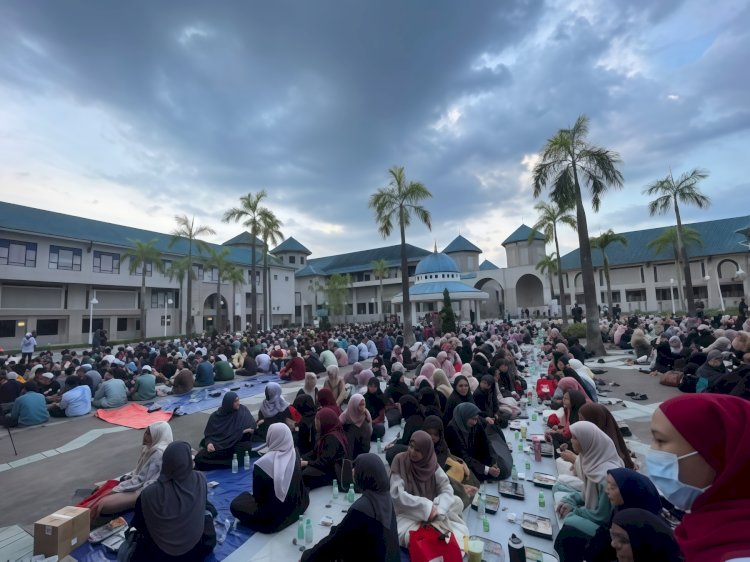
Breaking-of-Fast Program at IIUM. A meaningful gathering that benefited many and brought the community together, thanks to the generous sponsorship of the iftar. Photo credit: Siti Aisyah Ibrahim, IIUM
These values also have clear moral and social dimensions. Ramadhan nurtures empathy with the poor and needy people through the shared experience of hunger and restraint. Besides, there are institutionalized forms of giving such as ṣadaqah and zakat al-fiṭr, both reinforce the acts of generosity and social responsibility (Nasr, 2002). Findings from contemporary empirical studies indicate that Ramadhan is associated with increased social solidarity, greater charitable behavior, and heightened moral awareness within communities (Alghafli, 2019; Shalihin et al., 2022). This contributes to the development of positive personal qualities, stronger community bonds, and a deeper sense of brotherhood in society.
At the inner level, Ramadhan seeks to bring about transformation through the reordering of desires, the disciplining of the ego (nafs), and the purification of intentions. Al-Ghazali (2005) distinguishes between the outward form of fasting and its inward reality, arguing that its true aim is the refinement of the heart and the cultivation of sincerity and moral vigilance. This inner work aligns with the broader Islamic understanding of worship as a means of tazkiyat al-nafs (purification of the soul), through which the human being is gradually reoriented toward God and ethical excellence (Nasr, 2002).
Taken together, these dimensions justify viewing Ramadhan as a school of character (madrasah akhlaqiyyah). It is a divinely structured period for moral education and edification, in which revelation guides practice, practice shapes character, and character, in turn, is expressed in social responsibility and compassionate action. Thus, the values of Ramadhan are meant to be internalized and lived out through worship and good conduct in daily life.
The Purpose of Ramadhan: What It Ultimately Aims to Achieve
If the meaning of Ramadhan concerns what this month is, and its values concern what it forms in the human person, its purpose concerns what it ultimately seeks to achieve. In teleological terms, Ramadhan is oriented toward a clear Qurʾanic goal, that is the cultivation of taqwa (God-consciousness). The Qurʾan states that fasting is prescribed “so that you may attain taqwa” (Qurʾan 2:183), indicating that the purpose of Ramadhan is not mere abstention from food and drink, but the formation of a morally and spiritually ordered life.
Personal Purpose: Self-Improvement and Character Formation
At the personal level, Ramadhan aims to form a God-conscious, disciplined, and morally upright individuals. Through fasting and intensified worship, the believers learn self-restraint, patience, and sincerity, and gradually gain mastery over desire and impulse (al-Ghazali, 2005). This process also serves to realign life priorities away from excessive attachment to worldly concerns and toward accountability in the Hereafter (Nasr, 2002). In this sense, Ramadhan strengthens spiritual resilience and self-mastery, cultivating an inner orientation that extends beyond the month itself (Qurʾan 2:183; al-Ghazali, 2005).
Family, Work, and Everyday Life
The purpose of Ramadhan is not confined to private spirituality. The discipline learned through fasting and worship is meant to shape conduct within the family, the workplace, and daily social interactions. By fostering patience, empathy, honesty, and responsibility, Ramadhan trains individuals to carry these virtues into their roles as parents, spouses, colleagues, and leaders (Nasr, 2002). Contemporary studies suggest that the practices of Ramadhan are associated with increased moral awareness, self-regulation, and prosocial behavior, indicating that its formative effects extend into everyday life beyond ritual settings (Alghafli, 2019; Shalihin et al., 2022).
Social Purpose
At the social level, Ramadhan aims to contribute to the building of a compassionate, just, and morally responsible community. The shared experience of fasting nurtures empathy with the poor and vulnerable, while institutionalized acts of giving, such as ṣadaqah and zakat al-fiṭr, reinforce social solidarity and collective responsibility (Nasr, 2002). Empirical research likewise indicates that Ramadhan is associated with stronger communal bonds, increased charitable behaviors, and heightened social cohesion (Alghafli, 2019; Shalihin et al., 2022). This means that when individuals grow in moral character and ethical awareness, their improved behaviors strengthen families and communities, gradually renewing society’s values, strengthening relationships, and enhancing a shared sense of responsibility.
Orientation Toward the Hereafter
Ultimately, Ramadhan seeks to reorient human life toward its final end, which are accountability before God and success in the Hereafter. By weakening the dominance of desire and strengthening taqwa, fasting trains believers to live with a sense of moral purpose, responsibility, and transcendence (Qurʾan 2:183; al-Ghazali, 2005). This eschatological orientation does not negate worldly responsibilities. Rather, it gives them meaning by situating them within a higher moral horizon (Nasr, 2002).
Ramadhan as Preparation, Not an End in Itself
The above discussion indicates that Ramadhan should not be understood as an end in itself, but as a period of intensive training for the rest of the year. Classical scholars have emphasized that worship is meant to shape enduring character rather than temporary religious enthusiasm (al-Ghazali, 2005). In the context of Ramadhan, it serves as a model and rehearsal for sustained moral and spiritual living, in which the disciplines learned during the month are carried forward into family life, work, and society at large
Taken together, the foundations (how we understand Ramadhan), its meaning (what it truly is), its values (what it forms in us), and its purpose (what it aims to achieve) present Ramadhan as a holistic program of knowledge, being, character, and direction. It integrates revelation with practice, practice with character, and character with social responsibility and ultimate accountability before God (al-Ghazali, 2005; Nasr, 2002).
This integrated vision also warns against reducing Ramadhan to rituals alone or allowing its transformative spirit to fade once the month ends. When properly understood, Ramadhan is meant to shape the believer’s entire way of life namely at the personal level, within the family, at work, in society, and in preparation for the Hereafter.
About the author:
Shukran Abdul Rahman is a Professor at Department of Psychology, AbdulHamid AbuSulayman Kulliyyah of Islamic Revealed Knowledge and Human Sciences, International Islamic University, Malaysia (IIUM).
Disclaimer
The views expressed in this article are the author’s own and do not necessarily mirror Islamonweb’s editorial stance.


Related Posts














Leave A Comment