
I witnessed an al-Ghazali of My Imagination: Remembering Syed Muhammad Naquib al-Attas and His Legacy
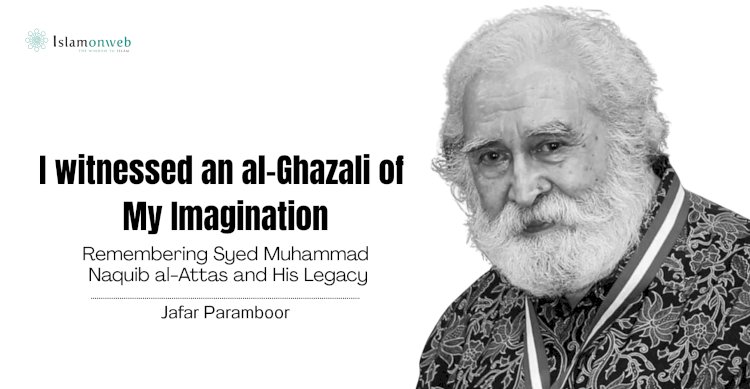
The First Encounter with a Giant
The first time I heard about Al-Attas was from his student, Professor Wan Mohd. Wan Daud[i], a senior friend and esteemed academician whom Al-Attas directly mentored as a Murabbi. In 2013, he came to the Kulliyyah of Education at IIUM to deliver a talk on the Islamization of knowledge while I was in the midst of my Master of Education journey. After the talk, I asked him a few questions related to his presentation. He responded, "Alright Jafar, if you are interested in this area, you may attend our Saturday night lecture series featuring Tans Sri SMN Al-Attas, organized by CASIS (Center for Advanced Studies on Islam, Science, and Civilization) at the UTM Kuala Lumpur Campus." I was thrilled to receive the invitation. The following week, I began preparing to attend and see the esteemed scholar-philosopher-historian-linguist, Al-Attas.
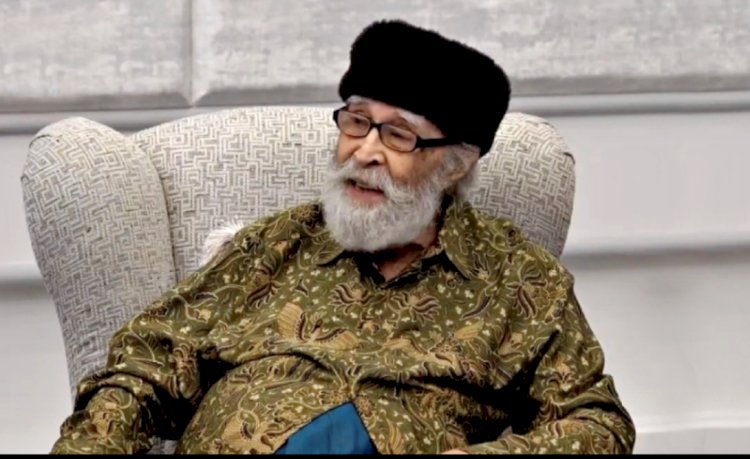
When he arrived, stepping out of his car with an elegant demeanor, I felt as if I were witnessing an Al-Ghazali from my imagination come to address his audience. I had never seen a scholar with such grace! As he entered the reception room, I observed the crowd taking their seats in the lecture hall (Dewan Kuliah).
I still remember the housekeeping announcement made by another student of Al-Attas, Prof. Zainy Othman, who was then a member of the academic staff at UTM CASIS. He advised us to switch off our mobile devices or set them to silent mode, as "Prof. Al-Attas is very sensitive to noises!" The Master of Ceremony welcomed Al-Attas, and the audience, consisting of local and international attendees totaling at least 300 people, including academicians and students, paid their respects with a standing ovation.
Holding a small, antique watch in his right hand, he gently placed it on the right side of his table as he took his seat and began his lecture. He opened his talk by touching upon several themes, with a primary focus on the Islamization of knowledge. He started precisely at 9:00 p.m. and would continue until around 11:00 or 11:30 p.m.
During this first encounter, I was utterly captivated by his command of language—his precision of expression, his careful choice of words, and the elegance of his delivery. So much so that I found myself unable to fully concentrate on the substance of what he was saying. Yet, it was not merely a matter of distraction; rather, it revealed my own lack of intellectual preparation to grasp his depth. I found myself largely clueless about many of the ideas, concepts, and theories he was engaging with. Still, I diligently jotted down certain points that appeared ‘key’ to me, hoping that I could later return to them, seek out his writings, and gradually come to understand them more clearly.
I returned from UTM to IIUM at around midnight by the university shuttle. The very next day, I rushed to the library, borrowed The Concept of Education in Islam by al-Attas, and began reading. That marked the beginning of my continued engagement, which eventually led me to attend several more of his Saturday night lecture series.
The Passionate Struggle
As I recall, on some Saturdays I had no one to accompany me, so I travelled alone by public transport. I would get down at an LRT station and walk approximately 1 kilometer to reach UTM. After the lectures, which would end late at night, I would walk to a nearby local restaurant—Restaurant Bismillah—and ask the owner if there might be a place for me to rest for the night. Since returning to my university at that hour was difficult and taxi fares were beyond my means, I depended on his kindness. He would graciously allow me to use one of his employee’s sleeping space, as the employee would be on the night shift.
On one such Saturday, prior to the lecture's commencement, I purchased The Educational Philosophy and Practice of Syed Muhammad Naquib al-Attas: An Exposition of the Original Concept of Islamization (1998) by Professor Wan Daud from the special pavilion set in front of the Dewan Kuliah, and I was fortunate enough to have him sign it. Initially, I struggled to comprehend al-Attas's profound ideas directly from his own works. It was only through reading Professor Wan Daud's exposition that these concepts began to clarify for me, prompting me to finish his book first.
Professor Wan Daud proved to be incredibly humble and kind in supporting my intellectual pursuit, particularly in my efforts to understand al-Attas's complex framework. Encouraged by his generosity, I once asked if it might be possible to meet al-Attas at his home for a brief face-to-face encounter, even if just for a few moments. He gently informed me that such a meeting was impossible during al-Attas’s retirement years, as he no longer received visitors. He recounted that even scholars who had traveled all the way from Turkey to meet him had been turned away.
Though deeply saddened by this reality, I would frequently ask Professor Wan Daud to convey my salam and utmost regards to his mentor, to which he warmly agreed. Whenever he visited al-Attas, he would later text me: "I have conveyed your salam to him, and I told him that you are writing about him." These messages brought me immense joy! Nevertheless, an underlying sorrow remained because I never truly had the chance to converse with this great 'Āalim in person, even though I was once honored to kiss his right hand as he arrived at UTM CASIS for a Saturday lecture.
To this day, I deeply envy all those who had the privilege to sit in classrooms and formally learn from al-Attas, a man of mountainous knowledge and philosophical thought. Yet, he was not merely a man of theoretical concepts. As his son, Sayed Ali Tawfiq al-Attas, highlighted while mourning his father's passing, he was fundamentally a man of action—a doer in many respects. He conceptualized the vision for a world-class institute of Islamic thought and civilization, successfully bringing ISTAC into existence. He also envisioned high-quality Islamic universities dedicated to the practice of the Islamization of knowledge, an effort that culminated in the establishment of the International Islamic University Malaysia (IIUM). To me, he was uniquely blessed with both 'ilm (knowledge) and 'amal (action)—a rare divine blessing that is bestowed upon very few.
Man of knowing
Among the ideas I learned directly from him during the Saturday lecture series are the following:
On Islamic worldview: In his lecture on April 13, 2013, he focused on this theme, elaborating on the concepts of tawḥīd (monotheism), rabb (Lord), ilāh (deity), quiddity and essence (al-dhāt wa al-ṣifāt), and actions (afʿāl). He explained how names symbolize reality, citing the verse wa ʿallama ādama al-asmāʾa kullahā (And He taught Adam the names—all of them; 2:31). He also discussed certain divine attributes, such as tanzīh (transcendence), al-wāḥid (The One) etc. To get all these in their fullest, one has to read his Prolegomena to the Metaphysics of Islām: An Exposition of the Fundamental Elements of the Worldview of Islam.
On language and Islamization of language: He emphasized the importance of Islamization of language first. Language as a medium of communication among human being, i.e., the rational animal (الحيوان الناطق), has a significant place in human life, and thus, it is vital to have proper language and the right use of language with adab. If the case is otherwise, we are corrupting the language, doing injustice to it. And it has been done even to Arabic. Arabic has been corrupted by the influence of a secularized world order. This can be understood by looking the word ‘tarbiyah’ which is commonly used to denote education in English. The word ‘tarbiyah’ never fully conveys the meaning of education in Islamic conception of education for human being. We can do tarbiyah to even a cat, by nurturing the animal and training it to eat properly for example. That is not the case when it comes to human. He needs more than ‘tarbiyah’, a mere nurturing act since he is a rational animal who can use his cognitive and spiritual capacities to think and act upon it. By secularization language, we are corrupting the basic vocabularies of Islam.
On Adab, ’Adl, and Ẓulm, and the concept of education (Ta’dīb) in Islam: While explaining the Ḥadīth Qudsī, i.e., addabanī Rabbī fa ’aḥsana ta’dībī (أَدَّبَنِي رَبِّي فَأَحْسَنَ تَأْدِيبِي) that he often cites when conceptualizing adab, he responded to the criticism that he was quoting a hadith that is considered either week or strange. He replied, "I am here to engage in scholarly and philosophical discourse, rather than to issue legal rulings in Islam. That is why I draw from the Sufi tradition and cite ḥadiths as found in their works, much like al-Ghazālī did." While going back to the etymological explanations of adabm he also referred to another Ḥadīth, i.e., ‘Inna hādha-l-Qur’ān ma’dubatullāh faqbalū min ma’dubatih ma-staṭa’tum ( إِنَّ هَذَا الْقُرْآنَ مَأْدُبَةُ اللَّهِ فَاقْبَلُوا مِنْ مَأْدُبَتِهِ مَا اسْتَطَعْتُمْ). In this Ḥadīth, the Prophet upon whom be peace tells his companions that, “Indeed, this Qur’an is the banquet of Allah, so take from His banquet as much as you can.” According to Al-Attas, the banquet is only served to people of adab, manners, and civilization. In other words, we as human beings have to raise to the civilizational perfection and adab to approach the Qur’an.
Referring to classical scholars, he defined ’adl as putting things on its right places (وضع الشيء في محله), and the opposite of ’adl is Ẓulm (ظلم) that, he defined, as not putting things in its proper places (وضع الشيء في غير محله); and adab is the actualization of ’adl, “… the discipline of body, mind and soul; the discipline that assures the recognition and acknowledgement of one’s proper place in relation to one’s physical, intellectual and spiritual capacities and potentials; the recognition and acknowledgement of the reality that knowledge and being are ordered hierarchically according to their various levels and degrees.” (See al-Attas, 1999, p. 22). Ta’dib is derived from adab, which he defines as “recognition and acknowledgement, progressively instilled into man, of the proper places of things, in the order of creation, such that it leads to the recognition and acknowledgement of God in the order of being and existence” (p.11). According to him, it is only ta’dīb that fully conveys the proper meaning of education in its Islamic sense, a combination of ta’līm and tarbiyah, as he argues that no other modern Arabic vocabulary denoting education is fully Islamic term fully encompasses its real meaning.
So, the purpose of education according to Islamic conception is to produce a man of adab. Here, he differs with the Western philosophy in that the purpose according to the latter is to produce a good citizen, while he argues that this is not enough in Islam, since a good citizen of a country may not necessarily be a good man, as the citizen may do good for his country while still doing injustice, ẓulm to himself (ظلم النفس). This ẓulm al-Nafs is introduced only by Islam, not any other religion in the world. Also, to be just, one has to have ma’rifah (knowledge of the essence), ’ilm (true knowledge), ḥikmah (wisdom), and adab. In this context, he explained the Qur’anic verse: وحملها الإنسان إنه كان ظلوما جهولا (But humanity assumed it, for they are truly wrongful to themselves and ignorant of the consequences (33:72). According to him the الإنسان here refers to those holding power to rule others. And جهول is ignorant compounded with arrogance. He argued that the crux of the problem of the modern world is loss of adab, leading to the corruption of many things, including knowledge.
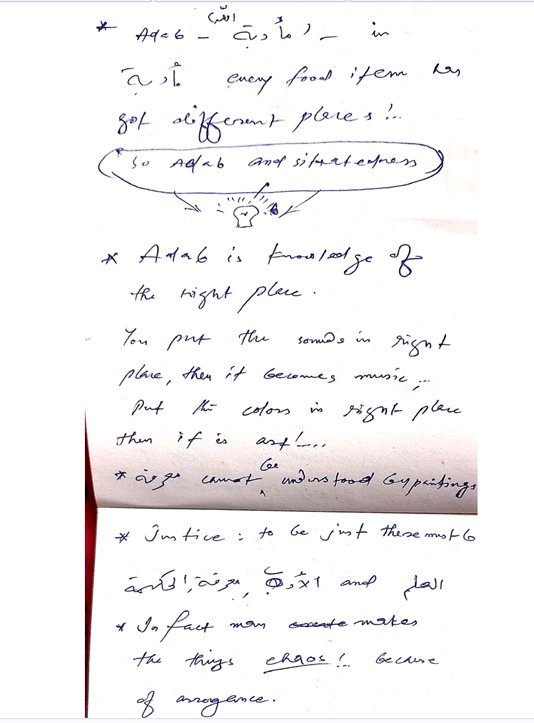
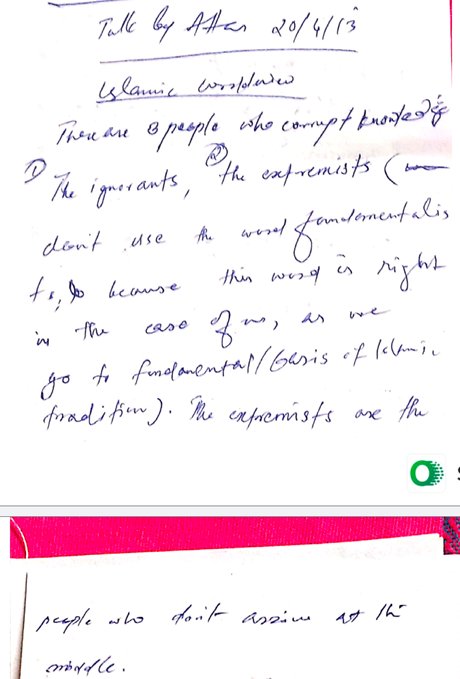
A few from my 37 pages of notes I scribbled during al-Attas’ Saturday night lecture series in 2013
On de-secularization of disciplines: Al-Attas explained how disciplines and their discourses were disenchanted by removing all the sacred elements from each. For instance, regarding the etymology of psychology, there was a term, such as ’Ilm al-Nafs in Arabic initially referred to as the study of soul and spirit before the separation of religion from science, a terrible epistemological corruption made by the Western worldview. For the West, to consider knowledge as scientific, it should have had the characteristics of being empirical and experiential, while the soul in a religious concept is out of such a definition. What they could deal with maximum was only the concept of mind and behaviour, as we learn today from our textbooks. As a result, they gradually took out and neglected the part of the soul from the definition of this, since they were totally confused about how to deal with the concept of soul in a purely scientific manner. That is, psychology, according to the Western definition is now the study of mind and behaviour, a mental process happening in human (Al-Attas, 1990).[ii] He referred to his ‘Islam and Secularism’ to narrate the historical origin, concept, and nature of secularism and secularization.
Islamization of contemporary knowledge: He defined Islamization as "the liberation of man first from magical, mythological, animistic, national-cultural tradition, and then from secular control over his reason and his language.” (1978, p.41). With this he meant Islamization of the contemporary knowledge, and that of the self and the soul. Even though his thoughts can be envisioned into a larger societal sphere, the first preference was for the self and the soul, the individual himself, like what al-Ghazali conceived. The latter highly emphasized self-purification first, so that he can act as a tool to purify and transform others. Hence, that is the difference between conceptualization of al-Attas and al-Faruqui regarding Islamization, whereas the latter perceived it from an Ummatic realm, since he thought from an activist’s point of view. Meanwhile al-Attas being a man of Taṣawwuf and a scholar (’Ālim) with an insight about multiple layers of knowledge, was concerned about the individual first. In one talk, he remarked that certain individuals and scholars, such as Aristotle, may have received wisdom from a prophet who lived during their era—possibly from Prophet Mūsā. This, he suggested, is because much of what Aristotle said was either true or closely aligned with the truth. And truth is one and ultimately, Islamic.
Man of Doing: The ISTAC as an Architectural Manifestation
In 1987, Professor al-Attas founded and directed ISTAC (the International Institute of Islamic Thought and Civilization), where he taught for ten years and amassed a collection of forty thousand manuscripts from across the Islamic world.
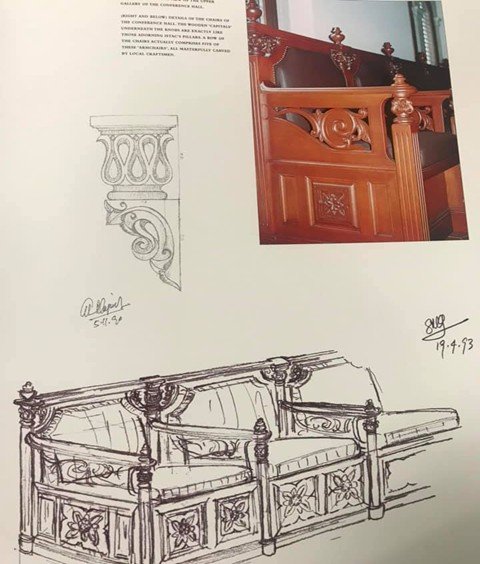
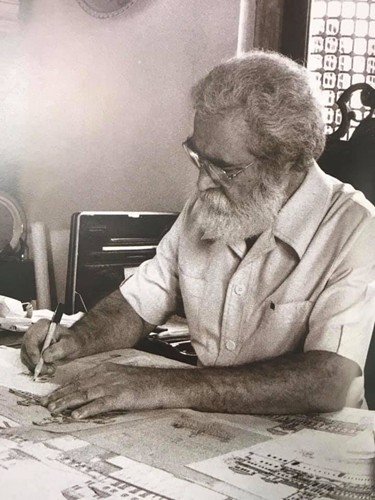
Before visiting ISTAC in Damansara, Kuala Lumpur, around 2013, I carefully studied ISTAC Illuminated: A Pictorial Tour of the International Institute of Islamic Thought and Civilization (ISTAC), edited by its architect himself, al-Attas. Had I not read this book, I would not have fully grasped the beauty and elegance of ISTAC. Even in the uniquely designed windows and carved furniture, one can see the touch of this great artist, designer, and calligrapher, who meticulously shaped the entire building into a world-class monument. While drafting its design, he drew inspiration from the great Islamic arabesque traditions of Córdoba and Granada.
When I recently visited the campus, one of my students showed me a white canopy beside the library and explained that al-Attas had intentionally placed it there so that students in those days could sit and engage in scholarly discussions even when the library was closed late at night.
Since 2025 as an instructor of Islamization of Education for PhD students at the IIUM Kulliyyah of Education, I have made it compulsory for all students to visit the ISTAC campus and library[iii]. This allows them to appreciate the legacy of its founding figure and draw inspiration from both the knowledge and legacy as they write their PhD theses. Some beautiful pictures of the ISTAC campus are below[iv]:
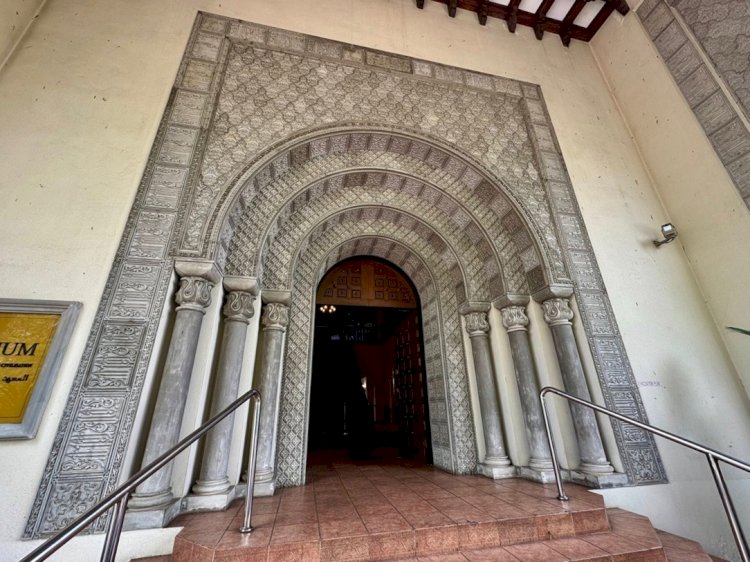
Main entrance
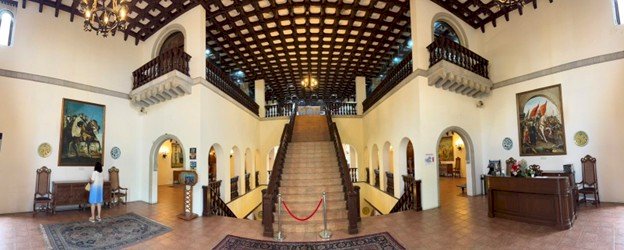
Reception area
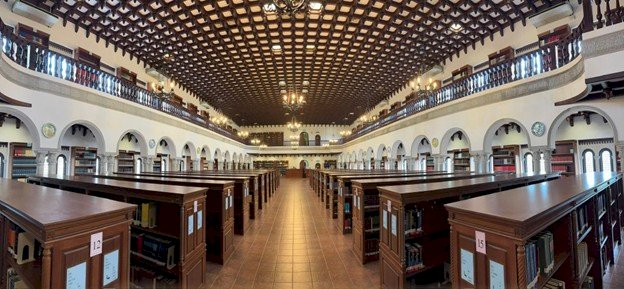
ISTAC library
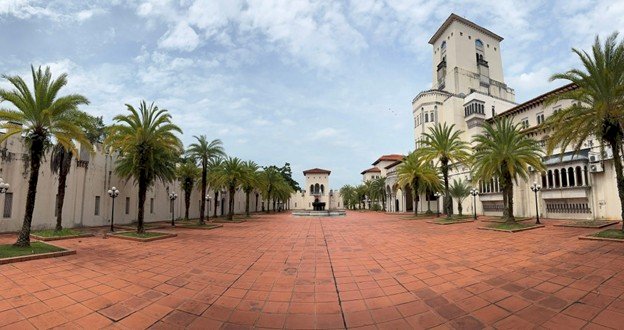
The courtyard in front of library
Let me also put a few pages from ISTAC Illuminated here:
Conclusion: A Legacy of Sincerity
In one of his latest videos I watched (and it is very rare to see him in videos; as I have heard his students say, he never allowed videos to be taken, since they could be presented out of context—edited and certain portions spread to serve one's own interests—and people might then react without understanding the true context.), Al-Attas emphasized sincerity (ikhlās), stating one cannot outsmart God because God knows your heart, your intention and so on. Reflecting on his life, one cannot but recognize that al-Attas embodied the unity of knowledge (’ilm) and action (’amal). He was not only a thinker but a doer, a man whose sincerity (ikhlās) was evident in his work. A mere reading of his works and an attempt to understand him is neither easy nor appropriate unless we receive proper guidance from those upon whom he has actualized ta'dīb. He has used sophisticated linguistic articulation throughout his books and justified clearly that ‘my works are not meant for laymen who has no intellectual background; rather they are for learned ones, with an intention of seeking the correct knowledge of Islam.’ His legacy continues to shape not only my own intellectual journey, but that of countless others. Indeed, we have lost a legend, a man of action with profound ikhlās. May Allah grant him mercy and elevate his rank among the righteous.
About the author:
Jafar Paramboor
Assistant Professor
Department of Social Foundations & Educational Leadership
Kulliyyah of Education
International Islamic University Malaysia
pjafar@iium.edu.my /jafarpoovathani@gmail.com
References
Al-Attas, S.M.N. (1978). Islam and Secularism. Kuala Lumpur: ABIM.
Al-Attas, S.M.N. (1980). The Concept of Education in Islam: A Framework for an Islamic Philosophy of Education. Kuala Lumpur: Angkatan BeliaIslam Malaysia.
Al-Attas, S. M. N. (1995). Prolegomena to the metaphysics of Islam: An exposition of the fundamental elements of the worldview of Islam. Penerbit UTM Press.
Al-Attas, S.M.N. (1999). The Concept of Education in Islam: A Framework for an Islamic Philosophy of Education. Kuala Lumpur: ISTAC.
Al-Attas, S. S. (Ed.). (1998). ISTAC illuminated: A pictorial tour of the International Institute of Islamic Thought and Civilization (ISTAC). International Institute of Islamic Thought and Civilization.
Wan Daud, W. M. N. (1998). The educational philosophy and practice of Syed Muhammad Naquib al-Attas: An exposition of the original concept of Islamization. International Institute of Islamic Thought and Civilization (ISTAC).
Citations
[i] See my interview with him here: https://en.islamonweb.net/de-westernization-of-education-is-a-dynamic-stabilism-through-tadib-interview-with-prof-wan-daud-malaysia
[ii] See: https://en.islamonweb.net/freud-was-not-always-scientific-so-is-psychology-deconstructing-the-present-narratives
[iii] For further reading on ISTAC library, see: Witkam, J. J. (2017). The Former ISTAC Library in Kuala Lumpur and Its Islamic Manuscripts. Travel Notes. Journal of Islamic Manuscripts, 8(3), 281-339. https://doi.org/10.1163/1878464X-00803003
[iv] All these pictures are retrieved from: https://www.facebook.com/share/p/18PGvdZ9d1/
Disclaimer
The views expressed in this article are the author’s own and do not necessarily mirror Islamonweb’s editorial stance.


Related Posts








Leave A Comment