
Gaza Holds the Qurʾān Dear Amid Israeli Raids, Displacement and Flooding
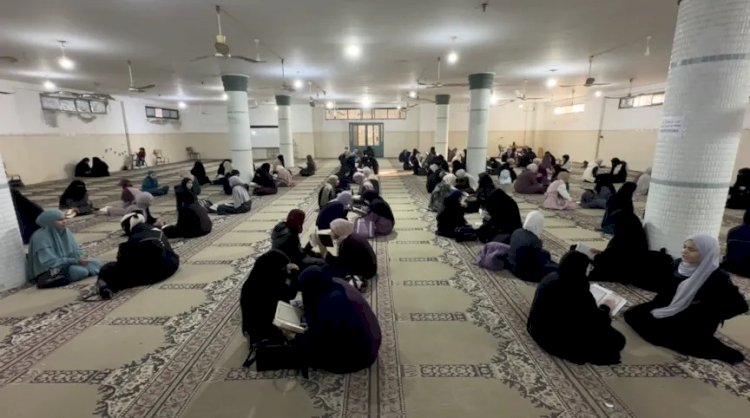
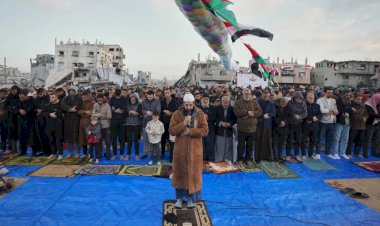
Around 150 Palestinian women and girls gathered at al-Shāfiʿī Mosque in Khan Younis on 18 November 2026 to recite and review the entire Qurʾān from memory. A separate ceremony earlier in November had honoured 1,000 men and women who completed memorising the Qurʾān and passed Gaza’s national memorisation examination. The two gatherings took place as displaced families faced renewed Israeli military operations and widespread flooding.
The women’s branch of Dār al-Qurʾān wa-l-Sunnah organised the Khan Younis gathering. From early morning, participants took turns reciting in circles while children sat nearby listening. Lana al-Maṣrī told Anadolu that she continued memorising and revising the Qurʾān while living in a displacement tent, even as gunfire reached the area. Another participant, Suʿād al-Salūt, said she began memorising the Qurʾān at 40 and completed it four years later.[1]
Gaza honours 1,000 Qurʾān memorisers

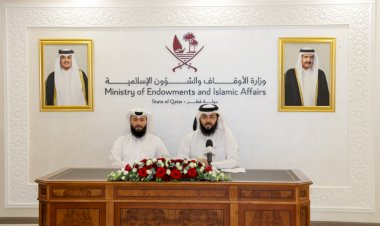
At the earlier ceremony, Gaza’s Ministry of Endowments and Religious Affairs honoured 1,000 people who had completed memorising the Qurʾān. Before the ceremony, participants of different ages walked in a procession carrying copies of the Qurʾān and singing religious songs. The ceremony included recitations and ended with the presentation of certificates and commemorative plaques in front of the graduates’ families. The International Union of Muslim Scholars reported that an Algerian association sponsored the event.[2]
Israeli ground raid forces families to flee again
On the day of the Khan Younis gathering, Israeli tanks crossed the ‘Yellow Line’, the military boundary established under the October 2025 ceasefire, in central Gaza. Reuters reported that dozens of displaced Palestinians fled their tents and shelters. The Israeli military said it was targeting a suspected tunnel that posed a threat to its troops. Hamas called the raid and the resulting displacement a violation of the ceasefire. Some families began returning on 19 November after Israel said the operation had ended.[3]
By mid-November, Gaza’s Health Ministry had reported 1,650 deaths and 5,975 injuries since the ceasefire, according to the UN humanitarian office. The World Health Organisation said an Israeli airstrike on 12 November hit the surgery department of Nasser Medical Complex in Khan Younis, killing six people and injuring at least 27. The strike damaged operating theatres and other parts of one of southern Gaza’s main referral hospitals.[4]
Flooding damages more than 40,000 shelters
Heavy rain from 6 to 8 November damaged more than 40,000 shelters, including over 9,000 beyond repair, according to preliminary UN assessments. About 226,000 people may have been affected, and more than 5,000 households reportedly slept without shelter. Floodwater also damaged food supplies, latrines and health facilities. On 13 November, Gaza’s Health Ministry reported that a nine-month-old infant had died of hypothermia.[4]
The UN humanitarian team said on 13 November that more than 150,000 tents procured by aid agencies and governments were still outside Gaza awaiting entry, most of them in al-ʿArīsh, Egypt. Aid workers reported shortages of shelter materials, pumps and generators. Funding shortfalls and access restrictions continued to hamper work at displacement sites exposed to further flooding.[4]
[1] Anadolu’s report and interviews, 19 November and the International Union of Muslim Scholars’ coverage, 21 November.
[2] International Union of Muslim Scholars, report on the ceremony honouring 1,000 Qurʾān memorisers, 14 November.
[3] Reuters, report on the ground raid, 18 November and follow-up on families returning, 19 November.
[4] UN Office for the Coordination of Humanitarian Affairs, humanitarian situation report, 18 November.
Disclaimer
The views expressed in this article are the author’s own and do not necessarily mirror Islamonweb’s editorial stance.
Related Posts






Leave A Comment