
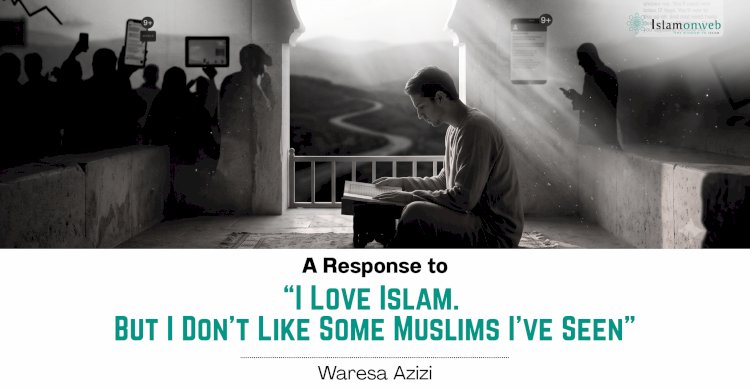
A Response to “I Love Islam. But I Don’t Like Some Muslims I’ve Seen”
The Passage of Faith: 9 Steps for Young Muslims to Question, Discover, and Build Their Own Relationship with Allah
Let’s be honest. Over the years, from childhood until today, we have all met some religious people who made our hearts feel lighter simply by being around them. They did not need to say much; sometimes it was just their smile, their kindness, or the quiet way they lived their faith you could simply feel something beautiful in them. But we have also met people who spoke about Islam and made us want to stop listening, not because we hated Islam or disrespected them, but because of the way they spoke, the way they looked at others, and the way they judged. Sometimes, their eyes seemed to say, “I know who belongs in Heaven, and I know who belongs in Hell.” After seeing this repeatedly, I began to wonder: How can someone speak so much about Allah, yet make people feel so far from Him? And that is where my journey began.
What Was I Reading?
I was fourteen when I picked up my first serious Islamic book, The Akhlāq of the Prophet ﷺ. It had a simple white-and-green cover, but the ideas inside quietly changed the way I saw Islam. I was already praying and fasting, yet the book made me ask questions I had never seriously considered: Is Islam merely a set of obligations, or is it supposed to transform the person I become? I knew that I loved Islam, but I did not want simply to inherit the identity of a Muslim; I wanted to understand what it meant to be one. So, at fifteen, I began slowly, imperfectly, and with many mistakes.
What Was I Watching?
The more I read about Islam, the harder it became to reconcile what I was discovering in its teachings with what I was witnessing in the lives of some of the people who claimed to represent it.
I saw the people who never missed a prayer five times a day they stood before Allah yet behind closed doors, they beat their wives and children.
I saw a man holding a tasbīḥ, the same beads he used to remember Allah, and then watched that same tasbīḥ become an instrument of cruelty.
I saw people praying shoulder to shoulder only moments after the salaam and gossip about someone who had just left.
I heard the people loudly reminding everyone else to pray while quietly accepting bribes.
I saw fully veiled girls looking at other girls with judgment and contempt.
I saw young men who dressed like religious men, deceived girls, and played with their feelings yet when it came time to marry, they wanted a good, modest, religious girl.
I listened to scholars speaking from the pulpit about women forgiving their husbands’ mahr, but when it came to women receiving their rightful share of inheritance, they were suddenly silent. And then there were the Qur’an competitions: young people reciting with extraordinary beauty, perfect pronunciation, and remarkable memorisation, while sometimes I wondered whether they even knew what they were saying? That question stayed with me because the more I learned about Islam, the more I began to see a painful distinction: there was Islam as I was discovering it in the book, and there was Islam as I was seeing it lived around me. They did not always look like the same thing. I did not yet know what to do with that contradiction, but I knew I could not simply ignore it.
What did I decide?
That realisation led me to decide that I could not learn Islam only through the people around me. I needed to return to the sources myself: the Qur’an, the life of the Prophet ﷺ, and the broader intellectual tradition of Islam. I feared that if I simply copied the people I saw, I might learn how to look religious without becoming a better human being. Then difficult questions followed.
If the Qur’an is supposed to transform us, why do some people read it every day and remain unchanged?
If prayer is supposed to restrain us from wrongdoing, why can someone pray and still hurt their family?
If remembrance of Allah is supposed to soften the heart, why can a tasbih remain in someone’s hand while their words continue to wound others?
If knowledge is supposed to produce humility, why does religious knowledge sometimes produce arrogance and condemnation?
The hardest part was not seeing ordinary people make mistakes; human beings are imperfect. What hurt more was seeing religious knowledge sometimes used as a weapon rather than a bridge. Then I encountered the saying of the Prophet ﷺ: “They recite the Qur’an, but it does not pass beyond their throats.” (Al-Adab Al-Mufrad, 774). The words frightened me. I began asking Allah not to make me someone who could recite the Qur’an beautifully, speak about religion intelligently, and yet remain unchanged inside.
Later, my Shaykh, Dr. Naser Ahmad Mushfiq, gave me a book containing a narration attributed to Abdullah ibn Mas‘ud (may Allah be pleased with him) about how the Companions learned the Qur’an: they learned its verses, understood them, reflected upon them, and sought to practise them before moving forward. This changed my understanding of what it meant to read the Qur’an. Perhaps the problem is not that we have too little Qur’an, but that sometimes we read more than we live. I did not want merely to finish the Qur’an; I wanted the Qur’an to finish something within me.
That realisation gradually changed the questions I was asking myself. I was no longer asking only whether I was reading enough, praying enough, or learning enough. I began asking whether all that knowledge and worship was actually changing the person I was becoming. Was my faith changing my character? Did my family feel safe around me? Did disagreement make me more thoughtful or more hostile? Was religious knowledge making me humbler, or simply more certain that everyone else was wrong?
The verse, “O believers! Protect yourselves and your families…” (At-Tahrim 66:6), became increasingly personal. Before correcting my family, friends, students, followers, or simply others, I needed to examine myself. These questions eventually became more than questions; they became a personal standard. I realised that if I was going to speak about Islam, I first had to ask whether I was allowing Islam to speak through my own character. That is why I made a personal decision:
I do not want to become that kind of Muslim.
I do not want the Qur’an to remain on my tongue without appearing in my character.
I do not want to be one person in the mosque and another at home.
I do not want a tasbih in my hand while my words hurt people.
I do not want religious knowledge that makes me proud rather than humble, or faith that makes others feel small.
As I grew older, I also realised that extremism could have quieter forms not only violence, but also treating every disagreement as disbelief, obsessing over the mistakes of other Muslims, confusing harshness with religious strength, or becoming so focused on proving who is a “real Muslim.” But this inward journey taught me that the danger was not always in what others were doing. Sometimes, I could become part of the same problem without even noticing it.
Therefore, the Prophet ﷺ became my standard not the loudest preacher, the harshest critic, or the person most confident in declaring others wrong, but the person whose character I wanted to understand and emulate.
Before judging someone else, I try to examine my own heart.
If social media makes me feel superior to other Muslims, I leave it.
If I enjoy watching someone being exposed or humiliated, I ask myself whether my faith is speaking or whether my ego is simply wearing religious clothes.
If I disagree with someone, I remind myself that disagreement does not automatically mean disbelief.
Above all, I remember that I am still a work in progress. Two years ago, I held opinions I am embarrassed by today; two years from now, I may look back at some of my present opinions and recognise how much I still do not know. I do not know another person’s entire story, their private struggles, or what exists inside their heart, but Allah does.
Where That Left Me?
I began to see how easy it is to reverse the order of the spiritual journey. Changing yourself is difficult because it requires confronting the parts of yourself that nobody else sees anger, jealousy, arrogance, selfishness, desires, laziness, and hidden weaknesses. By contrast, correcting others is much easier. We can tell someone how to dress, how to pray, how to behave, or what they should believe, while avoiding the uncomfortable work of looking inward. The more I reflected on this, the more I began to think of a thirsty person standing near a river, shouting, “Water! Water! Water!” louder and louder while never actually drinking. In much the same way, religion can sometimes become like that: we talk constantly about prayer, hijab, marriage, halal and haram, and the mistakes of others, while forgetting to ask whether our own hearts are still thirsty. That realization changed something in me. I still love Islam, but I no longer want my relationship with Islam to depend on whether other Muslims live up to it. Instead, I want to return to the source: to read, question, reflect, practise, fail, return, and begin again. Perhaps, then, finding Allah is not about becoming the person who can tell everyone else what they are doing wrong; perhaps it begins with becoming honest enough to ask one simple question: “What is Allah trying to change in me?” And perhaps that is where the real journey begins the journey I went through myself, and the nine steps I now want to share with you.
9 Steps to Find the Truth and Build Your Own Relationship with Allah
- Ask honestly: Do not be afraid of sincere questions.
Wabisa b. Ma'bad reported God’s Messenger as saying, “Have you come to ask about righteousness and sin, Wabisa?” When he replied that he had, he joined his fingers and striking his breast with them said, “Ask yourself for a decision, ask your heart for a decision (saying it three times). Righteousness is that with which the soul is tranquil and the heart is tranquil, but sin is that which rouses suspicion in the soul and is perplexing in the breast, even if people give you a decision in its favour.” (Mishkat al-Masabih 2774)
- Go back to the source: Read the Qur’an and learn the Sunnah.
˹This is˺ a blessed Book which We have revealed to you ˹O Prophet˺ so that they may contemplate its verses, and people of reason may be mindful. (Sad:30)
- Understand before judging: Learn the meaning, context, tafsir, and different scholarly opinions.
Ubaydullah ibn Abi Ja‘far reported that the Messenger of Allah ﷺ said: “The most daring of you in giving religious verdicts (fatwas) is the most daring of you in approaching the Fire.” (Sunan al-Darimi)
Abdullah ibn Mas‘ud said “Whoever gives people a religious verdict (fatwa) concerning every matter about which they ask him is a madman.”
A‘lām al-Muwaqqi‘īn ‘an Rabb al-‘Ālamīn, vol. 5, p. 87.
- Separate Islam from Muslims: People can fail; their failure does not define Islam.
It has been narrated that ‘Ali, may Allah ennoble his face, said to one of his companions: “O Harith, the matter has become confused for you. Indeed, the truth is not known by men; know the truth, and you will know its people.”
Zahrat al-Tafāsīr, vol. 1, p. 212.
- Do not confuse appearance with character: True religiousness should shape how you treat people.
Abu Huraira reported Allah's Messenger (ﷺ) as saying: Do you know who is poor? They (the Companions of the Holy Prophet) said: A poor man amongst us is one who has neither dirham with him nor wealth. He (the Holy Prophet) said: The poor of my Umma would be he who would come on the Day of Resurrection with prayers and fasts and Zakat but (he would find himself bankrupt on that day as he would have exhausted his funds of virtues) since he hurled abuses upon others, brought calumny against others and unlawfully consumed the wealth of others and shed the blood of others and beat others, and his virtues would be credited to the account of one (who suffered at his hand). And if his good deeds fall short to clear the account, then his sins would be entered in (his account) and he would be thrown in the Hell-Fire. (Sahih Muslim 2581)
- Learn slowly and practise deeply: Understand a verse, reflect on it, and try to live it before rushing ahead.
Abu Abdur Rahman reported: The companions would learn to recite ten verses from the Messenger of Allah, peace and blessings be upon him. They would not take another ten verses until they understood the knowledge and deeds they contained. They would say, “We learned sacred knowledge and action together.” (Musnad Ahmad 23482)
- Protect your mind: Do not let angry social media clips and comment sections become your source of Islam.
Abu Hurairah (May Allah be pleased with him) said:
The Prophet (ﷺ) said, "It is enough for a man to prove himself a liar when he goes on narrating whatever he hears." (Riyad as-Salihin 1547)
- Live what you learn: Let your Islam appear in your honesty, patience, mercy, family life, relationships, and treatment of others.
Worship Allah ˹alone˺ and associate none with Him. And be kind to parents, relatives, orphans, the poor, near and distant neighbours, close friends, ˹needy˺ travellers, and those ˹bondspeople˺ in your possession. Surely Allah does not like whoever is arrogant, boastful. (An-Nisa:36)
- Make your own journey with Allah: Do not let other people's failures push you away from Islam, and do not let their opinions replace your own sincere search for the truth.
‘It is truly I. I am Allah! There is no god ˹worthy of worship˺ except Me. So worship Me ˹alone˺, and establish prayer for My remembrance (Taha:15)
Narrated Abu Huraira: Allah's Messenger (ﷺ) said, "Allah said, 'If My slaves loves the meeting with Me, I too love the meeting with him; and if he dislikes the meeting with Me, I too dislike the meeting with him." (Sahih al-Bukhari 7504)
Narrated `Umar bin Al-Khattab: Some Sabi (i.e. war prisoners, children and woman only) were brought before the Prophet (ﷺ) and behold, a woman amongst them was milking her breasts to feed and whenever she found a child amongst the captives, she took it over her chest and nursed it (she had lost her child but later she found him) the Prophet said to us, "Do you think that this lady can throw her son in the fire?" We replied, "No, if she has the power not to throw it (in the fire)." The Prophet (ﷺ) then said, "Allah is more merciful to His slaves than this lady to her son." (Sahih al-Bukhari 5999)
In Conclusion: If you love Islam but feel hurt or confused by what you see in some Muslims, do not be ashamed of your questions. They may not be a sign of weak faith, but of a heart searching for what is true. You do not need to become harsh to prove your Islam, win every argument, or judge everyone around you. Instead, keep returning to the Islam sources and ask yourself: Is it changing me? Am I becoming softer, kinder, more honest, and humbler? I still love Islam. And I have learned not to judge Islam by the failures of Muslims, but to measure myself against the truth of Islam. I do not want to be someone who only reads the Qur’an. I want to be someone whom the Qur’an changes.
Disclaimer
The views expressed in this article are the author’s own and do not necessarily mirror Islamonweb’s editorial stance.


Related Posts











Leave A Comment