
The Prophet ﷺ and the Horse: Goodness in Their Forelocks
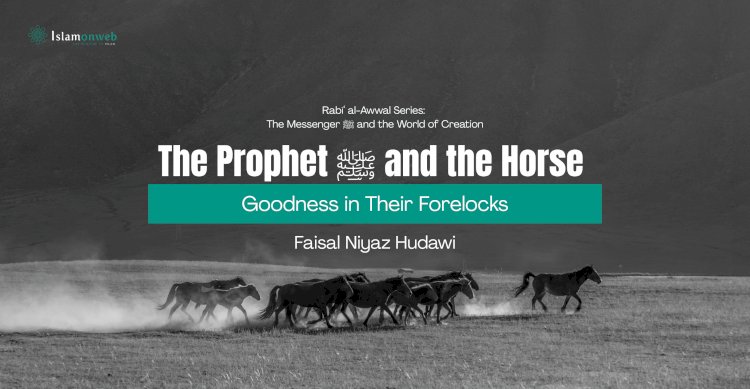
The horse occupied a distinctive place in Arabian life. It was valued not only for speed and strength, but also for beauty, lineage, courage and companionship. Arabs named their horses carefully, and the names often preserved a quality admired in the animal: flowing speed, powerful stride, beautiful neighing, endurance, colour or temperament.
The Qurʾān reflects this many-sided place of the horse. It speaks of horses as creatures created “for you to ride and as adornment” (Qurʾān 16:8), bringing usefulness and beauty together. Elsewhere, horses appear in the language of preparedness: “Prepare against them whatever force you can, including warhorses” (Qurʾān 8:60). Many classical exegetes also understood the opening of Sūrat al-ʿĀdiyāt as an image of charging horses, though an early interpretation also related the passage to the camels of Ḥajj (Qurʾān 100:1–5).[1]
These images help explain why the horse was never merely another domestic animal in the Prophetic world. It represented movement, readiness and disciplined strength. Yet the Prophetic teaching did not glorify strength for its own sake. What gave the horse its true value was the purpose for which it was kept and the intention of the person who kept it.
“Goodness Is Tied to Their Forelocks”
ʿUrwah al-Bāriqī رضي الله عنه relates that the Prophet ﷺ said: “Goodness is tied to the forelocks of horses until the Day of Resurrection: reward and spoils.”[2]
The image is striking. The nāṣiyah is the forelock, the hair falling over the horse’s forehead. Al-Nawawī explains that the expression means that goodness remains closely attached to horses when they are kept for a righteous purpose; citing al-Khaṭṭābī and others, he notes that the forelock can stand figuratively for the horse itself.[3]
Another narration makes the picture even more vivid. Jarīr ibn ʿAbdillāh رضي الله عنه says that he saw the Messenger of Allah ﷺ handling the forelock of a horse with his fingers while repeating this teaching about the goodness attached to horses. It is a small scene, but a memorable one: the Prophet ﷺ with his hand on the horse’s forelock, speaking of the blessing connected to it.[4]
That goodness, however, was never automatic. In another well-known ḥadīth, Abū Hurayrah رضي الله عنه relates that the Prophet ﷺ divided horses into three categories according to the intention of their owners. For one person a horse could become a source of reward; for another, a means of protection and sufficiency; for another, a source of sin. The horse kept sincerely for a righteous purpose earned reward even through its grazing, drinking and movement. The horse kept for legitimate need, while its rights were fulfilled, became a form of protection. But a horse kept for pride, ostentation and rivalry became a burden against its owner.[5]
This gives the Prophetic understanding of the horse an important moral balance. Speed was admired, but not vanity. Strength was encouraged, but not arrogance. Beauty was recognised, but its highest worth lay in service, discipline and right intention.
The Horses of the Messenger ﷺ
The Messenger of Allah ﷺ himself owned and rode horses, and the Sīrah and biographical works preserve the names of several of them. Later classical compilers commonly identify seven as the best-known and describe them as the horses over which there was broad agreement: al-Sakb, al-Murtajiz, al-Luḥayf, Lizāz, al-Ẓarib, Sabḥah and al-Ward. They also preserve additional names, though the attribution of these is more disputed.[6]
The names themselves reveal something of Arab horse culture. Al-Sakb evokes the image of water flowing freely and swiftly. Al-Murtajiz was explained in relation to the rhythm and beauty of its neighing, recalling rajaz poetry. Lizāz suggested closeness and persistence in pursuit; al-Ẓarib strength and solidity; and Sabḥah the broad, flowing stride of a horse that seemed almost to swim as it ran. The exact explanations vary in the historical literature, but the language shows how carefully horses were observed and remembered.
One of these names is securely preserved in Ṣaḥīḥ al-Bukhārī. Sahl ibn Saʿd رضي الله عنه reports: “The Prophet ﷺ had in our garden a horse called al-Luḥayf.” A brief report, but significant: the animal had an individual name, and that name remained part of the remembered details of the Prophet’s ﷺ life.[7]
al-Sakb: The Horse of Uḥud
Among the horses associated with the Messenger of Allah ﷺ, al-Sakb occupies a particularly early place in the Madinan period. Ibn Saʿd, through al-Wāqidī, reports that it was the first horse owned by the Prophet ﷺ in Madīnah. He purchased it from a man of Banū Fazārah for ten awāq. Its earlier name was said to have been al-Ḍirs, and the Prophet ﷺ renamed it al-Sakb. The same historical tradition associates it with his earliest military riding and with Uḥud.[8]
The name is suggestive. In Arabic, sakb carries the sense of pouring or flowing, and classical writers connected it with the smooth speed of running water. The historical sources differ over some physical details, including its colour, but the more important association is with a community still learning to defend itself in Madīnah.
Uḥud was one of the most painful days in the early Muslim community. A year after Badr, the Muslims would experience loss, confusion and a severe lesson in discipline. The appearance of al-Sakb in this setting gives the horse a particular place in the Sīrah: not as a symbol of prestige, but as a mount in a moment when readiness and courage were urgently required.
The contrast with the camel is instructive. Camels carried the Prophet ﷺ across the long distances of migration and pilgrimage; horses belonged especially to moments of speed, training and confrontation. Each animal occupied its own place in the landscape of the Sīrah.
al-Murtajiz and the Testimony of Khuzaymah
Another horse traditionally associated with the Prophet ﷺ is al-Murtajiz. Its story is memorable not because of a battle, but because a simple transaction involving a horse became an enduring testimony to the truthfulness of the Messenger ﷺ.
The Prophet ﷺ purchased a horse from a Bedouin. After agreeing to the sale, he walked ahead so that he could bring the payment, while the Bedouin followed more slowly with the horse. Some people, unaware that the sale had already been concluded, began offering the man a higher price. The Bedouin then called out to the Prophet ﷺ, in effect, that if he still wished to buy the horse, he should do so; otherwise, he would sell it to someone else.
The Prophet ﷺ replied that he had already purchased it. The man denied that the sale had been concluded and demanded a witness.
Khuzaymah ibn Thābit رضي الله عنه stepped forward and testified that the Prophet ﷺ had indeed bought the horse. The Prophet ﷺ asked him how he could testify when he had not witnessed the transaction. Khuzaymah replied that he believed the Messenger ﷺ in what he reported from heaven, so he would certainly believe him in this matter. The Prophet ﷺ then made Khuzaymah’s testimony equivalent to that of two men, and he became known as Dhū al-Shahādatayn, “the Possessor of Two Testimonies.”[9]
The incident itself is well attested in the ḥadīth collections. Later biographical sources identify the horse involved as al-Murtajiz; the name is not given in the earliest ḥadīth report, and that distinction should be preserved.[10]
The name al-Murtajiz was explained by classical writers as a reference to the horse’s fine neighing, likened to the rhythm of rajaz poetry. Yet the most enduring sound connected to this horse was not its neigh. It was Khuzaymah’s declaration of confidence in the truthfulness of the Messenger ﷺ.
When Madīnah Awoke in Fear
One night, the people of Madīnah were startled by a frightening sound. In a city that still faced the possibility of attack, such an alarm could not be ignored. People came out and began moving towards the direction from which the sound had come.
Before they reached it, they encountered someone already returning.
It was the Messenger of Allah ﷺ.
He had heard the same sound, mounted a horse belonging to Abū Ṭalḥah رضي الله عنه, and ridden ahead of everyone else to investigate. By the time the people were gathering to discover what had happened, the Prophet ﷺ had already reached the source of the alarm, assessed the situation and was on his way back.
Anas ibn Mālik رضي الله عنه remembered the scene vividly. The Prophet ﷺ was riding the horse bareback, with a sword hanging from his neck. As he met the frightened people, he reassured them: “Do not be afraid. Do not be afraid.” Then he praised the horse: “We found it a sea,” meaning that it ran with extraordinary breadth and speed. Another narration identifies the horse as al-Mandūb and notes that it had previously been considered somewhat slow.[11]
It is difficult to find a more vivid picture of Prophetic courage. He did not send others ahead while remaining behind. Hearing what might have been a threat to Madīnah, he mounted the available horse and went himself.
The report also reveals his horsemanship: he rode at speed, without a saddle, carrying his sword, investigated the danger and returned composed enough to calm everyone else. And after reassuring the people, he praised the animal that had carried him swiftly into the darkness.
Racing the Horses of Madīnah
The Prophet ﷺ did not merely praise horses. He encouraged their preparation and organised races among them.
Ibn ʿUmar رضي الله عنهما relates that the Messenger of Allah ﷺ arranged races for horses that had been conditioned and trained, setting their course from al-Ḥafyāʾ to Thaniyyat al-Wadāʿ. Horses that had not undergone such conditioning were given a shorter course, ending at the mosque of Banū Zurayq.[12]
The distinction is significant. The horses were not all treated as though they had the same level of preparation. Training mattered. Capacity mattered. The distance was adjusted accordingly. Horsemanship in the Prophetic environment was therefore not merely admiration for speed or beauty; it involved discipline, preparation and knowledge of the animal.
A separate report from Anas رضي الله عنه speaks of a horse of the Prophet ﷺ called Sabḥah. He was asked whether people raced horses in the time of the Messenger ﷺ and replied that the Prophet ﷺ raced Sabḥah, that it outstripped the other horses, and that he was pleased with its performance. The report is transmitted by Aḥmad and others; al-Haythamī judged the transmitters of Aḥmad’s route trustworthy.[13]
The name Sabḥah itself is evocative. Classical writers linked it to the image of a horse extending its forelegs beautifully in running, as though swimming through the ground. It is another example of a name preserving what people admired in a particular animal.
Strength, Beauty and Purpose
The horse brought together qualities that the Arabs deeply admired: beauty, speed, strength and nobility. The Qurʾān itself acknowledges this dimension when it speaks of horses as riding animals and as adornment. There was nothing blameworthy in appreciating a fine horse, its movement or its appearance.
The Prophetic teachings, however, consistently prevented admiration from turning into vanity. The same animal that could become a source of reward could also become a means of pride and ostentation. The difference was not in the horse, but in the heart and purpose of the person who kept it.
This balance runs throughout the Prophetic approach to strength. The Prophet ﷺ appreciated speed. He praised the horse that carried him swiftly on the night Madīnah was alarmed. He arranged races and distinguished between trained and untrained horses. The Qurʾān commanded preparation of warhorses as part of readiness.
Yet none of this made strength an end in itself.
The horse was trained, but not merely to display superiority. Its speed was appreciated because speed could serve. Its beauty was recognised without letting it become arrogance. Power was valuable when governed by discipline and directed towards a just purpose.
This is why the ḥadīth about horses being reward, protection or sin is so important. The horse has not changed; the intention has. Ordinary acts such as grazing, drinking, and walking can become reward when they serve a righteous purpose, while the same animal can become a burden when kept for pride and display.
Goodness in Their Forelocks
When the different reports are placed together, they offer more than a list of the Prophet’s ﷺ horses.
There is al-Sakb, remembered in the early Madinan period and associated by the Sīrah tradition with Uḥud. There is al-Murtajiz, whose purchase became the setting for Khuzaymah ibn Thābit’s remarkable testimony. There is al-Luḥayf, whose name was preserved in Ṣaḥīḥ al-Bukhārī. There is Sabḥah, remembered for racing. And there is the horse of Abū Ṭalḥah, which carried the Prophet ﷺ into the darkness while the rest of Madīnah was still gathering in alarm.
These horses belonged to a world very different from ours. They carried riders over difficult terrain, formed an essential part of defence and preparedness, and were carefully trained. Yet the lessons preserved through them are not limited to that historical setting.
The Prophet ﷺ taught that strength acquires its value from the purpose it serves.
He could handle the forelock of a horse and speak of the goodness attached to it. He could organise races and appreciate speed. He could ride bareback into possible danger before anyone else. He could own horses whose names remembered their movement, sound and character.
But behind all of this stood a larger ethic.
Perhaps that is why one Prophetic sentence has outlived all the individual names and descriptions: “Goodness is tied to the forelocks of horses until the Day of Resurrection.”
References:
[1] Qurʾān 16:8 and 8:60; Qurʾān 100:1–5. On the early exegetical disagreement over al-ʿĀdiyāt, see Ibn Kathīr, Tafsīr al-Qurʾān al-ʿAẓīm, commentary on Q 100:1, where the interpretation as horses is reported from Ibn ʿAbbās and others, while ʿAlī and Ibn Masʿūd are reported to have understood it as the camels of Ḥajj.
[2] Al-Bukhārī, Ṣaḥīḥ al-Bukhārī, Kitāb al-Jihād wa al-Siyar, no. 2852; Muslim, Ṣaḥīḥ Muslim, Kitāb al-Imārah, no. 1873.
[3] Al-Nawawī, al-Minhāj Sharḥ Ṣaḥīḥ Muslim, vol. 13, commentary on the chapter ‘al-Khayl fī Nawāṣīhā al-Khayr ilā Yawm al-Qiyāmah.’ Al-Nawawī cites al-Khaṭṭābī and others in explaining the forelock as a figurative reference to the horse as a whole.
[4] Muslim, Ṣaḥīḥ Muslim, no. 1872, from Jarīr ibn ʿAbdillāh. Al-Nawawī, in his commentary on this report, cites al-Qāḍī ʿIyāḍ on the indication that a person may personally tend a horse prepared for a righteous purpose.
[5] Al-Bukhārī, Ṣaḥīḥ al-Bukhārī, no. 2371; Muslim, Ṣaḥīḥ Muslim, no. 987, from Abū Hurayrah, on horses being a source of reward, protection, or sin according to the owner’s intention and use.
[6] Ibn al-Qayyim, Zād al-Maʿād fī Hady Khayr al-ʿIbād, 1:128–29, section on the Prophet’s ﷺ riding animals; Ibn Sayyid al-Nās, ʿUyūn al-Athar, section on the Prophet’s ﷺ horses. See also Samih Muḥammad al-Ballāḥ, ‘Waṣf Khayl al-Nabī ﷺ,’ Alukah, 26 May 2016, which collates the classical lists and their variant attributions.
[7] Al-Bukhārī, Ṣaḥīḥ al-Bukhārī, no. 2855, from Sahl ibn Saʿd: ‘The Prophet ﷺ had in our garden a horse called al-Luḥayf.’
[8] Ibn Saʿd, al-Ṭabaqāt al-Kubrā, 1:490, transmitting through al-Wāqidī; al-Maqrīzī, Imtāʿ al-Asmāʿ, 7:198. These are historical/Sīrah reports rather than reports of the same evidentiary rank as the Ṣaḥīḥayn; the sources also vary over some descriptive details of al-Sakb.
[9] Abū Dāwūd, Sunan Abī Dāwūd, no. 3607; al-Nasāʾī, Sunan al-Nasāʾī, no. 4647; Aḥmad ibn Ḥanbal, al-Musnad, no. 21883. The report of the transaction and Khuzaymah’s testimony is authenticated in the ḥadīth tradition.
[10] The earliest ḥadīth report of the transaction does not name the horse. The identification with al-Murtajiz appears in later biographical compilations; see Ibn al-Qayyim, Zād al-Maʿād, 1:133; Ibn Saʿd, al-Ṭabaqāt al-Kubrā, 1:490; and Ibn Sayyid al-Nās, ʿUyūn al-Athar, 2:320–21 (pagination varies by edition).
[11] Al-Bukhārī, Ṣaḥīḥ al-Bukhārī, nos. 2908 and 3040; Muslim, Ṣaḥīḥ Muslim, no. 2307, from Anas ibn Mālik. One Muslim recension names Abū Ṭalḥah’s horse al-Mandūb.
[12] Al-Bukhārī, Ṣaḥīḥ al-Bukhārī, no. 420; Muslim, Ṣaḥīḥ Muslim, no. 1870, from Ibn ʿUmar. The narration distinguishes between horses that had been conditioned (uḍmirat) and those that had not, assigning them different racing distances.
[13] Aḥmad ibn Ḥanbal, al-Musnad, no. 12627, from Anas ibn Mālik; al-Haythamī, Majmaʿ al-Zawāʾid, 5:266, states that the transmitters of Aḥmad’s route are trustworthy. The report is also transmitted by al-Dārimī.
Disclaimer
The views expressed in this article are the author’s own and do not necessarily mirror Islamonweb’s editorial stance.

Related Posts














Leave A Comment