
A Decade Of Policy Worth A Century: Religious And Enlightenment Reforms Of Sh. Mirziyoyev
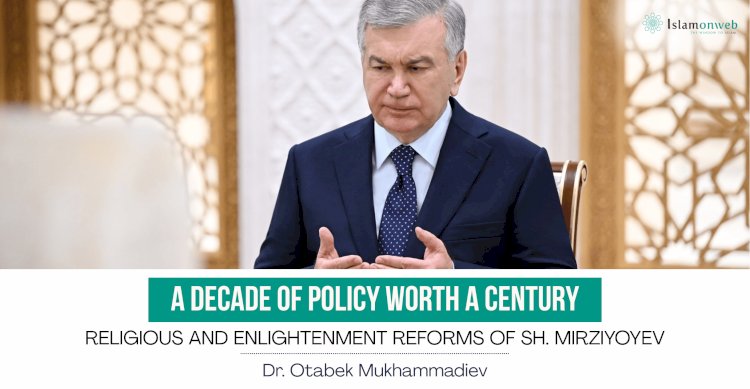
In the series of large-scale transformations and strategic reforms implemented in New Uzbekistan in recent years, the religious and enlightenment sphere, alongside the restoration and development of national and spiritual values, holds a central place. The results achieved and fundamental changes made under the leadership of President Shavkat Mirziyoyev are historic developments recognized not only domestically but also by the international community.
Historically, the land of Transoxiana served as a cradle of Islamic civilization and science, producing great Hadith scholars, theologians (kalam), and legal experts (fiqh). However, due to past restrictions, the ability to fully utilize this rich spiritual heritage for societal progress was limited. The central conceptual idea of the reforms in this new era has been to view the religious and enlightenment domain not as a security threat, but as a powerful driver of tolerance, enlightenment, and spiritual-ethical stability in society.
Shavkat Mirziyoyev’s initiative, "Enlightenment Against Ignorance," became the core philosophy of these reforms. This initiative rejects administrative and force-based methods in combating radicalism and extremism, choosing instead to heal society through education, tolerance, and the deep study of our ancestors' rich scientific legacy. The concepts of enlightened Islam championed by the Head of State at the UN General Assembly and other high-level forums, along with the adopted resolution on "Enlightenment and Religious Tolerance," serve as a crucial call to action for the world in today's turbulent times.
One of the most important milestones of President Mirziyoyev’s reforms in this sphere has been placing these efforts on a systematic, scientific, and institutional foundation. As a practical reflection of this, major national and international research, cultural, and educational centers were established in a short period.
The Center of Islamic Civilization in Uzbekistan, built in Tashkent, is one of New Uzbekistan's largest and most unique projects. This center is not merely a museum or library; it is a unified academic platform that collects, researches, and promotes the invaluable heritage of great scholars, thinkers, and Hadith masters from Transoxiana to the world. It houses a rich library, a manuscript fund, an information-resource center, and unique exhibits reflecting the history of Islamic culture.
To restore the pure scientific and theological heritage of our ancestors, specialized international research centers were created. Two of these—the Imam Bukhari International Scientific Research Center in Samarkand and the Imam Maturidi International Scientific Research Center in Tashkent—were established under the Cabinet of Ministers. Additionally, the Imam Termezi International Scientific Research Center was founded in Surkhandarya. They have become primary centers for conducting deep studies, producing accessible translations, preparing scientific refutations against distorted ideas, and strengthening religious tolerance and moderation.
A notable event in these reforms was the establishment of the high-level "Imam Bukhari" Order. This state award represents the highest recognition for contributions to science, enlightenment, Islamic culture, and international religious-enlightenment cooperation. Demonstrating its role in strengthening ties of friendship across the Islamic world, the order was solemnly presented to President Recep Tayyip Erdoğan of Türkiye and King Salman bin Abdulaziz Al Saud of Saudi Arabia.
To train competitive specialists who integrate religious and secular knowledge, the International Islamic Academy of Uzbekistan was established. This institution educates religious scholars, source experts, Islamic legal scholars, and international relations professionals. Furthermore, the establishment of the Higher School of Hadith in Samarkand, dedicated to specialized education in Hadith sciences, ensures the continuation of ancestral traditions.
Another major focus of Shavkat Mirziyoyev’s reforms has been enhancing the quality of religious education and introducing the vast manuscript heritage preserved in libraries and archives into active scientific research.
In recent years, the material-technical and academic foundations of secondary special and higher religious educational institutions have been overhauled. Admission quotas at the Tashkent Islamic Institute, the Mir-i Arab Higher Madrasah, and secondary madrasahs were increased, with curricula adapted to modern standards. Alongside religious subjects, exact sciences, social sciences, foreign languages, and information technology were prioritized to cultivate well-rounded scholars with broad worldviews.
A key highlight of these educational reforms was the graduation ceremony for the first master's degree students at the Tashkent Islamic Institute named after Imam Bukhari. These graduates published 52 scientific articles in local and foreign journals and earned 53 scientific authorizations (ijazahs) in fundamental texts such as Sahih al-Bukhari, Sunan al-Tirmidhi, Tafsīr al-Nasafī, Al-Hidayah, and Aqa'id al-Nasafi. Each of these young scholars—skilled in 3D modeling and holders of the Certified Islamic Finance Executive (CPSS) credential—was awarded a monetary grant of 20 million UZS by the Head of State, demonstrating high level of care for religious education and science.
More than 100,000 rare manuscripts preserved in Uzbek archives are being systematically studied by source scholars and textual critics. Extensive work is underway to digitize ancient written sources and make them accessible to the global scientific community. At the Imam Bukhari International Scientific Research Center alone, all surviving works of Imam Bukhari were fully translated into Uzbek, researched, and published.
By studying the pure theological and legal heritage of our ancestors, an ideological immunity against foreign and radical ideas was built within society, especially among the youth. Rather than relying on administrative pressure, the practice of providing scientific arguments and clear enlightened refutations was established.
At the center of New Uzbekistan's religious and enlightenment reforms lies the core idea of honoring human dignity, rights, and freedoms—a policy that has earned high international acclaim.
To meet the religious needs of citizens, quotas for the Hajj and Umrah pilgrimages were increased significantly, and overall organization was improved. On the direct initiative of the President, honorable seniors, families from social support registers ("Iron Notebook", "Women's Notebook", and "Generosity Notebook"), and families of service members who lost their lives for the peace of the Homeland were sent on the Holy Hajj pilgrimage using state and charitable funds. This initiative has become a strong symbol of honoring human dignity, rewarding honest work, and caring for the elderly and low-income citizens.
Another noteworthy initiative of New Uzbekistan was the "Mekhr" (Compassion) humanitarian operations (Phases 1 through 5), conducted to repatriate citizens from war zones in the Middle East. Under these missions, more than 530 citizens—primarily around 140 women and over 390 children (nearly 75%)—were brought back from Syria, Iraq, and Afghanistan. They received medical, psychological, and social rehabilitation to reintegrate into society. This practice demonstrated a shift away from punishing misled citizens toward giving them a second chance, restoring families, and showing state care in action.
The complete abolition of the "special lists", which had been in place prior to 2016 and affected thousands of families for decades, was one of the most courageous human rights steps of this era. Over 17,000 citizens were removed from these lists, restoring their rights to live, work, and move freely as full members of society. This step relieved social and psychological tension for thousands of families.
Through the institute of pardon introduced by President Shavkat Mirziyoyev, thousands of individuals convicted on religious and severe charges were pardoned and reunited with their families. Beyond release, systemic work was carried out to secure employment, encourage entrepreneurship, and provide social rehabilitation for these individuals. This demonstrated that rehabilitation and reintegration take priority over punishment.
In line with these principles of social support, nearly 1 trillion UZS was allocated during the holy month of Ramadan by presidential decree to assist vulnerable populations. To achieve these goals, 750–800 billion UZS was provided to the "Vaqf" Charitable Foundation and 300 billion UZS through the National Social Protection Agency under the slogan "Ramadan — A Month of Kindness, Unity, and Gratitude," funding poverty reduction, surgeries for critically ill individuals, and targeted aid for low-income families.
Uzbekistan is a multiethnic and multiconfessional nation. Throughout the reform process, the principle of political and social tolerance—regardless of religious affiliation—was strengthened. The adoption of the updated Law "On Freedom of Conscience and Religious Organizations" simplified registration for religious organizations and expanded legal guarantees for citizens to practice their faith freely. Non-Islamic religious organizations and houses of worship operate freely, and attention given to their holidays and ceremonies has further reinforced national harmony.
Overall, calling the decade of reforms implemented in the religious and enlightenment sphere under President Shavkat Mirziyoyev "a decade worth a century" is fully justified.
The strategic significance of these reforms is evident in:
- Systemic and Solid Foundation:The establishment of the Center of Islamic Civilization, the Imam Bukhari, Imam Termezi, and Imam Maturidi centers, the "Imam Bukhari" Order, and the International Islamic Academy of Uzbekistan has turned the study of heritage into a permanent, institutional system.
- International Recognition and Diplomatic Status:The creation of the high-level "Imam Bukhari" Order and its conferral upon the President of Türkiye and the King of Saudi Arabia symbolize global recognition of Uzbekistan's reforms in the Islamic world.
- "Enlightenment Against Ignorance":An effective model for combating radicalism was offered to the world—one rooted in education, knowledge, and healthy theological understanding.
- National and Spiritual Revival:Studying and publishing ancestral manuscript heritage, issuing scholarly authorizations (ijazahs) to young researchers, and providing incentives have launched a new stage of national self-awareness and spiritual renewal.
- Human Dignity and Social Care:Abolishing "special lists," pardoning thousands of convicts, executing the "Mekhr" operations, conducting charitable activities during Ramadan, and sponsoring Hajj trips for vulnerable citizens have made human dignity the primary benchmark of state reform.
In today's unpredictable world, the path of enlightenment and tolerance chosen by New Uzbekistan serves as an important beacon of peace and knowledge for the region and the broader Islamic world.
From our position at the Imam Bukhari International Scientific Research Center, we extend our hands of academic cooperation and brotherhood to all scientific institutions—foremost among them Al-Azhar Al-Sharif, the Islamic Research Academy, the Egyptian Dar Al-Ifta, and all universities and research centers in Egypt. Together, let us work to serve our authentic Islamic heritage and spread the values of peace and knowledge bequeathed to us by our noble scholars.
About the author:
Dr. Otabek Mukhammadiev,Deputy Director,, Imam Bukhari International Scientific Research Centre, Samarkand, Uzbekistan.
Disclaimer
The views expressed in this article are the author’s own and do not necessarily mirror Islamonweb’s editorial stance.
Related Posts







Leave A Comment