
The Politics of Secular Sufism: Orientalism, Neoliberalism, and the De-Islamisation of Mystical Traditions
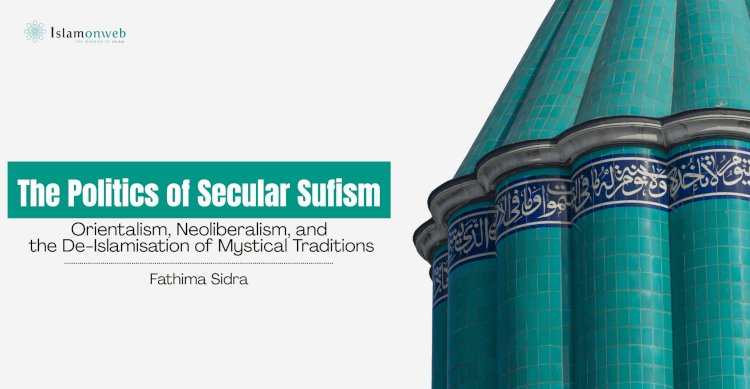
Some intellectuals who approach Sufism through Eurocentric liberal and secular frameworks have presented it in Western scholarship as separate from religion, sometimes even as a non-Islamic phenomenon[1]. Z. Abdollah’s comparison of Sufism and Surrealism illustrates this approach. Abdollah argues that both traditions seek deeper realities beyond ordinary thought, though by different means. Surrealist art explores dreams, contradictions and unusual states of consciousness, while the Sufi expression known as shaṭḥ (ecstatic utterances) conveys mystical experiences that resist ordinary language[2].
The comparison reveals similarities in expression, but it also raises a fundamental difference: Sufism places God at the centre of spiritual experience. This distinction becomes clearer when we consider Surrealism's origins and aims.
Surrealism and Sufism
Surrealism emerged as an artistic movement in the 1920s, with André Breton as a leading figure. Breton described it as a revolutionary movement[3]. Its writers and artists challenged ordinary perceptions of reality through dreams, unexpected images and the unconscious. Salvador Dalí and Luis Buñuel became closely associated with the movement, while Pablo Picasso’s connection was more limited; he was not a formal member. These experiments later encouraged comparisons between Surrealist expression and religious mysticism.
Z.Abdollah compares the unusual symbols and dream-like imagery of Surrealism with the poetry and ecstatic utterances of Sufi figures such as Rumi and ʿAṭṭār[4]. Both traditions use imaginative expression to explore realities beyond ordinary perception. The themes of fire and love in Rumi’s poetry, for example, can be compared at one level with the unusual imagery in Dalí’s paintings[5]. Yet the symbols serve different purposes: in Sufi poetry they point towards divine truth, while in Surrealism they tend to explore the deeper layers of human consciousness. Abdollah does not conclude that Surrealism is itself a form of religious mysticism; the comparison concerns certain shared modes of expression.
Orientalist Readings and the Secularisation of Sufism
The growing popularity of Sufism cannot be explained simply as an attraction to spirituality. Modern understandings of Sufism have also been shaped by colonial systems of knowledge, Western academic studies, ideas of secularism and the global cultural market[6]. The worldwide readership of Rumi’s poetry, the reception of Sufi music across different cultures and the prominence of Sufism in popular spiritual writing illustrate this appeal. But how has a tradition historically rooted in Islam come to be presented as a universal spirituality extending beyond religious boundaries?
A critical approach to modern secular interest in Sufism does not require us to reject its spiritual and literary value. Presenting Sufism as a symbol of love, tolerance and humanity can be meaningful. Yet when such portrayals overlook its Qurʾānic foundations, its relationship with the Prophetic tradition and Islamic law, and its place in the lives of Muslim communities, they reduce its historical complexity[7].
Three interconnected developments help explain this process: the influence of colonial Orientalism on the study of Sufism[8]; its presentation in some academic and popular settings as a universal spirituality detached from Islam; and its treatment as a commodity for personal satisfaction and self-development in the neoliberal age. Together, these developments raise questions about the relationship between knowledge, power, religion and the market.
During the eighteenth and nineteenth centuries, European scholars conducted extensive studies of Asian languages, literature, religions and philosophical traditions. Alongside the collection of knowledge about the East, a system of knowledge developed through which Eastern societies were defined and interpreted using particular categories. These studies often emerged within the historical context of European colonial expansion[9]. Although some European perceptions portrayed Eastern societies as lacking reason and progress, Orientalist scholars also recognised considerable complexity in their literary, philosophical and spiritual traditions, finding elements that could be compared with those of European intellectual life. However, these discoveries did not always lead to abandoning existing assumptions about Eastern societies. Instead, a tendency developed to separate certain cultural elements from their historical and social contexts and present them within new conceptual categories.
This tendency appeared in some European studies of Sufism. Islam was presented as a religion of law and ritual, while Sufism was treated as a separate world of love and spiritual experience. In Mystical Dimensions of Islam, Annemarie Schimmel discusses the jamālī and jalālī dimensions of Islamic spirituality, broadly associated with beauty, gentleness and mercy on the one hand, and majesty, power and awe on the other[10]. This distinction helps us understand different aspects of Islamic spirituality. Yet some interpretations set Islamic legal traditions against spirituality and portrayed Sufism as a universal humanism beyond Islam. In this way, legal and spiritual traditions that had developed in close relationship could come to be understood as opposing worlds.
European interest in Persian poetry played an important role in this history[11]. William Jones’s 1792 essay, On the Mystical Poetry of the Persians and Hindus, is an early example of introducing European readers to the similarities between Persian and Indian spiritual literature. Studies of this kind introduced the poetry of Saʿdi and Hafez to European intellectual circles and helped circulate Eastern literature more widely. At the same time, they need to be understood as part of a process through which these literary traditions were organised within concepts familiar to European readers. When the spirituality of Persian poetry was interpreted through the idea of a common mystical experience found across different religious traditions, the historical features of the Islamic intellectual world that shaped this poetry sometimes received less attention.
Readings that treat Sufism simply as a spiritual dimension of Persian literature, or weaken its Islamic context by comparing it with Greek philosophy, Indian mysticism and Christian spirituality, form part of this problem. Studying historical exchanges between different traditions is a valid and important academic activity. However, identifying connections between traditions is different from viewing the Islamic character of Sufism with suspicion.
Edward Said’s Orientalism is relevant to this discussion. His critical framework can also be used to examine European interpretations of Sufism. Scholars who produced knowledge about Sufism did more than record its history. They also played a role in defining what Sufism was and what its essential character should be understood to mean. As a result, differences emerged between the concepts that Muslim communities used to understand their religious traditions and those that modern academic institutions used to classify Sufism.
At the same time, treating all Orientalist scholarship as if it followed the same approach would overlook historical complexity. Scholars who made important contributions to the linguistic and historical study of Sufism, as well as researchers who examined its Islamic foundations seriously, were also part of Western academia.
Rumi and Universal Spirituality
The global popularity of Rumi offers a clear example of the secularisation of Sufism. Jalal al-Din Rumi, the thirteenth-century Persian poet and Sufi thinker, is now widely read and quoted across the world. His poetry explores love, separation, the search for the self and human relationships, themes that naturally appeal to modern readers. However, examining the history of Rumi’s global popularity also raises an important question: how is the Islamic context of his poetry represented?
Modern interpretations that present Rumi’s poetry as a universal language of love and humanity introduce important aspects of his work to readers worldwide. At the same time, it is necessary to examine how much attention these interpretations give to Qur’anic ideas, the Prophetic tradition, Islamic theology and religious practices. When Rumi’s spirituality is presented as a human experience that extends beyond religious boundaries, the Islamic world that shaped his thought is often reduced to a historical background. In some popular interpretations, this background disappears completely.
Rumi’s Mas̱navī offers a key example. Qur’anic narratives, the lives of the Prophets and Islamic ideas occupy a central place in his poetic world. He retells Qur’anic stories through his poetic language and uses them to explain the human spiritual condition and moral struggles. Therefore, understanding the universal appeal of Rumi’s poetry does not require removing its Islamic context. Instead, the important question is how ideas that emerge from within this context communicate with readers from different cultures. This issue is not limited to Rumi. Similar questions arise when the works of Hafez, Farid al-Din Attar and other Sufi poets reach modern reading audiences.
These modern presentations differ from those developed during the colonial period, but both help explain how Sufism came to be understood apart from its wider religious setting. Colonial forms of knowledge influenced its classification; the contemporary market has increasingly presented spirituality as a resource for personal satisfaction and self-development.
Neoliberalism and the Commodification of Spirituality
Neoliberalism is commonly discussed in relation to economic policies and the expansion of markets. Its influence on contemporary social life, however, extends beyond the economy. Neoliberal conditions also strengthen a social logic that encourages individuals to improve their lives continuously and take responsibility for achieving greater efficiency, success and mental satisfaction. Within this logic, human emotions, desires, self-reflection and efforts towards personal development become new areas of market activity[12].
Byung-Chul Han examines this process in his book Psychopolitics: Neoliberalism and New Technologies of Power. He argues that neoliberal societies operate through forms of power that encourage individuals to regulate their own abilities, emotions and behaviour, alongside forms of power that control people from the outside. This approach helps us understand how modern systems of power operate through individuals’ inner lives[13].
Against this background, religious traditions can be redefined as resources for psychological well-being. When Sufism is presented chiefly as a path to inner peace, happiness or personal resilience, its religious practices, social relationships and historical meanings may receive less attention. Sufi poetry may be reduced to inspirational quotations, and Sufi ideas recast as tools for self-development.
This is one form of the commodification of spirituality: ideas and practices are detached from their historical settings and marketed as products or elements of personal lifestyles. The commercialisation of Sufi music, inspirational books drawn from Rumi’s poetry and programmes connecting spirituality with personal development offer examples[14]. They do not all operate in the same way, but they invite examination of how spiritual traditions are reshaped for consumption.
The popularisation of Sufism makes its ideas accessible to a wider audience. At the same time, it can reduce its meaning to personal satisfaction. Spiritual practices within Sufi traditions have often been connected with moral responsibility, the relationship with God, duties towards society, relationships between spiritual teachers and their students, and religious learning. When these practices are presented simply as tools for mental peace, the importance of these wider relationships may decline. As a result, Sufism may be accepted as an inward personal experience, while its social and religious meanings gradually disappear from public discussion.
Personal comfort through spirituality is not, in itself, a form of neoliberal exploitation. Religious poetry, Sufi music and spiritual practices can offer genuine comfort and meaning. The concern is the process by which a religious tradition becomes a market-shaped product, while its historical and social relationships fade from view.
The secularisation of Sufism cannot be understood merely as a change in religious interpretation or cultural preference. It reflects broader historical processes through which spiritual traditions have been redefined by systems of knowledge, political power and market interests. Orientalist scholarship contributed to presenting Sufism as a form of mysticism separate from its Islamic foundations, while contemporary neoliberal culture has increasingly promoted spirituality as a means of personal fulfilment and consumption. Although the wider appreciation of Sufi literature, music and spiritual teachings has brought these traditions to new audiences, their universal appeal should not come at the expense of their historical and religious identity. Understanding Sufism requires recognising both its engagement with diverse cultures and its foundations in the Qurʾān, the Prophetic tradition and Islamic spiritual and intellectual life. Its universal relevance need not depend on separating it from the religious tradition in which it developed.
About the Author:
Fathima Sidra completed a BA in History at Indira Gandhi University and the Alwarda course.
Reference:
[1] Mark Sedgwick, Western Sufism: From the Abbasids to the New Age (New York: Oxford University Press, 2016), especially 102–112. https://doi.org/10.1093/acprof:oso/9780199977642.001.0001
[2] Carl W. Ernst, Words of Ecstasy in Sufism (Albany: State University of New York Press, 1985).
[3] Franklin Rosemont, ed., What Is Surrealism? Selected Writings of André Breton (New York: Monad Press, 1978). Breton’s writings provide primary material for understanding the movement’s revolutionary ambitions and its conception of imaginative freedom.
[4] Z. Abdollah, “Sufism: Shat’h versus Surrealism in Literature and Art,” UJAH: Unizik Journal of Arts and Humanities 15, no. 2 (2015). https://doi.org/10.4314/ujah.v15i2.4
[5] Anvar Chenderoff, “Wondrous Images: Surrealism and the Imaginal in Rumi’s Poetic Imagery” (2007).
[6] Marcia Hermansen and Saeed Zarrabi-Zadeh, eds., Handbook of Sufi Studies, vol. 3, Sufism in Western Contexts (Leiden: Brill, 2023). https://doi.org/10.1163/9789004392625
[7] Mark Sedgwick, “Universalist Sufism,” in Western Sufism: From the Abbasids to the New Age (New York: Oxford University Press, 2016), 102–112. https://doi.org/10.1093/acprof:oso/9780199977642.003.0007
[8] Edward W. Said, Orientalism (New York: Pantheon Books, 1978), especially 1–28.
[9] Carl W. Ernst, Sufism: An Introduction to the Mystical Tradition of Islam (Boston: Shambhala Publications, 2011).
[10] Annemarie Schimmel, Mystical Dimensions of Islam (Chapel Hill: University of North Carolina Press, 1975; 35th anniversary edition, 2011).
[11] William Jones, “On the Mystical Poetry of the Persians and Hindus,” in The Works of Sir William Jones, edited by Lord Teignmouth (first published in 1807; Cambridge: Cambridge University Press, 2013), 211–235. https://doi.org/10.1017/CBO9781139506939.009
[12] Wendy Brown, Undoing the Demos: Neoliberalism’s Stealth Revolution (New York: Zone Books, 2015), especially the introduction and chapter 1. Brown examines how neoliberal rationality extends beyond economic policy and reshapes social relationships, individual conduct, and understandings of personal responsibility.
[13] Byung-Chul Han, Psychopolitics: Neoliberalism and New Technologies of Power, trans. Erik Butler (London: Verso, 2017), especially 1–12 and 41–48.
[14] Carl W. Ernst, Sufism: An Introduction to the Mystical Tradition of Islam (Boston: Shambhala Publications, 2011).
AI-use declaration: AI was used for language refinement and proofreading.
Disclaimer
The views expressed in this article are the author’s own and do not necessarily mirror Islamonweb’s editorial stance.

Related Posts











Leave A Comment