
The Sensory Turn in Islamic Studies: A Review of Sounding Islam by Patrick Eisenlohr
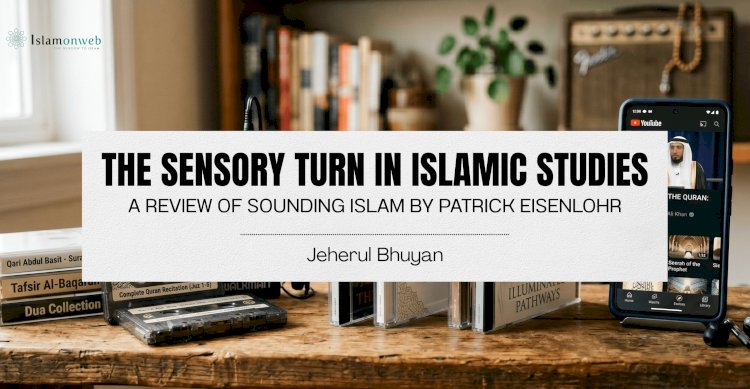
Patrick Eisenlohr is Professor of Anthropology and Chair in Society and Culture in Modern India at the University of Göttingen. His book ‘Sounding Islam’ brings the study of Islamic devotion into the “sensory turn” by focusing on sound and voice. Drawing on long-term fieldwork in Muslim Mauritius, he argues that the recited voice, especially in the Urdu Naʿt poetry tradition, is treated as a site of divine presence and is deeply entangled with modern media technologies. He shows how Mauritian Muslims use audio recordings, microphones, and global networks to circulate devotional sound as well as sustain a transnational religious community. At the core of the book is a theoretical intervention, in which he introduces the concepts of sonic atmosphere and transduction to explain how sound feels and acts on bodies.
The voice, as a divine manifestation, becomes “refracted in media practices” and creates affective, embodied experiences for listeners. In doing so, Sounding Islam joins calls within anthropology and religious studies to study the “sensual, material, and embodied” dimensions of faith rather than doctrines alone. It therefore connects debates in Islamic studies (sensory dimensions of piety), media studies (theology of techne), and anthropology (phenomenology of religion) in a new way. The book is generally persuasive in showing that sound cannot be reduced to just text or meaning. As Eisenlohr puts it, his project asks: when a Mauritian listener hears a beloved Naʿt Khwān (reciter), what is the “sonic presence” they perceive, why does it seem ineffable, and how does it move listeners? Through detailed examples, he shows that Mauritians care about how the Prophet Muhammad’s praise sounds. Too much echo or vocal “effect” is judged as insincere or entertainment, whereas a clear, powerful voice is said to “lift” the listeners’ felt-bodies “above and away” to Madīna. The book thus demonstrates ethnographically that faith here is voiced and mediated. Audio recordings and even YouTube streams become “integral parts of religious traditions” in Mauritius, underpinning authority and community across the Indian Ocean. Mauritians, a Hindu-majority diaspora, are acutely aware of being a minority far from South Asian centres of Islam. As the book explains, they turn to “media-supported circulation” of the right Naʿt style to address doubts about authenticity and piety. In short, Sounding Islam introduces voice and sound into debates about how minority Muslims stay connected to global Islam and negotiate belonging.
The Voice in Media: Divine Presence and Transnational Ties
Eisenlohr begins by situating Mauritian devotional sound in its ethnographic context. Most Mauritian Muslims descend from 19th-century indentured labourers or later Gujarati merchants, and Mauritius today is a Hindu-majority state with a small Muslim minority. In this diasporic context, religious authority often comes through transnational networks (visiting preachers, cassette recordings from India, Arab satellite channels, etc.). Eisenlohr shows how the embodied voice plays a mediating role in this process. For believers, the voice of a reciter (Naʿt Khwān) is treated as refracting the Prophet Muhammad’s presence. Recordings circulated by diaspora networks are not just entertainment but are believed to carry blessing (sawāb) and spiritual potency. One informant, Farhad, insists that even without technology, “a true lover of the Prophet will recite” Naʿt. Still, he also criticises others who overload the voice with reverb or background tracks, saying it “does not sound right” and has become mere badināz (trivia). Eisenlohr interprets this as a tension: Mauritians embrace media as the “condition of possibility” for revelation, yet they fear that technical artifice can undermine authentic presence.
In the chapter on “Devotional Islam and Sound Reproduction,” the author documents how Mauritians learned Urdu Naʿt in India and began using cassette and CD recordings in the 1980s–90s. Older Imam Shareef emphasises that proper Naʿt should have no musical instruments and no female voices (except women-only gatherings), and must be recited slowly, “restrained and respectful,” avoiding Bollywood-style liveliness. The spread of recordings helps maintain this style: listening to the favoured Naʿt khwān multiple times is seen as multiplying spiritual benefit. The book shows how Mauritians balance enthusiasm for wider broadcast with caution: they worry Naʿt might blend into film music or become just entertainment. Thus, sound reproduction is both a safeguard of tradition and a source of anxiety.
Crucially, Sounding Islam places these practices within a “South Asian reformist” tradition (Ahl-e Sunnat/Barelwī Islam) that historically legitimised devotional media. Eisenlohr traces how Gujarati merchant elites in early-20th-century Mauritius built mosques and imported scholars from the Ahl-e Sunnat (Barelwī) movement. By the mid-20th century, the Ahl-e Sunnat current became dominant on the island. The book shows that many Mauritians affiliate with this tradition (“Sunnat Jamāʿat” or simply “Sunni”), which emphasises saints, Sufism, and the Prophet’s continuing spiritual presence. In theory, this Islam venerates the Prophet as manifest light (“nūr-e Muḥammadī”) and assures devotees that reciting naʿt brings him into presence. Eisenlohr argues that this doctrinal context aligns with the focus on presence and mediation by technical means. For his interlocutors, the recited voice is an “agent that transports” the listener closer to God. In this way, the book connects Islamic theology (the “ḥāẓir-nāẓir” doctrine of the Prophet’s presence) with media practice: printed texts alone aren’t enough, so sound and images are also used. Here, the work resonates with broader scholarship on Islam in modernity: it joins in showing that, contrary to a simplistic secularisation narrative, South Asian Muslims often intensify devotional practices alongside globalisation.
Another major theme is transnational religious networks. Eisenlohr shows how Mauritians cultivate ties with scholars and reciters in India and Pakistan, funding their travel or sending recordings. This creates a Muslim “public” linked across oceans. He writes that “flows of sonic media undergird Islamic networks and authority in the Indian Ocean region, creating transnational religious publics”. This insight ties the book to media studies' notions of globalisation: devotion is not contained by the nation-state but is propelled by communication. In Mauritius, local reputations hinge on global connections: a locally unknown imam described how Mauritian merchants of “formerly indentured” origin now emulate the lifestyles and Islam of wealthy Gujarati trader families by joining broad networks. And Eisenlohr finds that ambition in religious media and in business often goes hand in hand. An interlocutor, Asif, remarks that “in the end I think there is always a personal interest. I don’t believe it is just to spread the message of Islam.” The book shows many interlocutors share this scepticism. But Eisenlohr cautions that religious zeal and economic aspirations are difficult to separate, linking to international scholars can raise a local imam’s prestige and political influence as much as it answers spiritual needs. In sum, Sounding Islam connects the micro-level of voiced devotion to larger questions of globalisation, showing how media circulate religious content but also social capital.
Sonic Atmospheres and Transduction
The most original contribution of Sounding Islam is its theoretical framing. Eisenlohr argues that to understand what makes Naʿt feel powerful, scholars must go beyond treating sound as a mere text or ritual act. He develops the concept of “sonic atmosphere” by drawing on recent phenomenology and anthropological theory. In this view, sound is not merely interpreted as speech but rather exists as an energetic field that can penetrate bodies and alter their “felt” state. The book adapts Gilbert Simondon’s notion of transduction to explain this process. Transduction is here defined as the transformation and transfer of energy between modalities, from vocal cords to air waves, or from speaker to listener, creating new phenomena. According to Eisenlohr, each Naʿt performance produces “energetic forces” that fill the space, making listeners feel “moved” or “touched” in ways analogous to the sound’s vibrations. In his words, these suggestive forces are “chiefly differences in air pressure that fill spaces between their sources and those who hear them. He calls this audible force a sonic atmosphere, a tangible ambient presence co-created by voice and air.
This approach treats sound as an embodied phenomenon. It shifts focus from what Naʿt says to how it feels. Eisenlohr emphasises that atmospheres “exert suggestions of movement on the felt-bodies of those they envelop”. In an interview, he explains that for an Ahl-e Sunnat devotee, these sonic atmospheres feel like physical currents that seize the body. In contrast, a listener with a stricter orientation (Deobandi/Salafi) might “merely observe” them without being moved. By conceptualising sound this way, Eisenlohr overcomes a strict divide between meaning and feeling. He argues that the discursive content of Naʿt (its poetic praise) and its sonic effect are distinct yet “closely entangled” dimensions. The voice-as-atmosphere adds a non-discursive “mode of religious engagement” to accompany the textual meanings.
Importantly, Eisenlohr distinguishes sonic atmospheres from the current vogue of “affect theory.” Unlike a Deleuzian “affect”, which is often subconscious or autonomous, sonic atmospheres are both felt and interpreted in a cultural context. They are not mindless vibrations: the believer knows they are listening to a prayer for the Prophet. In conclusion, he notes that recent sound studies have equated sonic intensity with Massumi-type affect, but he insists that atmospheres are always bound up with meaning. In other words, he refuses the romantic idea that music or voice simply bypasses culture. Instead, an analysis of atmospheres bridges feeling and interpretation. As Eisenlohr puts it in an interview, sonic atmospheres are “feelings extended into space” that require a stance from the listener, merging “energy through bodies” with social context. This novel framing allows him to consider, for example, why two recordings of the same hymn can have very different effects on people. The detailed spectral diagrams in chapters 5–6 (an innovation in religious anthropology) show how loudness, pitch and echo contribute to this effect.
In summary, the book’s theoretical contribution is to carve out a middle ground: sound matters not just because of its symbolic content, nor purely as an opaque sensory rush, but as atmospheres that are physically real and culturally meaningful. This offers Islamic scholars a new tool. It also invites media theorists to take sound in religious spaces seriously. Further, Eisenlohr adds scholarship such as Jonathan Sterne’s on sound reproduction, Thomas Csordas’s on globalisation and religion, and Charles Hirschkind’s on devotional sounds, by making voice and space analytic categories.
Minoritarian Belonging and Regionally Engaged Ethnography
Sounding Islam implicitly engages with issues of “minoritarian belonging.” Mauritian Muslims deploy these sonic practices in part to assert their identity. As Eisenlohr notes, they are a small community “far removed from centres of religious authority”, and this heightens concern for correctness. The book shows them using Urdu as a “Muslim ancestral culture” to mark difference from Hindu majorities, yet also drawing on English- and French-language media. In this sense, the study resonates with broader South Asian religious debates, highlighting how a colonial/post-colonial diaspora uses religion to claim legitimacy and modernity simultaneously. The Indian Ocean setting also evokes long-term South Asian links, which refer to Mauritius as “the cradle of globalization” and so speak to readers interested in regional connections beyond national boundaries.
The focus on media situates the book within contemporary concerns: Sounding Islam shows that for South Asian Muslims, screens and speakers are as important as mosques. It connects to related phenomena in the region, such as television broadcasts of religious festivals, viral qawwālī videos, and the popular culture of Islamic music (Qur’ān reciters, Naʿt albums). Although the book does not cover it, the concept of sonic atmosphere could apply to, say, Tablighi Jamaat cassettes in Uttar Pradesh or Islamic TV channels in Kerala. The work thus opens questions about “transnational religious publics” more generally, where modern media unify believers in far-flung minoritarian spaces, a theme of growing relevance in South Asia’s Muslim and other religious minorities.
The author’s tone is analytical and richly detailed; he writes for readers comfortable with theory but avoids excessive jargon. His prose is objective, with little use of “I” or personal narrative (even though it is an ethnography). He embeds technical discussions (such as spectrogram analysis) in a way that a non-specialist with some curiosity can follow, and he provides English translations of Urdu examples. The writing style is measured, making complex ideas accessible to an engaged audience. In sum, Sounding Islam demonstrates how an anthropological study can illuminate the politics of religion in South Asia by tracking something as elemental as the reverberation of a voice.
Critical Remarks
While Sounding Islam is impressive in scope and originality, some limitations are noteworthy. First, gender is treated mostly as given, where women’s voices are largely absent from the main narrative. The book notes in passing that Naʿt gatherings exclude female vocalists (only men recite publicly; women chant privately in separate spaces). But it does not explore what women’s own sonic practices might look like, or how female devotees experience these atmospheres. A discussion of gendered listening could have enriched the analysis, since elsewhere researchers show that Islamic soundscapes can differ markedly for women.
Second, the book is ethnographically partial to one community (Sunni Barelwīs); it tells us less about other groups. For example, it mentions Deobandi and Salafī criticism of Naʿt (treating it as bidʿa innovation) in passing, but the focus remains on those who do embrace devotional voice. A reader might wonder how “silent” or “negative” reactions to sound fit in. Are there Mauritians who reject these sonic practices entirely, and if so, how do they interpret silence or dissonance? Similarly, the study does not delve into caste or class within the Muslim minority beyond the brief historical sketch of Gujarati elites versus Indo-Mauritian indentured descendants. Given Mauritian society’s economic stratification, a deeper look at how class shapes access to technology (e.g., who can afford good audio equipment) or who becomes a popular reciter might have been illuminating.
Third, on political economy: Eisenlohr does address how religion and entrepreneurship mix (noting charges of fund-raising abuse and personal gain. He argues that spiritual and material ambitions intertwine. But the book stops short of critically examining the structures that underlie media circulation. For instance, it does not discuss the global industries behind Islamic audio, such as the role of Moroccan cassette networks, Pakistani music corporations, or YouTube monetisation. Nor does it link the rise of devotional sound to big-picture trends like neoliberalism or media capitalism. These topics may have been beyond scope, but some readers might expect an analysis of how global tech markets or inequality influence religious soundscapes.
Finally, one could ask about the political importance of such a book. Eisenlohr mentions affective politics in passing (noting that atmospheres can also serve exclusionary nationalism), but Sounding Islam does not directly engage with contemporary controversies (for example, debates in Mauritius about secularism or social cohesion). The focus is on ritual and experience, rather than policy or conflict.
Conclusion
Patrick Eisenlohr’s Sounding Islam is a pathbreaking ethnography that asks scholars to listen differently. By treating sound itself as its core qualities, its energies, and its spaces, being an object of study, the book enriches our understanding of Islamic experience in a globalised age. Its concept of sonic atmospheres and its meticulous attention to voice and mediation open new lines of inquiry for anthropologists of religion and media. At the same time, the study leaves room for further questions about gender, inequality, and the broader political context. For readers interested in South Asian religiosity and the Muslim community, the book offers a compelling model by showing how transnational flows, technological forms, and the body itself shape a South Asian minority community’s religious life. In a nutshell, Sounding Islam delivers both a distinctive sensory analysis and a reminder that in Islam, “the sound is the object of perception” just as surely as words are.
About the author
Jeherul Bhuyan is a postgraduate scholar at Darul Huda Islamic University, Kerala, and a Fellow in Cohort 4 of the Aspire Leaders Program, founded at Harvard University. His work explores Muslim identity, political anthropology, interfaith dynamics, and cultural pluralism in South Asia.
Endnote
Naʿt: A Naʿt, derived from the Arabic word, is a type of poetry written in praise of the Islamic Prophet Muhammad. It is a devotional art form, often recited during religious festivals such as Mawlid (the Prophet's birthday), to express deep love and seek his intercession (shafa'at).
Naʿt khwān: A Naʽt Khwan (or Naat Khawan) is a person who recites Naʽt.
Reference
Sounding Islam by Patrick Eisenlohr - Paper - University of California Press
Disclaimer
The views expressed in this article are the author’s own and do not necessarily mirror Islamonweb’s editorial stance.


Related Posts

















Leave A Comment