
The Qurʾānic Path of Wasatiyyah (Moderation): Insights for Contemporary Muslim Life
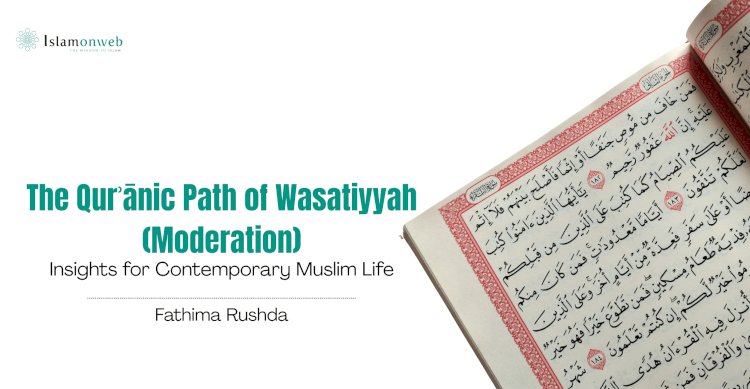
“Eat and drink, but do not be excessive. Indeed, He does not love those who are excessive.” (Al-Aʿrāf: 31)
One day, I listened to a speech by an Islamic scholar on Ṭibb al-Nabawī where he mentioned this verse. Hearing Allāh say in the Qur’ān, “Eat and drink,” created a simple but deep reflection in my mind: why would Allāh mention such an ordinary matter in a divine book unless it carried an important message for human life? This made me realise that Islām is not only about prohibitions and restrictions, but also about recognising human needs, lawful enjoyment, and balance in daily life. This reflection deepened my interest in the Qurʾānic concept of wasatiyyah (moderation) and how it guides Muslims in everyday life.
Understanding Wasatiyyah
Allāh says in the Qur’ān:
“And thus We have made you a middle nation (ummatan wasaṭan) so that you may be witnesses over humanity and the Messenger may be a witness over you.” (Qur’ān 2:143)
Classical Qurʾānic exegetes understood ummatan wasaṭan as describing a community characterised by justice, excellence, balance, and uprightness. Ibn Kathīr explains wasaṭ as “the best and most excellent” (khiyār) position and connects it with the complete Sharīʿah and clear guidance given to the Muslim Ummah.[1] al-Ṭabarī famously notes that a middle position gives an observer the ultimate vantage point to execute justice without leaning heavily toward either extreme. He explains wasat linguistically through the lenses of justice (ʿadl) and equity. By definition, maintaining total justice requires a community to actively reject both ifrāt (religious extremism/excess) and tafrīt (negligence/deficiency).[2] Al-Qurṭubī similarly connects the term with justice and the Ummah’s role as a witness over humanity. [3]Al-Baghawī and al-Saʿdī also present Wasatiyyah as justice, excellence, and balance in religious belief and practice. Thus, classical tafsīr establishes Wasatiyyah as a comprehensive principle rather than merely a position between two extremes.[4]
The word wasaṭ is not simply a numerical midpoint. In discussing Qurʾān 2:143, it is also understood in terms of justice and excellence, because the community is called to bear witness before humanity. Al-Shinqīṭī likewise connects the Qurʾānic descriptions of the community as “best” and as “middle.” Moderation therefore requires fairness and fidelity to truth, not merely choosing a compromise between two opinions.[5]
Modern Muslim scholars further developed this concept for contemporary life. Yūsuf al-Qaraḍāwī particularly emphasised Wasatiyyah as a balanced approach that combines adherence to Islamic texts with consideration of changing circumstances and the broader objectives of Sharīʿah. His methodology emphasises Maqāṣid al-Sharīʿah, facilitation, and avoiding both excessive rigidity and excessive flexibility. Sayyid[6] Quṭb explains Wasatiyyah (moderation) as a practical way to live a balanced life. It means balancing worship with daily life, meeting your personal needs while helping others, and applying Islamic principles in practical ways. Ultimately, it keeps believers from going to extremes and helps them make a positive difference in society.[7]
How the Qur’ān Applies Wasatiyyah to Daily Life
The Qurʾānic concept of Wasatiyyah is not limited to Qur’ān 2:143. Its principle is reflected in several verses that guide believers towards balance in different aspects of life. Allāh says, “Eat and drink, but do not be excessive” (Qur’ān 7:31), and describes believers as neither extravagant nor miserly in their spending (Qur’ān 25:67). Qur’ān 28:77 also teaches believers to seek the Hereafter without neglecting their legitimate share of worldly life. These verses show that Wasatiyyah extends to various areas of Muslim life, including belief, worship, spending, food, and dress. This broader Qurʾānic framework provides the basis for examining moderation specifically in daily practices.
Wasatiyyah in Islamic Belief
The basic principles of Islamic faith are clearly established in verses 285–286 of Sūrah al-Baqarah. In his interpretation of these verses, Imām al-Ṭabarī explains that believers affirm Allāh, His angels, His Books, and all His messengers without accepting some and rejecting others. They believe that all the messengers came from Allāh and called people towards His obedience. In this way, Islamic belief differs from those who accepted some messengers while rejecting others.[8]
This balanced understanding is also reflected in the Islamic concept of Tawḥīd (monotheism). Islām affirms the oneness of Allāh and rejects both denying God and believing in multiple gods. Allāh says: “Say, O Prophet, ‘He is Allāh—One and Indivisible.’” (Qur’ān 112:1). The believer’s relationship with Allāh reflects the same balance. A Muslim should neither lose hope in Allāh’s mercy nor become careless about His commands. Islām therefore teaches believers to maintain a balance between hope (rajāʾ) and fear (khawf). Allāh describes them as those who “call upon their Lord in fear and hope.” (Qur’ān 32:16). This balanced approach also encourages Muslims to be careful in judging the faith of others.
The principle of moderation is equally clear in the Islamic understanding of prophethood. Muslims believe in all the messengers of Allāh, respect and love them, but do not worship them or attribute divinity to them. Islām therefore avoids both extremes: exaggerating the status of prophets and rejecting them. Ibn ʿAbbās (RA) reported that ʿUmar (RA) said from the pulpit: “I heard the Messenger of Allāh ﷺ say: Do not praise me as the Christians praised the son of Mary, for I am only His servant, so say: the servant of Allāh.”[9]
Thus, Wasatiyyah in Islamic belief is reflected in faith in all the messengers, the affirmation of Tawḥīd, and a balanced relationship with Allāh based on rajāʾ and khawf. Muslims neither worship the messengers nor reject them; rather, they believe in them, affirm their truth, respect their status, and follow the guidance they conveyed.
Wasatiyyah: Rejecting Extremism and Terrorism
The Qur’ān strongly warns against excess and extremism in religious matters. Allāh says: "Say, 'O People of the Scripture! Do not go to extremes in your religion beyond the truth, and do not follow the vain desires of people who went astray before. They misled many and themselves strayed from the Right Path.'" (Qurʾān 5:77)
This verse highlights the importance of remaining within the limits of revealed guidance. If Allāh warns the People of the Book against religious excess, Muslims should also reflect on their own religious attitudes and ask: if excess is condemned in religion, how much more should we, as followers of the Qur’ān, be careful to stay within the limits Allāh has set? The Prophetic teachings likewise emphasise moderation and warn against religious excess.
This principle provides an important basis for rejecting violence and terrorism carried out in the name of Islām. Islām emphasises justice, human dignity, and the protection of human life. The Prophet ﷺ prohibited the killing of women and children during warfare, showing that even armed conflict is subject to moral and legal restrictions.[10]
The Prophet ﷺ also warned against religious extremism. Ibn ʿAbbās (RA) reported that he said: “Beware of extremism in religion, for extremism in religion destroyed those who came before you.” The Qur’ān[11] further emphasises the sanctity of human life: "That is why We ordained for the Children of Israel that whoever takes a life—unless as a punishment for murder or mischief in the land—it will be as if they killed all of humanity; and whoever saves a life, it will be as if they saved all of humanity." (Qur’ān 5:32). Thus, Wasatiyyah calls Muslims away from extremism and towards justice, respect for human dignity, and responsible coexistence.
The International Islamic Fiqh Academy (IIFA) has stated that modern terrorism is not part of Sharīʿah and has linked its causes to fanaticism, extremism, ignorance of Sharīʿah, and various forms of injustice. At the same time, Islamic jurisprudence distinguishes terrorism from forms of armed struggle considered legitimate defence, which remain subject to the rules and conditions of Sharīʿah. Therefore, jihād should not simply be equated with terrorism.[12]
Wasatiyyah in Sharīʿah (Moderation in Islamic Law)
Allāh says in the Qur’ān:
“They are those who follow the Messenger, the unlettered Prophet, whose description they find in the Torah and the Gospel. He commands them to do good and forbids them from evil, permits for them what is lawful and forbids them from what is impure, and relieves them from their burdens and the shackles that bind them.” (Sūrah al-Aʿrāf 7:157)
This verse reflects an important dimension of moderation within Islamic Sharīʿah. Islām does not impose unnecessary hardship that disregards human needs, nor does it grant unrestricted freedom without moral and legal limits. Instead, Islamic law seeks to balance the needs of the human soul and body, as well as individual interests and social responsibilities. In this way, Sharīʿah protects human welfare while maintaining moral and legal boundaries.
This balance is reflected in various areas of Islamic law, including marriage, divorce, purity, food, and social relations. Sharīʿah avoids both unnecessary restrictions and unlimited permissibility, taking human needs and circumstances into account. For example, Islam provides practical methods of purification and permits a wide range of lawful foods while setting clear limits. Allāh says, “Eat and drink, but do not be excessive” (Qur’ān 7:31). He also says, “Allāh intends for you ease and does not intend for you hardship” (Qur’ān 2:185). Together, these verses illustrate how Islamic law allows lawful enjoyment while encouraging moderation and avoiding unnecessary hardship. This balance between religious obligations and human needs is an important expression of Wasatiyyah.
The same balance can be observed in the Islamic approach to marriage. Islām recognises marriage as a basic human need and encourages Muslims to marry when able. The Prophet ﷺ said, “O young people! Whoever among you can marry, should marry.”[13] Marriage is described in the Qurʾān as a mīthāqan ghalīẓan (solemn covenant)[14] founded upon mutual rights and obligations. Islām therefore encourages marriage while establishing legal and moral boundaries to protect individuals, families, and society.
A similar balance can be seen in the Islamic approach to divorce. Islām permits divorce within a regulated legal framework while setting limits on its use. The Qurʾān states that a husband must either retain his wife honourably or release her with kindness[15]. It also establishes rules governing the waiting period and prohibits unjustly expelling a divorced woman from her home during that period[16]. In this way, Islamic law seeks to preserve family stability while protecting both spouses' legitimate rights.
Another important example is the Islamic ruling concerning menstruation. Islām adopts a balanced approach that avoids both unnecessary restriction and negligence. A menstruating woman is not required to be isolated from normal family and social life; eating and sitting together remain permissible, while sexual intercourse is prohibited. Allāh says: “They ask you about menstruation. Say, ‘It is harm, so keep away from women during menstruation and do not approach them until they are pure’” (Qurʾān 2:222).
The Prophet ﷺ clarified the practical meaning of this ruling by saying, “Do everything except intercourse.”[17]ʿĀʾishah (RA) also reported that she would drink from a vessel and then pass it to the Prophet ﷺ, who would drink from the same place, even when she was menstruating.[18] Thus, this ruling reflects Wasatiyyah by recognising the natural condition of menstruation, preserving women’s dignity, and maintaining moral discipline.
The principle of moderation is also evident in Islām’s treatment of individual and social rights. Islām recognises individual freedom while placing it within moral and legal boundaries and emphasising responsibilities towards others. The Qurʾān prohibits unlawfully taking another person’s wealth and permits trade based on mutual consent.[19] It also encourages the sharing of wealth with relatives, orphans, the needy, and travellers.[20] Furthermore, Allāh commands believers to uphold justice, even when it goes against their own interests[21]. These principles illustrate how Islām seeks to protect individual rights while promoting social welfare and justice.
In Islām, the individual is respected as a responsible human being with rights relating to property, dignity, and legitimate freedom, but these rights are accompanied by duties towards others and society. Wasatiyyah in Sharīʿah represents a fair, balanced system that protects both individual needs and social welfare without allowing either to completely dominate the other.
Moderation in Material Life
Islām emphasises that the worldly life (dunyā) is temporary, while the Hereafter is everlasting. Therefore, believers are encouraged to prioritise the Hereafter without abandoning the legitimate benefits of worldly life. Islām does not support completely sacrificing the material world or totally withdrawing from worldly life in pursuit of spirituality. Instead, it guides us to use worldly blessings responsibly while keeping the Hereafter as the ultimate purpose.
This is expressed in the verse: “But seek, through what Allāh has given you, the Hereafter, and do not forget your share of this world.” (Qur’ān 28:77). Scholars interpret this to mean that believers are not commanded to give away all their wealth and become destitute. Rather, they should use their wealth for the sake of the Hereafter while enjoying their worldly life in a manner that does not compromise their faith or their prospects in the Hereafter. Tafsīr al-Jalālayn explains that the wealth bestowed by Allāh should be used in obedience to Him [22]
This balanced approach is also reflected in Islām’s understanding of wealth. Islām regards wealth as a blessing from Allāh and teaches believers to earn, use, and manage it properly. Allāh says, “Then seek the bounty of Allāh.” (Qur’ān 62:10). At the same time, Islām warns against excessive attachment to wealth and accumulating it without fulfilling one’s responsibilities. Allāh says: “Woe to every scorner and mocker, who collects wealth and continuously counts it. He thinks that his wealth will make him immortal.” (Qur’ān 104:1–3). The problem, therefore, is not wealth itself, but letting the pursuit and accumulation of wealth become life's central purpose.
Since earning a livelihood (kasb) is a necessary part of human life, Islām provides guidance on how material pursuits can be balanced with religious responsibilities. Sūrah al-Jumuʿah presents this balance particularly clearly. Allāh says: “O you who believe! When the call is proclaimed for prayer on Friday, hasten to the remembrance of Allāh and leave off business. That is better for you, if you only knew.” (Qur’ān 62:9). This verse teaches that when the time for Jumuʿah prayer arrives, the remembrance and worship of Allāh must take priority over business and financial activities.
However, this does not mean that Islām requires believers to abandon material life. Immediately afterwards, Allāh says: “And when the prayer is finished, then disperse through the land and seek from the bounty of Allāh, and remember Allāh often so that you may be successful.” (Qur’ān 62:10). The verse therefore presents a clear balance: worldly activities are not rejected, but they must remain within the framework of obedience to Allāh.
Moderation in Financial Dealings and Spending
The principle of moderation becomes particularly clear in matters of spending. Allāh says: “And do not make your hand tied to your neck, nor extend it completely, lest you become blamed and destitute.” (Qur’ān 17:29). This verse establishes an important principle of infāq (spending). Islām does not encourage believers to withhold their wealth completely, nor does it encourage uncontrolled expenditure. Both extremes can cause harm: stinginess can prevent a person from fulfilling responsibilities towards others, while extravagance can lead to waste, financial difficulty, and loss.
Instead, Islām promotes a balanced approach to spending in which a person manages wealth wisely, fulfils personal and family responsibilities, assists others when possible, and avoids unnecessary waste. Allāh praises those who maintain this balance, saying: “And those who, when they spend, are neither extravagant nor stingy, but hold a balance between the two.” (Qur’ān 25:67).
The Prophetic teachings further strengthen this principle. The Prophet ﷺ warned against stinginess, saying: “Beware of stinginess (shuhḥ), for stinginess destroys those who came before you.” In another narration[23], the Prophet encouraged believers to eat, drink, give charity, and wear clothing as long as these actions were not accompanied by extravagance (isrāf) or pride (mukhīlah).[24][25] These teachings show that Islām permits enjoyment of lawful blessings while setting ethical limits on their use.
Moderation in Worship
Allāh says:
“And I did not create the jinn and mankind except to worship Me.” (Qur’ān 51:56).
Worship is therefore the fundamental purpose of human existence. However, Islām does not require believers to neglect their normal human and biological needs in the pursuit of worship. Rather, it teaches a balanced understanding in which ordinary activities can also become acts of worship through sincere intention (niyyah).
The Qur’ān provides a clear framework for this balance. Allāh says:
“So recite as much of the Qur’ān as is easy for you” (Qur’ān 73:20), and: “Allāh does not burden a soul beyond its capacity.” (Qur’ān 2:286).
Islamic law also provides concessions, such as allowing a person to break the fast when fasting causes genuine harm. This shows that worship is not intended to impose unnecessary hardship.
The Qur’ān further says: “Do not raise your voice too loudly in prayer nor be too silent, but seek a middle way between them.” (Qur’ān 17:110).
This reflects the broader principle of balance even in outward religious practice. The Prophet ﷺ also encouraged moderation and consistency. ʿĀʾishah (RA) reported that the Prophet said: “Take from deeds only what you are able to bear.” He also taught that the most beloved deeds to Allah are those performed consistently, even if they are small.[26]These teachings show that Islām values sustainable, sincere worship over excessive practices that cannot be maintained.
This principle is also illustrated by the narration of Anas ibn Mālik (RA), who reported that the Prophet saw a rope stretched between two pillars and was told that Zaynab (RA) used it to support herself when she became tired during prayer. The Prophet instructed them to untie it and taught that a person should pray while energetic and rest when tired.[27] Imām al-Nawawī included this narration in Riyāḍ al-Ṣāliḥīn under the chapter “Moderation in Worship,” illustrating the importance of avoiding excessive strain in voluntary acts of worship.[28]
A further example is the report of three men who proposed fasting without interruption, praying throughout the night, or remaining unmarried. The Prophet ﷺ corrected their understanding by describing his own practice of fasting and breaking the fast, praying and sleeping, and marrying. Ibn Ḥajar explains that an excessively demanding practice may lead to fatigue, whereas a measured practice is more likely to continue[29]
In Conclusion
In Islām, the concept of Wasatiyyah manifests itself throughout the life of a Muslim and is not limited to formal acts of worship. Allāh says: “And thus We have made you a just community.” (Qur’ān 2:143). This principle shapes a Muslim’s approach to worship, social dealings, moral character, and everyday activities. A Muslim is expected neither to fall into extremes that cause harm nor to neglect legitimate responsibilities. Instead, Islamic moderation seeks harmony between the spirit and the body and between worldly responsibilities and the Hereafter.
About the author
Fathima Rushda Sreekandapuram is a final-year degree student in the Department of Qur’an and Related Sciences at Fathima Zahra Islamic Women’s College, Chemmad, under Darul Huda Islamic University. Her academic interests focus on exploring the Qur’an and its guidance in relation to contemporary life. She is particularly interested in Qur’anic studies, Tafsir, Islamic thought, and understanding how Qur’anic principles can provide practical and spiritual guidance for everyday life.
Reference:
[1] https://quran.com/al-baqarah/143/tafsirs/en-tafisr-ibn-kathir,Ibn Kathīr , Tafsīr al-Qurʾān al-ʿAẓīm (تفسير القرآن العظيم) Vol. 1, Surah Al-Baqarah, Ayah 143. Q 2:143
[2] Jāmiʿ al-bayān ʿan taʾwīl āy al-Qurʾān (جامع البيان عن تأويل آي القرآن) Commentary on Surah Al-Baqarah, Ayah 143.
[3] Al-Jāmiʿ li-Aḥkām al-Qurʾān (الجامع لأحكام القرآن) Vol. 2, Surah Al-Baqarah, Ayah 143.
[4] Al-Baghawī, Maʿālim al-Tanzīl, commentary on Qurʾān 2:143; al-Saʿdī, Taysīr al-Karīm al-Raḥmān, commentary on Qurʾān 2:143.
[5] Islamweb, “al-Wasaṭiyyah fī al-Islām: Maʿnāhā wa-Taṭbīqātuhā” (2 October 2023), section on the linguistic meanings of wasaṭ, citing Muḥammad al-Amīn al-Shinqīṭī, Aḍwāʾ al-Bayān, vol. 1, p. 87. https://www.islamweb.net/ar/article/237139/ .
[6] Yūsuf al-Qaraḍāwī, Islamic Awakening: Between Rejection and Extremism (International Institute of Islamic Thought, 2006); see also his Fiqh al-Wasaṭiyyah wa-l-Tajdīd fī al-Islām
[7] Sayyid Quṭb, Fī Ẓilāl al-Qurʾān, commentary on Qurʾān 2:143, available via https://quran.com/2:143/tafsirs.
[8] . Tafsīr al-Ṭabarī on Qur’an 2:285 – Quran.com
[9] (ṢṢaḥīḥ al-Bukhārī, 3445). Ṣaḥīḥ al-Bukhārī 3445 – Sunnah.com
[10] Muḥammad ibn Ismāʿīl al-Bukhārī, ṢṢaḥīḥ al-Bukhārī, Kitāb al-Jihād wa-l-Siyar, ḥadīth 3015.
[11] Sunan Ibn Mājah, no. 3029 (Ibn ʿAbbās, warning against ghulūw); https://sunnah.com/ibnmajah:3029.
[12] (International Islamic Fiqh Academy, Resolution No. 154 (3/17)).
[13] 1. Muḥammad ibn Ismāʿīl al-Bukhārī, ṢṢaḥīḥ al-Bukhārī, Kitāb al-Nikāḥ, ḥadīth 5066.
[14] The Qurʾān, Sūrat al-Nisāʾ 4:21. .
[15] The Qurʾān, Sūrat al-Baqarah 2:229.
[16] The Qurʾān, Sūrat al-Ṭalāq 65:1.
[17] Muslim ibn al-Ḥajjāj, Ṣaḥīḥ Muslim, Kitāb al-Ḥayḍ, ḥadīth 302. . The report from Anas ibn Mālik explains the context of Qurʾān 2:222
[18] Muslim ibn al-Ḥajjāj, Ṣaḥīḥ Muslim, Kitāb al-Ḥayḍ, ḥadīth 300.
[19] The Qurʾān, Sūrat al-Nisāʾ 4:29.
[20] The Qurʾān, Sūrat al-Baqarah 2:177. .
[21] Qurʾān 4:135
[22] Jalāl al-Dīn al-Maḥallī and Jalāl al-Dīn al-Suyūṭī, Tafsīr al-Jalālayn, commentary on Sūrat al-Qaṣaṣ 28:77. .
[23] Muslim ibn al-Ḥajjāj, Ṣaḥīḥ Muslim, Kitāb al-Birr wa-l-Ṣilah wa-l-Ādāb, ḥadīth 2578.
[24] Sunan Ibn Mājah, no. 3605, on eating, drinking, charity and clothing without extravagance or pride; https://sunnah.com/ibnmajah:3605
[26] Ṣaḥīḥ al-Bukhārī, no. 6465; also Ṣaḥīḥ Muslim, no. 783
[27] Ṣaḥīḥ Muslim, no. 784a; also ṢṢaḥīḥ al-Bukhārī and Riyāḍ al-Ṣāliḥīn, no. 146.
[28] . Yaḥyā ibn Sharaf al-Nawawī, Riyāḍ al-Ṣāliḥīn, chapter 14, “Moderation in Worship” (Bāb al-Iqtiṣād fī al-ʿIbādah), ḥadīth 146.
[29] Ṣaḥīḥ al-Bukhārī, no. 5063 (the three men and the Prophet’s response)
AI Declaration
AI tools were used in preparing and editing this article for language correction, grammar, readability, structural organisation, and footnote formatting. The final editorial version also received AI-assisted support for language and citation formatting. The ideas, arguments, research, interpretation, and final content of the article are my own, and I take full responsibility for the accuracy and content of the article.
Disclaimer
The views expressed in this article are the author’s own and do not necessarily mirror Islamonweb’s editorial stance.

Related Posts











Leave A Comment