
The Politics of Olive Trees: Land, Livelihood and Dispossession in Palestine
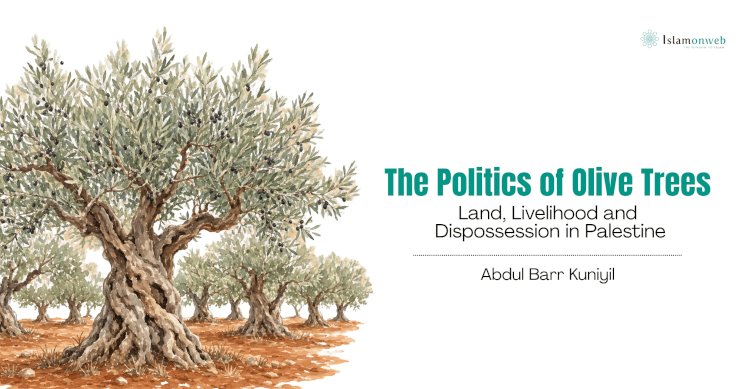
The olive harvest in the occupied West Bank has increasingly become a site of confrontation between Palestinian farmers, Israeli settlers and the military authorities governing access to agricultural land. During the 2026 harvest season, attacks on farmers, destruction of olive trees, theft of harvested produce and restrictions on access to groves have exposed the vulnerability of Palestinian rural livelihoods.
According to the United Nations Office for the Coordination of Humanitarian Affairs (OCHA), 435 settler attacks associated with the olive harvest were documented between 1 September and 15 November 2026, the highest number recorded during any olive harvest season since the United Nations began documenting such incidents. A statement issued by the Humanitarian Country Team on 20 November reported damage to more than 4,000 trees and saplings since September.[1]
The destruction of an olive grove is more than the loss of an agricultural asset. It affects a family’s income, its relationship with ancestral land, the continuity of local agricultural knowledge and its ability to sustain rural life. The politics surrounding olive cultivation therefore offers an important perspective on how settler colonialism operates through the control of land, agricultural production and the everyday conditions of Palestinian existence.
Olive Cultivation and Palestinian Agrarian History
The olive tree occupies a distinctive position in Palestine’s agricultural and economic history. Its cultivation has sustained rural communities for centuries, providing olive oil for domestic consumption, commercial exchange and traditional industries.
Historical agricultural records reveal the remarkable scale of this relationship. In 1596, approximately 1.4 million olive trees were recorded across 400 Palestinian villages. By 1943, the number had increased to more than six million trees across 644 villages.[2]
These figures demonstrate that olive cultivation was not a marginal agricultural activity but a substantial component of the historical Palestinian economy. Nablus, in particular, developed an important soap-making industry based on locally produced olive oil, connecting village agriculture with regional and international commercial networks. Olive oil and soap were among the agricultural products exported through Jaffa during the nineteenth century.
The Palestinian olive-growing landscape has thus been shaped by generations of cultivation, trade, labour and rural social organisation. Agricultural knowledge, including selecting suitable varieties, pruning, harvesting, and oil production, has been transmitted across generations.
The destruction of these groves consequently affects several dimensions of Palestinian life. The loss of a mature tree can reduce household income for years, while the destruction of entire groves weakens the productive capacity of farming communities and threatens the continuity of their agricultural traditions.
Land Ownership and the Politics of Agricultural Access
Following the Israeli occupation of the West Bank in 1967, agricultural land became increasingly entangled with military administration, settlement expansion and restrictions on Palestinian movement.
Access to farmland, particularly in areas surrounding Israeli settlements and behind the separation barrier, has become subject to permits, military coordination and periodically imposed restrictions. For Palestinian farmers, legal ownership does not necessarily guarantee the practical ability to cultivate their land. A farmer may possess inherited property yet remain unable to reach it during the harvesting season, maintain irrigation systems, prune trees or transport agricultural produce to local markets.
The 2026 olive harvest illustrates this contradiction. OCHA’s reports throughout October and November documented repeated cancellations and postponements of coordinated agricultural access, limited harvesting days and difficulties in obtaining permits. Farmers in several areas faced considerable restrictions on reaching their own groves.[3]
Even when access was granted, farmers were not necessarily protected from violence. In Deir Ammar, near Ramallah, agricultural access was restricted to three days and fifteen farmers over the age of forty. During the permitted harvesting period, an 82-year-old farmer was reportedly assaulted by Israeli settlers.[4]
Such restrictions transform agricultural access into a political question. The capacity to produce depends increasingly on administrative permissions and security arrangements rather than land ownership alone.
This is particularly consequential for olive cultivation because olive trees require year-round care. Access limited to a few days during the harvest cannot compensate for the inability to maintain groves throughout the agricultural year. Pruning, soil management and other essential agricultural activities cannot simply be postponed until the harvesting season.
Restrictions on agricultural access may therefore undermine the productivity of olive groves even when the trees themselves remain physically intact.
The Olive Tree as a Symbol of Identity and Resistance
The political significance of olive cultivation becomes clearer when examined through the relationship between land, identity and resistance.
Planting and maintaining olive trees can be understood as an assertion of continued presence on ancestral land, particularly when agricultural inactivity may expose land to further appropriation.
Irus Braverman, in her study of the regulation of olive trees in the occupied West Bank, examines how the olive has become closely associated with Palestinian national identity and resistance. She argues that this identification reflects both the economic and cultural significance of olive cultivation and the experience of occupation. Administrative regulation, surveillance and restrictions surrounding the cultivation and protection of trees become part of the wider mechanisms governing Palestinian everyday life.[5]
The olive tree consequently occupies a distinctive position: it is both a symbol of Palestinian rootedness and an object around which occupation mechanisms operate.
For a farming family, planting a sapling is an investment in a future harvest. It is also an expression of continuity, belonging and the intention to remain on the land. The long lifespan of olive trees strengthens this association between agricultural activity and intergenerational attachment to a particular place.
The theoretical framework of settler colonialism offers another way to understand this process. Patrick Wolfe argues that settler colonialism is fundamentally structured around access to Indigenous territory and the transformation of the societies inhabiting it.[6]
Applied to Palestine, this framework provides a way to examine settlement expansion, restrictions on agricultural access, the destruction of productive assets, and the displacement of rural communities as interconnected processes rather than isolated incidents.
From this perspective, the destruction of olive groves can have implications beyond the immediate economic losses suffered by individual farmers. It can weaken the material conditions that enable communities to maintain their presence on ancestral land.
Traditional Seeds and Food Sovereignty
The struggle over Palestinian agricultural life also extends beyond land ownership to the preservation of traditional seeds and farming knowledge.
Locally cultivated varieties, commonly known as baladī seeds, represent generations of agricultural selection, adaptation and exchange. These varieties are connected to local environmental conditions, culinary traditions and the accumulated knowledge of farming communities.
An important initiative in this regard is the Local Seed Bank established by the Union of Agricultural Work Committees (UAWC) in Palestine. Its activities include collecting, preserving, reproducing and redistributing traditional Palestinian seeds among farmers. The initiative seeks to protect agricultural biodiversity and strengthen farmers’ autonomy at a time when commercial agricultural systems increasingly favour a limited number of high-yield varieties.[7]
Food sovereignty, in this context, concerns communities' ability to determine how their food is produced, which seeds they cultivate, and how agricultural resources are managed. Restrictions affecting access to farmland, water, seeds, fertilisers and agricultural equipment can weaken this autonomy.
It would, however, be misleading to suggest that Palestinian farmers universally avoid chemical fertilisers or exclusively practise organic agriculture. Their farming practices are diverse. The more significant issue is their ability to maintain locally adapted agricultural systems and preserve the knowledge and resources necessary for independent production.
The preservation of agricultural biodiversity is therefore closely connected to the preservation of rural livelihoods. When farmers lose access to land or can no longer maintain traditional agricultural practices, locally adapted varieties and the knowledge associated with them may also gradually disappear.
The Economic Consequences of Agricultural Dispossession
The scale of the 2026 olive harvest crisis demonstrates how agricultural destruction can have consequences extending far beyond a single season. Olive cultivation supports the livelihoods of tens of thousands of Palestinian families, making restrictions on production a broader economic concern.
Unlike seasonal crops, olive trees require several years to become productive. Replanting a destroyed grove does not immediately restore the income that a farming family previously received from mature trees. Farmers must also invest labour and resources in maintaining newly planted trees before they can expect a substantial harvest.
The economic consequences of agricultural destruction therefore accumulate over time. The loss of olive production affects not only farmers but also those involved in harvesting, transportation, oil extraction and local trade.
Restrictions on agricultural access further compound these difficulties. According to OCHA’s 18 November 2026 report, citing the World Food Programme’s October Palestine Market Monitor, settler violence and movement restrictions had reduced the area harvested and contributed to an anticipated decline in olive oil production.[8]
These developments point towards a structural problem: the gradual weakening of the economic conditions that enable Palestinian communities to sustain their rural livelihoods. When trees are destroyed, farmers are prevented from reaching their fields and traditional agricultural resources become increasingly difficult to maintain, the consequences may extend across generations.
The Right to Remain
The politics of olive trees offers a revealing perspective on settler colonialism in Palestine. It brings together questions of land ownership, agricultural production, food sovereignty, cultural memory and the right to remain.
A Palestinian olive grove is simultaneously a productive agricultural space, a repository of family history and a landscape of political significance. Its preservation is closely linked to farming communities' ability to maintain their relationship with the land.
Ultimately, the struggle surrounding olive cultivation concerns more than protecting an agricultural commodity or recovering losses suffered during a particular harvest. It concerns the conditions under which a society can preserve its agricultural knowledge, sustain its rural livelihoods and pass its land and traditions on to future generations.
The olive tree, with its long growth cycles and deep roots in Palestinian history, remains an enduring expression of the Palestinian struggle against dispossession.
About the Author
Abdul Barr Kuniyil is pursuing a bachelor’s degree in History at the University of Calicut.
Reference:
[1] United Nations Office for the Coordination of Humanitarian Affairs (OCHA), Humanitarian Situation Report, 26 November 2026; Humanitarian Country Team of the Occupied Palestinian Territory, Israeli Authorities Must Urgently Act on Repeated Calls to Protect Palestinian Olive Harvesters amid Unprecedented Violence, 20 November 2026.
[2] Kate Raphael et al., “Olive Tree Cultivation and the Olive Oil Industry in Palestine: Trends of Growth and Decline from the Late Mamluk Period to the End of the British Mandate,” Land 15, no. 4 (2026): 609. DOI.
[3] OCHA, Humanitarian Situation Report, 29 October 2026; OCHA, Humanitarian Situation Report, 13 November 2026.
[4] OCHA, Humanitarian Situation Report, 5 November 2026.
[5] Irus Braverman, “Uprooting Identities: The Regulation of Olive Trees in the Occupied West Bank,” PoLAR: Political and Legal Anthropology Review 32, no. 2 (2009): 237–264. DOI.
[6] Patrick Wolfe, “Settler Colonialism and the Elimination of the Native,” Journal of Genocide Research 8, no. 4 (2006): 387–409. DOI.
[7] Hiba Al-Jibeihi, Local Seed Bank in Palestine, Food and Agriculture Organization of the United Nations (FAO), 2017.
[8] OCHA, Humanitarian Situation Report, 18 November 2026.
Author’s Declaration on AI Use
Gemini was used for language refinement during the preparation of the original manuscript.
Disclaimer
The views expressed in this article are the author’s own and do not necessarily mirror Islamonweb’s editorial stance.

Related Posts









Leave A Comment