
MALIK AMBAR: ARCHITECT OF RESISTANCE AND MUSLIM STATECRAFT IN THE DECCAN
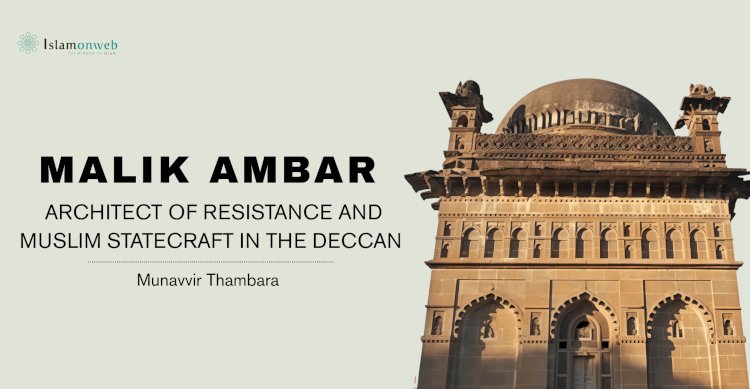
ENTRANCE TO THE HISTORY
Malik Ambar, an extraordinary figure in Indian and Islamic history, stands out as one of the most influential and enterprising leaders of the Deccan during the 16th and 17th centuries. Rising from the depths of slavery to become the Prime Minister of the Ahmadnagar Sultanate, his life story reflects the great portrayal of Muslim history in India and represents the richness of Indian culture, administrative brilliance, and military innovation. His life unfolded within complex political and social transformations, the significance of his resistance to Mughal authority, and his enduring impact on the history of the Indian subcontinent.
Malik Ambar was born in approximately 1548 in Hararghe, in the eastern part of Ethiopia. Ambar belonged to the Oromo people, semi-agriculturalists. During his youth, Ambar was captured and sold into slavery, taken first to southern Arabia around 1560, then traded onward to Baghdad. There, he converted to Islam and received an education under the care of Mir Qasim, a merchant who educated him and gave him the name Ambar. After recognizing his superior intellectual qualities, he was brought to India.
LEGACY OF INDIAN SUBCONTINENT
Around 1571, Ambar was sold on the western coast of India to Mirak Dabir, better known as Chengiz Khan, the chief minister of the Ahmadnagar Sultanate at the time. Chengiz Khan, himself a formerly enslaved person who had risen to power, recognized Ambar’s talent and trained him in military and political affairs, laying the foundation for Ambar’s future rise to prominence in Ahmadnagar. Upon Chengiz Khan's murder in 1574, Khan's widow granted Ambar his freedom. Ambar married and became a freelance mercenary soldier, initially serving the Sultan of Bijapur as an officer, where he acquired the title "Malik".
During the late 16th century, the Indian subcontinent was marked by intense rivalry: the powerful Mughal Empire, under Akbar the great sought to expand his kingdom into southwards, while regional sultanates such as Ahmadnagar, Bijapur, and Golconda struggled to maintain their autonomy. The Deccan sultanates struggled with both internal divisions and the pressure of Mughal ambitions. It was within this tensed context that Malik Ambar rose to prominence as both a military leader and a political administrator.
BIRTH OF A GREAT LEADER
After the Mughal invasion and partial conquest of Ahmadnagar in 1600, Malik Ambar assembled the remaining nobles and local forces, declared the minor Murtaza Nizam Shah II as the ruler, and assumed the role of Prime Minister and regent. Successfully, Ambar became the real power in the sultanate, rebuilding its military strength, restoring stability, and declaring independence against the Mughals. Malik Ambar made himself the Regent (de facto ruler) and Peshwa (Prime Minister) of the Ahmadnagar Sultanate from 1600 until his death in 1626. Ambar rapidly expanded his army, pioneering the use of guerrilla tactics and forming alliances with influential local Maratha chiefs, such as Maloji and Shahaji Bhosale. These alliances not only bolstered Ahmadnagar’s power but also sowed the seeds for later Maratha dominance in the region.
RMEMBRENCE OF LEGACY
Malik Ambar’s most significant contribution to Indian history lies in his effective resistance against the Mughal Empire. For nearly three decades, he frustrated Mughal efforts to annex the Deccan, inflicting defeats on Mughal generals such as Khan Khanan Abdur Rahim. Emperor Jahangir, in particular, harbored a deep enmity for Ambar, whose successes he openly mocked in art due to repeated failures of Mughal campaigns.
Beyond his military achievements, Malik Ambar was a capable administrator and visionary reformer. He introduced an efficient revenue system based on land measurement (bandobast), similar to later Mughal administrative practices. His reforms classified and assessed land according to fertility, ensuring fair taxation and improving agrarian stability. These initiatives increased state revenues and laid the groundwork for the region’s economic growth.
Malik Ambar also focused on the prosperity and welfare of his subjects. He initiated major public works projects, including an advanced water management system for Aurangabad (then Khadki), featuring canals, reservoirs, and the famous Neher-e-Ambar. These projects not only transformed barren land into productive fields but also sustained the city’s population and agriculture.
Malik Ambar’s architectural and urban vision profoundly shaped the Deccan. He founded Aurangabad, a city that blended Persian and Indian styles, and adorned it with mosques, palaces, and gardens. His support for local culture, including Marathi language and literature, fostered a syncretic environment where Hindu and Muslim traditions merged productively. This climate allowed Maratha leaders to rise, setting the stage for the eventual decline of Mughal dominance and the rise of Maratha power.
As a leader of African origin (belonging to the Habshi or Siddi community), Malik Ambar’s rise to prominence challenges monolithic views of Indian history and highlights the diversity and dynamism of the Muslim experience in the subcontinent. His life is celebrated not just among Indian Muslims but also among the Siddis, showing the rich intersection of African and Indian identities. Malik Ambar’s death in 1626 marked the beginning of Ahmadnagar’s decline; within a decade, the sultanate fell to Mughal forces. However, the administrative systems and resistance tactics established by Ambar profoundly destabilized Mughal rule in the Deccan and had a far-reaching impact on the evolution of Indian polity and society.
About the author:
Munavvir Thambara is a P.G scholar at Darul Huda Islamic University, specialising in the Department of Study of Religion. He is also pursuing a B.A.Poltical science at Calicut University.
REFERENCE
“From Slavery To Kingship; How An African Man Fought The Mughals In 16th Century India.” Homegrown Explore, June 8, 2021.
South Asia Institute. “Malik Ambar.” South Asia Institute, University of Chicago.
Google Arts & Culture. “Malik Ambar: The Future Prime Minister of Ahmadnagar.” National Museum – New Delhi. Accessed November 20, 2025.
Beg, Sahil M. “From Khirki to Fathepur and ‘Sambhaji Nagar’, the Many Names of Aurangabad.” The Indian Express, January 11, 2021.
Padma, Anisha. The Multiple Pasts and Presents of Siddis in India.
Disclaimer
The views expressed in this article are the author’s own and do not necessarily mirror Islamonweb’s editorial stance.


Related Posts












Leave A Comment