
From Qatar 2022 to USA 2026: Where Have the Critics Gone?
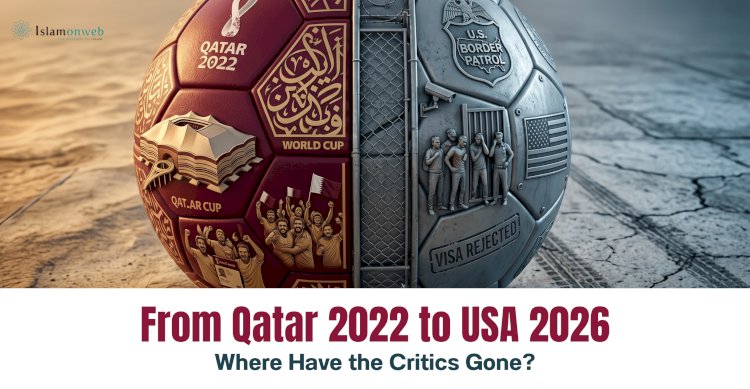
When Qatar hosted the FIFA World Cup in 2022, it faced an unprecedented wave of criticism from Western politicians, media outlets, activists, and football associations. Long before the opening match, debates over migrant workers, social values, alcohol regulations, and human rights dominated international headlines. Some commentators even questioned whether Qatar should have been awarded the tournament in the first place, while calls for boycotts echoed across parts of Europe and North America.
Yet despite the intense scrutiny, Qatar sought to present the tournament as a platform for cultural dialogue rather than confrontation. One of the most memorable moments of the opening ceremony was the recitation of the Qur'anic verse:
“O mankind! Indeed, We created you from a male and a female and made you into peoples and tribes so that you may know one another. Indeed, the most honoured of you in the sight of Allah is the most righteous of you.” (Qur'an 49:13)
The choice of this verse was significant. It conveyed a message of mutual respect, diversity, and human fraternity to an audience of billions around the world. For many observers, the tournament became not only a sporting spectacle but also an opportunity to introduce Islamic values and Arab culture to a global audience.
Four years later, the FIFA World Cup has arrived in North America. However, the atmosphere surrounding the 2026 tournament stands in stark contrast to that of Qatar 2022. Instead of debates about whether the host nation deserves to stage the competition, reports have emerged of visa denials, lengthy interrogations, travel restrictions, and difficulties faced by players, officials, referees, and supporters from various countries.
Swiss footballer Breel Embolo reportedly saw his visa placed under review, delaying his arrival. Iraqi international Aymen Hussein was subjected to hours of questioning upon entering the United States. Members of the Iranian delegation struggled with visa procedures, while several officials were denied entry altogether. Omar Abdulkadir Artan, Africa's top referee in 2025, was reportedly refused a visa despite travelling on a diplomatic passport, preventing him from officiating at the tournament. Delegations from South Africa, Senegal, and Uzbekistan have also faced various travel and security-related difficulties.
For many football supporters, the experience has been equally frustrating. Some fans who had already purchased tickets and accommodation reportedly saw their visa applications rejected or travel authorisations revoked, leaving them with significant financial losses.
The contrast between Qatar 2022 and the current tournament exposes a broader pattern that many observers have long described as Western hypocrisy. During Qatar 2022, criticism was not limited to specific policies or shortcomings. Qatar's culture, traditions, and even its religious values were frequently portrayed as obstacles to modernity. Western commentators often demanded that Qatar conform to standards and social norms that reflected Western preferences, while showing little interest in understanding the cultural and religious context of the host nation.
This selective approach raises uncomfortable questions. When Qatar restricted alcohol sales around stadiums, it was presented as evidence of intolerance. Yet when visitors to the United States face visa denials, intrusive searches, lengthy interrogations, or restrictions on entry, these are largely described as routine security measures. Actions that are interpreted as human-rights concerns in one country suddenly become administrative necessities in another.
The inconsistency becomes even more striking when viewed against the broader global record of Western powers. Many of the same governments and media organisations that lectured Qatar on human rights have remained comparatively silent about military interventions, civilian casualties, racial discrimination, migrant detention centres, and the ongoing humanitarian crises linked to Western foreign policies. As one commentator observed, countries responsible for wars that displaced millions of people often present themselves as guardians of global morality when judging others.
The difficulties faced by players, officials, and supporters are not isolated incidents. They reflect a broader reality that many travellers from Africa, Asia, the Middle East, and Muslim-majority countries have experienced for years when entering Western countries. Strict visa regimes, extensive security screenings, racial profiling, and unequal treatment at borders have become so commonplace that they rarely attract international condemnation.
Ironically, many of the nations whose citizens faced the greatest obstacles in attending the 2026 World Cup are countries that contribute significantly to world football. Players, coaches, officials, and supporters from Africa, the Arab world, and parts of Asia often encounter barriers that supporters from Western countries seldom experience. What is treated as discrimination elsewhere is frequently accepted as a legitimate security concern when it occurs in the West.
The contrast with Qatar 2022 is striking. Qatar welcomed millions of visitors through a streamlined entry system, allowing supporters from diverse nationalities, cultures, and religions to attend the tournament with relatively few obstacles. The Hayya Card system became a model for facilitating international travel during a mega sporting event. Yet these efforts received only limited recognition compared to the extensive criticism directed at the country before the tournament.
Another notable difference lies in the language used by the media. During Qatar 2022, individual incidents were often portrayed as evidence of broader cultural or civilisational problems. In the case of the 2026 tournament, similar incidents are frequently explained away as immigration procedures, security protocols, or bureaucratic complications. The difference is not merely in the events themselves, but in how those events are interpreted and presented to the global public.
This disparity reveals a deeper imbalance in the international conversation. Western societies often reserve for themselves the right to judge others according to universal standards while expecting their own policies and practices to be viewed through the lens of exceptional circumstances. Such an approach undermines the credibility of genuine human-rights advocacy and reinforces perceptions that moral principles are applied selectively.
If international sport is truly meant to unite humanity across borders, races, and cultures, then fairness must extend beyond the football pitch. The same standards of dignity, equality, and inclusion that were demanded of Qatar should also be expected of every host nation, regardless of its political influence, economic power, or place in the global order.
Disclaimer
The views expressed in this article are the author’s own and do not necessarily mirror Islamonweb’s editorial stance.


Related Posts














Leave A Comment