
CSR Organises Condolence Meeting in Memory of Prof. Syed Muhammad Naquib al-Attas
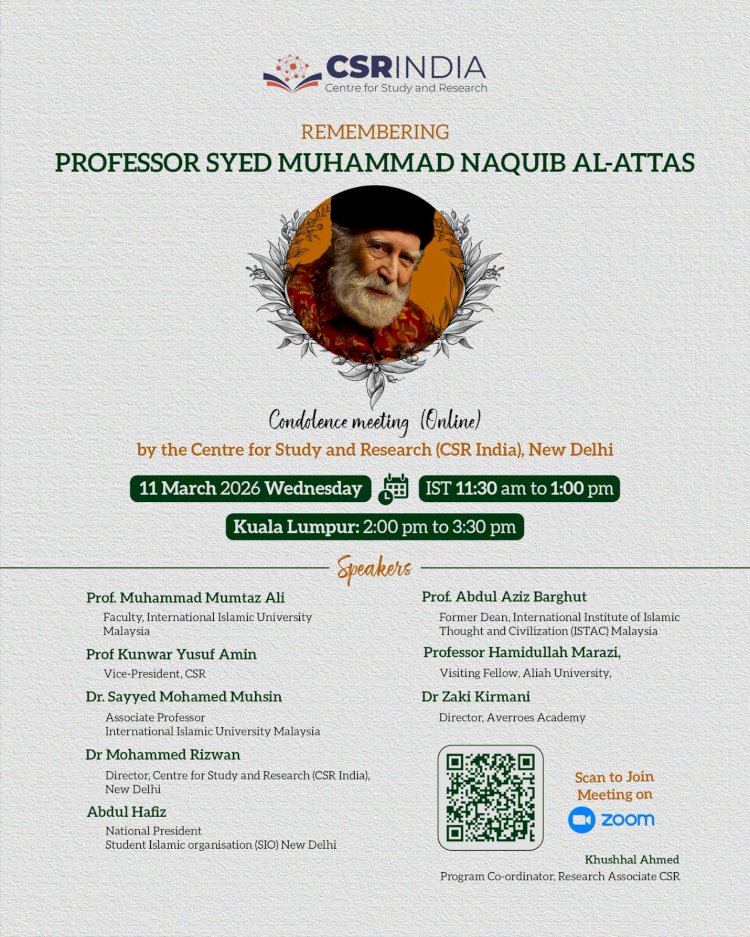
The Centre for Study and Research (CSR) organised an online condolence meeting on 11 March 2026 to remember and reflect upon the life and intellectual legacy of Professor Syed Muhammad Naquib al-Attas, one of the most influential Muslim thinkers of the contemporary era. The gathering brought together scholars, intellectuals, and students who paid tribute to his enduring contributions to Islamic thought, philosophy, and education.
The program commenced with the tilawat of the Holy Qur’an by Dr. Mohammed Rizwan, Director, CSR, setting a solemn and reflective tone for the session. The meeting was chaired by Prof. Mohammad Yusuf Amin, a distinguished Islamic scholar and retired Professor of Pharmacology from the Faculty of Unani Medicine at Aligarh Muslim University, who guided the proceedings.
The session featured reflections from several scholars who spoke about different dimensions of Professor al-Attas’s intellectual contributions and lasting influence.
In his remarks, Prof. Muhammad Mumtaz Ali of the International Islamic University Malaysia (IIUM) shared personal reflections on his intellectual engagement with Professor al-Attas. He noted that al-Attas’s writings, particularly Islam and Secularism, had a profound influence on contemporary Islamic thought by presenting Islam as a comprehensive worldview rather than merely a religion. Prof. Mumtaz also highlighted al-Attas’s pioneering role in shaping the discourse on the Islamization of knowledge, emphasising his call for scholars to critically engage with modern disciplines while creatively developing knowledge rooted in Islamic epistemology.
Prof. Abdul Aziz Barghout, also from IIUM, reflected on al-Attas’s re-articulation of key Islamic concepts, particularly adab. He explained that al-Attas viewed adab not simply as good conduct but as a comprehensive epistemological framework linking virtue, wisdom (hikmah), knowledge, and righteous action within the Qur’anic understanding of knowledge. Prof. Barghout further highlighted al-Attas’s methodological approach of grounding intellectual inquiry in the Qur’an and Sunnah while critically engaging with Western epistemology to develop an authentic Islamic understanding of the human being and civilisation.
Dr. Zaki Kirmani, Founder Director of the Averroes Academy, described al-Attas’s Islam and Secularism as a landmark work that exposed the deeper philosophical and civilizational implications of secularism and helped Muslim intellectuals rethink the ideological foundations of modernity. He also emphasised the breadth of al-Attas’s intellectual personality, noting that he was not only a philosopher but also a linguist, a lover of art and calligraphy, and an institution builder who played a central role in shaping the vision of the International Institute of Islamic Thought and Civilisation (ISTAC).
Dr Sayyed Mohamed Muhsin of IIUM highlighted al-Attas’s enduring influence on the discourse surrounding the Islamization of knowledge, noting that it stimulated extensive debates among Muslim intellectuals regarding the nature of knowledge and the crisis of modern education. He explained that al-Attas viewed Islamization as a process of liberating human understanding from mythological, cultural, and secular influences that distort the Islamic worldview, and advocated the “de-westernisation of present-day knowledge” while engaging critically with contemporary disciplines.
Prof. Hamidullah Marazi, Visiting Researcher at ISTAC, reflected on al-Attas as a holistic scholar in the tradition of classical Muslim thinkers such as Imam al-Ghazali and Ibn Taymiyyah. He noted that al-Attas’s work offered a powerful critique of modern secular ideologies while emphasising the importance of adab and spiritual discipline in education, and highlighted the enduring significance of ISTAC as a centre for Islamic intellectual renewal.
Br. Abdul Hafeez, National President of the Students Islamic Organisation of India (SIO), highlighted al-Attas’s emphasis on the de-secularisation of knowledge and his call to rethink the classification of sciences and intellectual disciplines through an Islamic worldview. He also noted that al-Attas combined spiritual refinement (tarbiyah and tazkiyah) with intellectual inquiry, describing him as both a philosopher and a “man of action” whose ideas were practically realised through institutions such as ISTAC.
In his concluding remarks, Prof. Yusuf Amin, Chair of the session, described Professor al-Attas as one of the two foremost global scholars of Islam in the contemporary era, alongside Seyyed Hossein Nasr, noting that his passing leaves a profound intellectual void in the Muslim world. He highlighted al-Attas’s intellectual project of liberating thought and learning from the grip of modern Western materialism and scientism, and re-grounding knowledge on enduring principles such as faith in God, revelation, spirituality, moral excellence, and gnosis (ma‘rifa).
Prof. Amin further emphasised that al-Attas was not only a profound scholar but also an institution builder, playing a pivotal role in shaping the intellectual foundations of the International Islamic University Malaysia and the International Institute of Islamic Thought and Civilisation (ISTAC). He called upon scholars and students to carefully study and integrate al-Attas’s intellectual legacy, reconnect with the rich Islamic intellectual tradition, and continue the critical engagement necessary for the renewal of knowledge and civilisation.
The session concluded with prayers for the departed scholar, with participants expressing hope that his intellectual legacy would continue to inspire future generations of scholars and seekers of knowledge.
Disclaimer
The views expressed in this article are the author’s own and do not necessarily mirror Islamonweb’s editorial stance.

Related Posts












Leave A Comment