
Reaching Forty: What the Qurʾān Teaches About Maturity and the Rest of Life
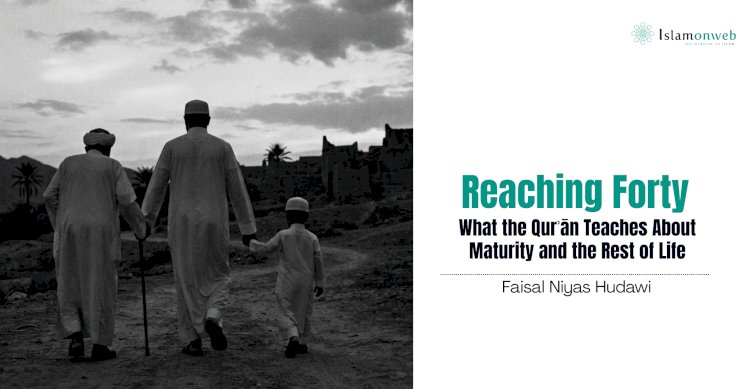
Forty is one of those ages that makes a person look in two directions at once. Much of life has already passed, yet a substantial part may still lie ahead. It is often an age of reassessment: what has been achieved, what has been neglected, how one’s relationships have changed, and what kind of life one wishes to live from this point onward. Modern discussions often describe this period in terms of a “midlife crisis.” The Qurʾān, however, presents forty through a different lens.
In Sūrat al-Aḥqāf, Allah speaks of the human being reaching full maturity and then specifically mentions the age of forty:
“Until, when he reaches full strength and reaches forty years, he says, ‘My Lord, enable me to be grateful for Your favour which You have bestowed upon me and upon my parents, and to do righteousness that pleases You; and make righteous for me my offspring. Indeed, I have turned to You in repentance, and indeed I am of the Muslims.’”
Al-Aḥqāf 46:15
Remarkably, the prayer connected with forty is not about extending youth, preserving status, or accumulating more of the world. It is a prayer of gratitude, righteous action, concern for one’s children, repentance, and renewed submission to Allah. A person is made to look backwards to blessings received through parents, inward at the state of his own deeds, and forward to the generation that follows. Forty is presented as a point of mature consciousness, where experience should deepen gratitude, responsibility, and awareness of the Hereafter.
“Until He Reaches His Full Strength and Reaches Forty Years”
The word ashuddahu (أَشُدَّهُ) denotes the attainment of strength and maturity. Classical exegetes differed over the precise age intended by ashudd. Some understood it as puberty, while others placed it later, at eighteen, thirty-three, or another point at which a person’s physical and intellectual capacities become established. Al-Ṭabarī preferred the view that ashudd here refers to around thirty-three years, followed by the explicit mention of forty as a further stage of maturity.[1]
The disagreement itself is instructive. The Qurʾān does not reduce maturity to a single biological moment. A person may have reached legal adulthood many years earlier, yet experience, judgement, responsibility, and awareness continue to develop. By explicitly adding “and reaches forty years”, the verse directs attention to a stage when the impulsiveness and inexperience of youth should increasingly give way to steadiness and reflection.
Al-Ṭabarī remarks that at forty a person has passed much of the ignorance associated with youth and has become better able to recognise the obligations owed to Allah and to one’s parents[2]. Other exegetes similarly regarded forty as a point of fuller human maturity, although they did not treat it as an absolute rule applying identically to every individual.
By this age, a person has normally accumulated enough experience to look at life differently. The years of formation are largely behind him; patterns of character are clearer; responsibilities have multiplied; parents have grown older; children may now depend upon him; and the consequences of earlier choices are becoming visible. The Qurʾānic mention of forty thus points not to a new beginning of accountability, but to a deeper consciousness of an accountability that has long existed.
The Prophet ﷺ at Forty: A Beginning, Not an Ending
The life of the Prophet Muhammad ﷺ gives the age of forty an especially meaningful place in the Muslim imagination. Ibn ʿAbbās رضي الله عنهما reported:
“The Messenger of Allah ﷺ was sent when he was forty years old. He remained in Makkah for thirteen years receiving revelation, then he was commanded to migrate. He lived in Madinah for ten years and died at the age of sixty-three.”[3]
Ṣaḥīḥ al-Bukhārī, no. 3902
For the Prophet ﷺ, forty marked the beginning of the greatest responsibility of his life. Some of his most consequential years came after forty; the Hijrah occurred more than a decade later, and the entire Madinan period belonged to the later part of his life.
This does not mean that forty itself confers a special spiritual rank upon every person. What the Prophetic biography shows is that maturity need not be understood as the closing of possibilities. Rather, it can become the stage at which experience, ability and understanding are gathered around a clearer purpose. By this point, a person has often lived long enough to recognise his strengths, responsibilities, opportunities and the needs around him. The question is no longer only what one wishes to achieve, but what one’s life should now be directed towards.
In that sense, forty can become a time to identify one’s larger mission in life: the work through which one can best serve Allah, fulfil one’s responsibilities, benefit others and leave something of lasting value behind. For one person, that may be teaching; for another, raising a righteous family, serving the community, producing beneficial knowledge, supporting institutions, mentoring a younger generation, or reforming an area of life within one’s reach. The form may differ, but the principle remains the same: maturity should increasingly bring focus.
Rather than resignation over what has passed, forty can therefore prompt a more serious question: what have the years already lived prepared me to do with the years that remain? The answer may mark the beginning of a person’s most purposeful and beneficial phase of life.
The Prayer of Forty: A Programme for the Years Ahead
What gives the Qurʾānic reference to forty its real significance is not the number itself, but the prayer that follows it. The prayer begins with gratitude: “My Lord, enable me to be grateful for Your favour.” The expression awziʿnī carries the sense of being inspired and enabled to give thanks. Al-Ṭabarī explains it as asking Allah to inspire a person to recognise and thank Him for His blessings. At forty, gratitude can acquire a different depth. A person has lived long enough to recognise blessings once taken for granted: faith, health, family, opportunities, protection from unseen harms, and lessons learned through hardship.[4]
Significantly, this gratitude extends to “the favour which You have bestowed upon me and upon my parents.” The verse has already recalled the hardship of pregnancy, childbirth and nurturing a child. A person now carrying responsibilities for others may understand more fully what his own parents carried for him. For many, this is also the period when parents are ageing and require greater care.
The next request is “to do righteousness that pleases You.” The prayer is not simply for the ability to do more, but for deeds that Allah accepts and is pleased with. Mature life should therefore shift the question from activity, visibility or achievement to the worth of deeds before Allah: what among what I do is actually pleasing to Him?
Then the prayer turns towards the future: “and make righteous for me my offspring.” Parents, the individual, and descendants appear within the same āyah. The forty-year-old stands, as it were, between three generations: remembering those before him, examining his own record, and worrying about the faith and well-being of those who come after him.
Finally, the prayer ends with repentance: “Indeed, I have turned to You in repentance, and indeed I am of the Muslims.” A person may already have decades behind them filled with failures, missed opportunities, and neglected duties. Forty does not close the door on them; it provides another occasion to turn back. Ibn Kathīr therefore says that the verse guides the person who reaches forty to renew repentance and turning to Allah (inābah), and to resolve firmly upon it.[5]
إذا بلغ أحدكم أربعين سنة فليأخذ حذره من الله عز وجل
“When one of you reaches forty years of age, let him be on his guard before Allah.”[6]
This saying attributed to the Tābiʿī Masrūq ibn al-Ajdaʿ رحمه الله captures the sense of increased vigilance that should accompany mature life. The point is not that accountability begins at forty. Rather, after four decades, heedlessness becomes harder to justify; experience should have left its mark upon the heart.
The following verse gives this prayer a hopeful conclusion: Allah promises to accept the best of their deeds and overlook their misdeeds among the people of Paradise. The message of forty is therefore neither anxiety about ageing nor regret over vanished youth. It invites us to gather lessons from the past and redirect the years ahead through gratitude, righteous action, concern for the next generation, and sincere repentance.[7]
After Forty: From Achievement to Legacy
One striking feature of the prayer in Sūrat al-Aḥqāf is that it turns to the next generation: “and make righteous for me my offspring.” Earlier adulthood is naturally occupied with building a life—education, work, marriage, family and financial stability. As the years advance, another question becomes more pressing: what will remain when I am no longer here?
The Qurʾānic prayer does not ask merely for successful children, but for righteous offspring. The concern is not simply that the next generation inherit wealth or opportunities, but that they inherit faith, character and a relationship with Allah. The believer begins to think less of what he can acquire and more of what he can transmit.
The Messenger of Allah ﷺ said:
“When a person dies, his deeds come to an end except for three: ongoing charity, knowledge from which benefit is derived, or a righteous child who supplicates for him.”[8]
Ṣaḥīḥ Muslim, no. 1631
All three are forms of legacy. Wealth may become ṣadaqah jāriyah; knowledge gathered over decades may be taught or written; children nurtured in faith may continue to pray for their parents. Later-life productivity can therefore be measured less by what one owns and more by what continues to benefit others—through family, teaching, mentoring, charity, reconciliation, or service. After forty, the question gradually changes from “What have I accomplished?” to “What good will continue after me?”
Growing Older Is Not Becoming Less Valuable
Islam does not deny the physical realities of ageing. The Qurʾān describes human life as a movement through changing stages:
“Allah is the One who created you from weakness, then made after weakness strength, then made after strength weakness and grey hair. He creates what He wills, and He is the Knowing, the Competent.”[9]
Al-Rūm 30:54
Strength itself is placed between two periods of weakness. Grey hair is mentioned without embarrassment; it belongs to the pattern Allah has created for human life. Yet physical decline does not mean that a person’s value before Allah is declining. When the Messenger of Allah ﷺ was asked who among people is best, he replied:
“He whose life is long and whose deeds are good.”[10]
Jāmiʿ al-Tirmidhī, no. 2330
A longer life can therefore become a blessing when its additional days are filled with good. Every year offers further opportunities for prayer, repentance, charity, service, learning and reconciliation. With age, some capacities may diminish, but other qualities may deepen: judgement formed through experience, patience learned through hardship, detachment from things once considered important, and a stronger consciousness of the Hereafter. Time itself does not improve a person; what matters is what one does with the time Allah gives. The aim is not to resist ageing as though youth were the only valuable period of existence, but to ensure that as physical strength decreases, the weight of good deeds continues to increase.
From Forty Towards Sixty: The Shortening Horizon
If the Qurʾān presents forty as an age of mature reflection, the Prophetic teachings give particular weight to the stage that follows: sixty. Abū Hurayrah رضي الله عنه reported that the Messenger of Allah ﷺ said:
“The lifespan of my Ummah is between sixty and seventy years, and few of them go beyond that.”[11]
Jāmiʿ al-Tirmidhī, no. 2331
This is not a prediction of how long any particular person will live. It does, however, place human life within a limited horizon. For someone reaching forty, twenty years can still appear long. Yet there is less reason to postpone repairing relationships, correcting habits, seeking knowledge, giving charity, returning neglected rights, or renewing one’s relationship with Allah.
The language becomes even more direct at sixty. The Prophet ﷺ said:
“Allah has left no excuse for a person whose term He has delayed until he reaches sixty years of age.”[12]
Ṣaḥīḥ al-Bukhārī, no. 6419
The meaning is not that repentance is no longer accepted after sixty. Rather, a person granted such a length of life has ample opportunity to recognise, reflect, and return. Al-Bukhārī places this ḥadīth alongside the Qurʾānic words: “Did We not grant you life long enough for whoever would take heed to take heed, and the warner had come to you?” (Fāṭir 35:37).[13]
After forty, therefore, one of the most important changes may be in the word “later.” Repent later. Repair the relationship later. Learn the Qurʾān later. Spend time with ageing parents later. Begin the beneficial project later. The Qurʾānic vision of maturity gradually removes the comfort of an unlimited “later.” What remains may still be many years, but because their number is unknown, they deserve more careful treatment than the years already passed.
The Qurʾān does not tell the person who reaches forty to withdraw from the world, nor does it invite him to mourn the passing of youth. It places before him a prayer that connects the past, present and future of a human life: gratitude for blessings and parents, the quality of one’s own deeds, concern for children, and repentance before Allah.
“My Lord, enable me to be grateful for Your favour which You have bestowed upon me and upon my parents, and to do righteousness that pleases You; and make righteous for me my offspring. Indeed, I have turned to You in repentance, and indeed I am of the Muslims.”
Al-Aḥqāf 46:15
For the believer, growing older is ultimately not a journey away from youth. It is a journey closer to the meeting with Allah.
Reference:
[1]Muḥammad ibn Jarīr al-Ṭabarī, Jāmiʿ al-Bayān ʿan Taʾwīl Āy al-Qurʾān, commentary on al-Aḥqāf 46:15. Al-Ṭabarī discusses the differing views on “ashudd” and prefers thirty-three as closer to the wording of the verse.
[2]Al-Ṭabarī, Jāmiʿ al-Bayān, commentary on al-Aḥqāf 46:15: on reaching forty, the completion of the proof against a person, the passing of youthful ignorance, and recognition of the rights owed to Allah and one’s parents.
[3]Al-Bukhārī, Ṣaḥīḥ al-Bukhārī, no. 3902, from Ibn ʿAbbās رضي الله عنهما.
[4]Al-Ṭabarī, Jāmiʿ al-Bayān, commentary on al-Aḥqāf 46:15, explaining “awziʿnī” as asking Allah to inspire and enable gratitude for His blessings.
[5]Ismāʿīl ibn Kathīr, Tafsīr al-Qurʾān al-ʿAẓīm, commentary on al-Aḥqāf 46:15: “This contains guidance for one who reaches forty to renew repentance and turning to Allah (inābah), and to resolve upon it.”
[6]Aḥmad ibn Ḥanbal, Kitāb al-Zuhd, p. 283, report from Masrūq ibn al-Ajdaʿ; cited also in classical tafsīr discussions of Fāṭir 35:37.
[7]The Qurʾān, al-Aḥqāf 46:16.
[8]Muslim ibn al-Ḥajjāj, Ṣaḥīḥ Muslim, no. 1631, from Abū Hurayrah رضي الله عنه.
[9]The Qurʾān, al-Rūm 30:54. English translation adapted from Ṣaḥīḥ International.
[10]Al-Tirmidhī, Jāmiʿ al-Tirmidhī, no. 2330, from Abū Bakrah رضي الله عنه. Al-Tirmidhī described the report as ḥasan ṣaḥīḥ.
[11]Al-Tirmidhī, Jāmiʿ al-Tirmidhī, no. 2331, from Abū Hurayrah رضي الله عنه. Al-Tirmidhī described it as ḥasan gharīb and noted that it is reported through other routes from Abū Hurayrah.
[12]Al-Bukhārī, Ṣaḥīḥ al-Bukhārī, no. 6419, from Abū Hurayrah رضي الله عنه.
[13]The Qurʾān, Fāṭir 35:37; al-Bukhārī places the ḥadīth of reaching sixty in Kitāb al-Riqāq, under the chapter “Whoever reaches sixty years of age, Allah has left him no excuse concerning his lifespan.”
Disclaimer
The views expressed in this article are the author’s own and do not necessarily mirror Islamonweb’s editorial stance.



Related Posts















Leave A Comment