
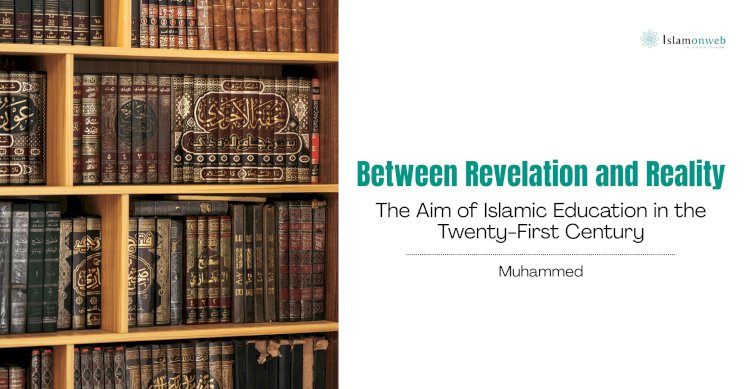
Between Revelation and Reality: The Aim of Islamic Education in the Twenty-First Century
Every educational system answers, whether it admits it or not, a basic question: what is a human being? Modern curricula often reply in economic language. Education, they say, prepares workers, supplies marketable skills, and drives growth. Islam gives a different answer — and that answer matters more, not less, in an age shaped by digital media, artificial intelligence, mass migration, and a constant flood of information.
This article argues that the aim of Islamic education in the twenty-first century remains what it has always been: the formation of the whole person — someone who knows Allāh, purifies the self, and serves creation with competence and integrity (iḥsān). The aim itself is not new. What is new is the range of demands it now places on teachers, parents, and institutions.
Drawing on the Qurʾān, the ḥadīth literature, and both classical and contemporary scholarship, the discussion moves through four steps: the foundational purpose of knowledge, the formation of character, the particular challenges of our time, and the kind of educational response those challenges require.
Knowledge in the Service of Worship
The Qurʾān states that human beings and jinn were created only to worship Allāh.1 If this is the purpose of life, it must also be the horizon of education. Yet worship (ʿibādah) in Islamic thought reaches far beyond ritual. It includes every act done with awareness of Allāh and in keeping with His guidance. An education that serves this purpose cannot stop at teaching rites. It has to cultivate the understanding, the will, and the habits through which an entire life becomes an act of devotion.
The first revelation began with the command to read in the name of the Lord who created, and the same passage affirms that He taught by the pen and taught humanity what it did not know.2 Knowledge is presented here as both a divine gift and a trust. The account of Ādam reinforces the point. Allāh announced a khalīfah — a vicegerent — on earth, and the angels were shown that humanity’s distinctive capacity lay in being taught the names of things.3 The Qurʾān elevates those who have knowledge,4 asks whether those who know and those who do not are equal,5 and teaches the believer to ask Allāh for increase in knowledge.6 It also links knowledge with reverence, declaring that awe of Allāh is found most truly among those who know.7
The Prophetic tradition follows the same path. The Messenger of Allāh (ṣallā Allāhu ʿalayhi wa-sallam) taught that whoever treads a path in search of knowledge, Allāh makes easy for him a path to Paradise.8 Another report, transmitted by Ibn Mājah, describes seeking knowledge as a duty upon every Muslim.9 Scholars have graded this second report differently, but its meaning is amply supported by the wider evidence.
Classical scholars drew a practical conclusion from all this. Al-Ghazālī (d. 505/1111) distinguished between knowledge that is an individual obligation (farḍ ʿayn) — what every Muslim needs in order to practise the faith — and knowledge that is a communal obligation (farḍ kifāyah), such as the disciplines on which the welfare of society depends, among them medicine and arithmetic.10 This distinction remains especially useful today. It means that the sciences, engineering, and the professions are not a distraction from Islamic education but part of its scope, provided they are pursued within an ethical framework and for the common good.
Purifying the Self: Tazkiyah, Adab and Character
If knowledge alone were the aim, education would be little more than the transfer of information. The Qurʾān, however, joins instruction with purification. Among the functions of the Prophet it lists reciting the verses, purifying people (tazkiyah), and teaching the Book and wisdom.11 Elsewhere it declares that the one who purifies the soul has succeeded and the one who corrupts it has failed.12 The Prophet himself described his mission in terms of perfecting noble character (makārim al-akhlāq).13 Education in the Islamic sense is therefore incomplete unless it shapes the learner’s moral and spiritual life.
Syed Muhammad Naquib al-Attas has argued that the most precise term for this process is neither tarbiyah (nurturing) nor taʿlīm (instruction) but taʿdīb, derived from adab. For him, adab is the recognition and acknowledgement of the proper place of things within the order of creation, and education is the gradual instilling of that recognition in the person.14 One need not accept every detail of his terminology to see the force of the point. A learner may master a body of knowledge and still lack humility, honesty, and restraint. The classical manual of al-Zarnūjī, long used across Muslim lands, accordingly gives early and prominent attention to the learner’s intention and to reverence for knowledge and those who carry it.15
This has clear consequences for the teacher. The Prophet described the learned as the heirs of the prophets,16 and he also taught that the best of people are those who learn the Qurʾān and teach it.17 Inheritance of this kind is not a matter of credentials. Teachers educate by what they are as much as by what they say, and no syllabus can replace the example of a sincere and knowledgeable person.
Three Challenges of the Present Age
The first challenge is fragmentation. In many Muslim societies, education has been split between institutions that teach the revealed sciences and those that teach modern disciplines, with little conversation between them. The First World Conference on Muslim Education, held in Makkah in 1977, identified this division as a central problem and called for an education that integrates revealed and acquired knowledge.18 Ismāʿīl al-Fārūqī’s programme for the “Islamization of knowledge” was one influential response.19 The methods proposed have been debated, and intellectual honesty requires acknowledging that debate. The underlying concern, however, is hard to dismiss: a student who is taught to regard faith and inquiry as belonging to separate worlds will struggle to live as a coherent whole.
The second challenge is the abundance and unreliability of information. Students today encounter more claims in a single day than earlier generations met in a month, and many of those claims are false, partial, or manipulative. The Qurʾān offers principles that speak directly to this condition. It commands believers to verify news brought by a person of doubtful character before acting on it, and it forbids pursuing what one has no knowledge of.20 The classical discipline of verifying reports, so central to ḥadīth scholarship, is a heritage that Muslim education should recover and extend. Teaching students to ask for sources, to distinguish evidence from assertion, and to withhold judgement until they have understood is no longer an optional extra. It is both a religious and an intellectual duty.
The third challenge is plurality. Muslims now live alongside people of other faiths and of none, in societies more mixed than ever before. Even where they do not meet diversity in person, they encounter it daily through screens. The Qurʾān presents human diversity as part of the divine design and as an invitation to mutual recognition.21 Islamic education that produces suspicion of others, or an inability to explain one’s own faith to a sceptical neighbour, fails both the learner and the community. The aim should be confident, well-informed Muslims who are secure in their convictions and courteous in their engagement.
Education for Stewardship
How, then, should Islamic education respond? The answer begins with the purposes (maqāṣid) of the Sharīʿah. Al-Ghazālī identified the preservation of religion, life, intellect, lineage, and property as its essential aims.22 More recently, Jasser Auda has argued that the maqāṣid should be read in a way that includes human development and the protection of dignity and rights, and that they offer a framework for thinking systematically about contemporary problems.23 Applied to education, this suggests that schools should be judged by whether they protect and develop the intellect and the person — not only by examination results.
Such an education would encourage reflection on creation. The Qurʾān speaks of signs in the heavens and the earth for people of understanding, who remember Allāh and reflect on the creation of the universe,24 and it reminds human beings that they were given hearing, sight, and hearts so that they might be grateful.25 Scientific curiosity is thus rooted in the Qurʾānic call to reflection, not opposed to it. A Muslim student who studies biology, data science, or economics may be engaged in a form of worship when the work is done with sincerity and brings benefit to others.
Education for stewardship also develops responsibility. The Prophet said that each person is a shepherd and each is responsible for his or her flock.26 The Qurʾānic concept of the khalīfah makes humanity accountable for the earth and for one another.27 Education should therefore cultivate habits of service: honest work, care for the environment, concern for the poor, and a refusal to treat knowledge as merely a means of personal advancement. Where possible, learning should be connected to the life of the community through service, mentoring, and practical projects.
Conclusion
The aim of Islamic education has not changed across the centuries: to form human beings who know their Lord, purify themselves, and benefit creation. What changes is the setting in which this aim must be pursued. In the twenty-first century that setting is marked by fragmented curricula, overwhelming information, and increasing plurality. An education faithful to the sources will answer these conditions by integrating revealed and worldly knowledge, training discernment, attending to character, and preparing learners for service.
Such an education asks more of teachers and institutions than the transmission of facts. It asks them to embody the trust (amānah) of knowledge and to pass it on with sincerity, humility, and care.
About the Author
Muhammed is a student pursuing the Hudawi course at MIC Darul Irshad Academy. His intellectual interests encompass Islamic education, Islamic scholarship, literature, and critical inquiry. He is particularly interested in exploring the relationship between traditional Islamic knowledge and contemporary educational and social realities. His interest in these areas reflects a desire to understand how Islamic intellectual traditions can contribute to character formation, ethical responsibility, and the holistic development of individuals. Through his writing, he seeks to engage with contemporary questions from an informed Islamic perspective, with an emphasis on sincerity, intellectual integrity, and the responsible pursuit of knowledge.
Endnotes
1.Qurʾān 51:56.
2.Qurʾān 96:1–5.
3.Qurʾān 2:30–31.
4.Qurʾān 58:11.
5.Qurʾān 39:9.
6.Qurʾān 20:114.
7.Qurʾān 35:28.
8.Muslim b. al-Ḥajjāj, Ṣaḥīḥ Muslim, Kitāb al-Dhikr wa’l-Duʿāʾ wa’l-Tawbah wa’l-Istighfār, no. 2699.
9.Ibn Mājah, Sunan, Muqaddimah, no. 224. The grading of this report is disputed: the Darussalam edition gives the chain of the full report as very weak, while al-Albānī accepts the clause on seeking knowledge as sound through supporting routes.
10.Al-Ghazālī, Iḥyāʾ ʿUlūm al-Dīn, Kitāb al-ʿIlm, Bāb 2 (on praiseworthy and blameworthy branches of knowledge). English translation: Nabih Amin Faris, The Book of Knowledge (Lahore: Sh. Muhammad Ashraf, 1962), section 2.
11.Qurʾān 62:2.
12.Qurʾān 91:7–10.
13.Aḥmad b. Ḥanbal, Musnad, no. 8952; al-Bukhārī, al-Adab al-Mufrad, no. 273. The wording differs between reports: the Adab al-Mufrad version reads ṣāliḥ al-akhlāq (“good character”), while the form makārim al-akhlāq used in this article appears in other transmissions.
14.Syed Muhammad Naquib al-Attas, The Concept of Education in Islam (Kuala Lumpur: ABIM, 1980).
15.Al-Zarnūjī, Taʿlīm al-Mutaʿallim Ṭarīq al-Taʿallum, the chapters on intention (niyyah) and on reverence for knowledge and its people.
16.Abū Dāwūd, Sunan, Kitāb al-ʿIlm, no. 3641.
17.Al-Bukhārī, Ṣaḥīḥ, Kitāb Faḍāʾil al-Qurʾān, no. 5027.
18.Syed Muhammad Naquib al-Attas (ed.), Aims and Objectives of Islamic Education (Jeddah: King Abdulaziz University; London: Hodder and Stoughton, 1979), the proceedings of the First World Conference on Muslim Education, Makkah, 1977.
19.Ismāʿīl Rājī al-Fārūqī, Islamization of Knowledge: General Principles and Work Plan, 2nd rev. and expanded ed. (Herndon, VA: International Institute of Islamic Thought, 1989). The first edition appeared from the same institute in the early 1980s; catalogues and scholarship give 1981 or 1982.
20.Qurʾān 49:6; Qurʾān 17:36.
21.Qurʾān 49:13.
22.Al-Ghazālī, al-Mustaṣfā min ʿIlm al-Uṣūl, the discussion of maṣlaḥah (public interest).
23.Jasser Auda, Maqasid al-Shariah as Philosophy of Islamic Law: A Systems Approach (London: International Institute of Islamic Thought, 2008).
24.Qurʾān 3:190–191.
25.Qurʾān 16:78.
26.Al-Bukhārī, Ṣaḥīḥ, no. 893; Muslim, Ṣaḥīḥ, no. 1829.
27.Qurʾān 2:30.
Declaration of AI Use
Claude, an AI assistant developed by Anthropic, was used during the preparation of this article to assist with wording, organisation, and the expansion of some sections, and in a final editing pass to correct grammatical errors and to check the endnotes against published editions. The central ideas were developed by the author. The author takes responsibility for the submitted manuscript and for ensuring the accuracy of its arguments, Islamic references, and scholarly citations.
Disclaimer
The views expressed in this article are the author’s own and do not necessarily mirror Islamonweb’s editorial stance.

Related Posts













Leave A Comment