
Etiquettes of ʿĪd in Islam
All praise is due to Allah. We praise Him, seek His help, and ask for His forgiveness. We seek refuge in Allah from the evils within ourselves and from the consequences of our deeds. Whomsoever Allah guides, none can lead astray; and whomsoever He allows to stray, none can guide. I bear witness that there is no deity worthy of worship except Allah alone, without partner, and I bear witness that Muḥammad is His servant and Messenger ﷺ.
Islam is a religion of ease, mercy, and balance. Among its manifestations of ease and compassion is that it has granted people occasions of joy and happiness. Among these blessed occasions are ʿĪd al-Fiṭr and ʿĪd al-Aḍḥā. We need to understand the proper etiquettes of these days, so that our joy aligns with divine guidance.
The Two Eids in Islam
Islam recognises only two festivals, no more and no less.
It is reported from Anas ibn Mālik رضي الله عنه that he said:
“The people of Madinah used to have two days in which they would play and celebrate during the pre-Islamic period. When the Prophet ﷺ came, he said: ‘You had two days in which you used to celebrate, and Allah has replaced them with something better than them: the day of al-Fiṭr and the day of al-Naḥr.’”[2]
This ḥadīth clearly establishes that the only legislated festivals in Islam are ʿĪd al-Fiṭr and ʿĪd al-Aḍḥā. Islam does not recognise other newly introduced celebrations such as spring festivals, Valentine’s Day, or similar occasions that people have innovated.
Therefore, a Muslim should adhere to what Allah and His Messenger ﷺ have prescribed, and avoid what has been prohibited. In doing so lies true happiness—both in this world and in the Hereafter.
Etiquettes of ʿĪd
Islam has outlined several etiquettes for the days of ʿĪd. The Prophet ﷺ guided his Ummah towards them and encouraged embodying these noble practices.
1.Performing the Prayer Before the Sermon
Among the established etiquettes of ʿĪd is that the prayer is performed before the sermon.
It is reported from Ibn ʿUmar رضي الله عنهما:
“The Prophet ﷺ, Abū Bakr, and ʿUmar used to perform the ʿĪd prayer before delivering the sermon.” [2]
Jābir رضي الله عنه said:
“I attended the ʿĪd with the Prophet ﷺ, and he began with the prayer before the sermon.” [3]
Ibn ʿAbbās رضي الله عنهما said:
“I witnessed the ʿĪd with the Prophet ﷺ, Abū Bakr, and ʿUmar, and they all began with the prayer before the sermon.” [4]
Abū ʿUbayd, the freed slave of ʿAbd al-Raḥmān ibn ʿAwf رضي الله عنه, narrated:
“I witnessed ʿUmar ibn al-Khaṭṭāb on the day of Naḥr; he began with the prayer before the sermon. Then he said: ‘I heard the Messenger of Allah ﷺ forbidding fasting on these two days. As for the day of al-Fiṭr, it is your breaking of the fast and a festival for the Muslims.’ Then I witnessed ʿUthmān on a day when ʿĪd and Jumuʿah coincided; he began with the prayer before the sermon and said: ‘These are two Eids that have come together on one day.’” [5]
These narrations clearly demonstrate the consistent Prophetic practice and that of the Rightly Guided Caliphs—placing the prayer before the sermon on the day of ʿĪd.
2.Giving the Option to Stay for the Sermon or Leave
It is recommended for the imām to give people the choice either to remain for the sermon or to leave after the prayer.
ʿAbdullāh ibn al-Sāʾib رضي الله عنه reported:
“I attended the ʿĪd prayer with the Messenger of Allah ﷺ. After he finished the prayer, he said: ‘We have completed the prayer. Whoever wishes to sit for the sermon may sit, and whoever wishes to leave may leave.’” [6]
This highlights the ease and flexibility within Islamic practice. While attending the sermon carries benefit, it is not obligatory like the prayer itself.
3.Eating and Drinking on the Day of ʿĪd
The days of ʿĪd are meant to be days of joy, gratitude, and lawful enjoyment.
Mūsā ibn ʿAlī narrated from his father that he heard ʿUqbah ibn ʿĀmir al-Juhanī رضي الله عنه say that the Messenger of Allah ﷺ said:
“The Day of ʿArafah, the Day of Sacrifice, and the Days of Tashrīq are our festivals, O people of Islam, and they are days of eating and drinking.” [7]
This ḥadīth emphasises that these are not days of fasting or hardship, but rather days of celebration within the limits set by Allah.
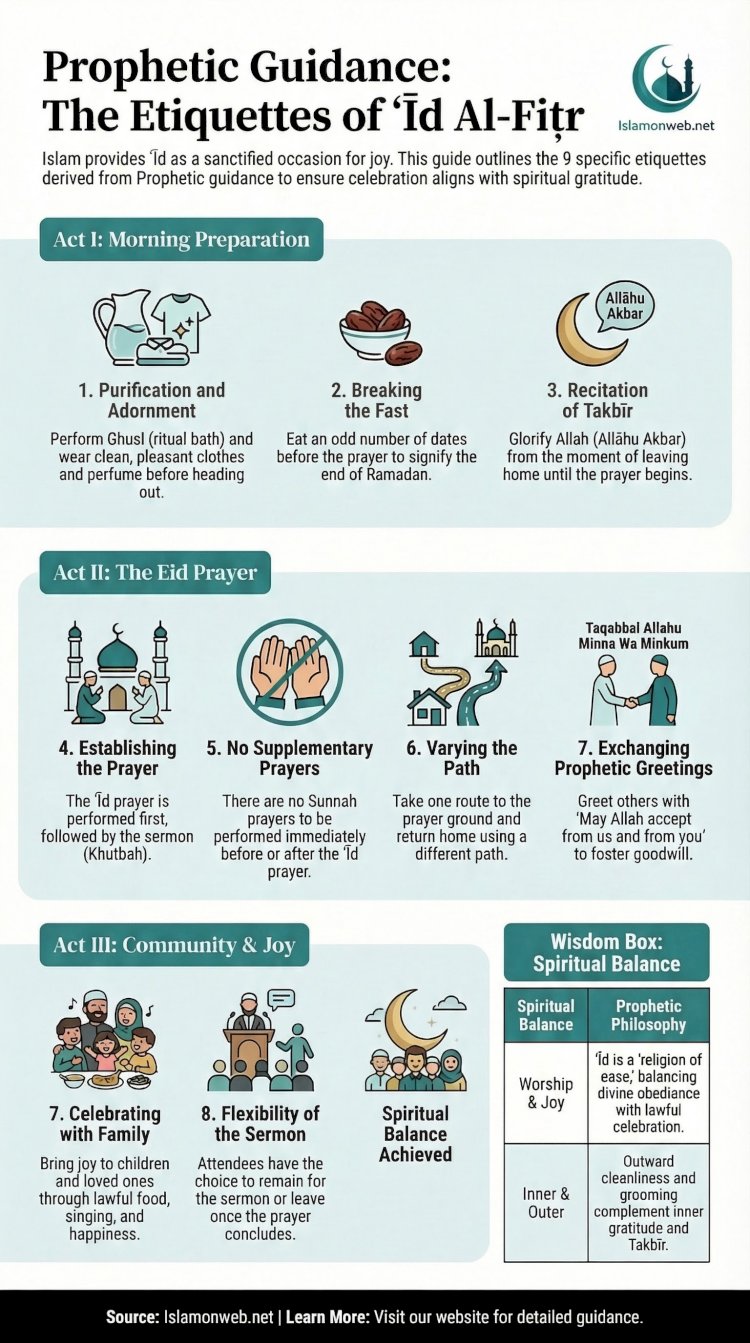
4.Bathing and Adorning Oneself for ʿĪd
It is recommended to perform ghusl (ritual bathing) and to present oneself in a clean and pleasant manner on the day of ʿĪd.
It is reported that Ibn ʿUmar رضي الله عنهما used to perform ghusl on the day of al-Fiṭr before going out to the prayer ground [8]. In another narration, Nāfiʿ reported that Ibn ʿUmar رضي الله عنهما would bathe for both Eids and go early to the prayer place before eating [9]. Likewise, al-Jaʿd ibn ʿAbd al-Raḥmān said: “I saw al-Sāʾib ibn Yazīd bathing before going out to the prayer.” [10]
It is also reported that Ibn ʿUmar رضي الله عنهما would apply perfume on the day of al-Fiṭr.
Saʿīd ibn al-Musayyib رحمه الله said:
“The Sunnah of al-Fiṭr consists of three things: walking to the prayer place, eating before going out, and bathing.” [11]
These practices reflect the beauty of Islam, where outward cleanliness complements inner gratitude, and preparation for worship is accompanied by dignity and joy.
5. Eating Before the ʿĪd al-Fiṭr Prayer
It is recommended to eat before going out for the ʿĪd al-Fiṭr prayer.
Saʿīd ibn al-Musayyib رحمه الله said:
“The Muslims used to eat on the day of al-Fiṭr before the prayer, but they would not do so on the day of al-Naḥr.” [12]
He also said:
“Do not go out on the day of al-Fiṭr until you have eaten, and do not eat on the day of al-Naḥr until you have sacrificed.” [16]
Imām Mālik رحمه الله commented:
“People were instructed to eat before going out on the day of al-Fiṭr, and this is what I found people practising.”
Anas ibn Mālik رضي الله عنه reported:
“The Messenger of Allah ﷺ would not go out on the day of al-Fiṭr until he had eaten some dates, and he would eat them in odd numbers.” [17]
The scholars have highlighted wisdom behind this practice. Al-Muhallab رحمه الله explained that eating before the prayer removes any misconception that fasting continues until after the ʿĪd prayer. Others noted that since breaking the fast becomes obligatory after Ramadan, hastening to eat reflects prompt obedience to Allah’s command. The Prophet ﷺ sufficed with a small amount, indicating that the purpose was not indulgence, but compliance with divine instruction [18].
6. No Sunnah Prayer Before or After the ʿĪd Prayer
There is no prescribed Sunnah prayer before or after the ʿĪd prayer.
Ibn ʿAbbās رضي الله عنهما reported:
“The Messenger of Allah ﷺ went out on the day of ʿĪd al-Aḍḥā or al-Fiṭr and prayed two rakʿahs. He did not pray before them nor after them. Then he went to the women with Bilāl and instructed them to give charity, and the women began giving their jewellery.”
Jābir ibn Samurah رضي الله عنه said:
“I prayed the two ʿĪd prayers with the Messenger of Allah ﷺ more than once or twice without any adhān or iqāmah.” [21]
Ibn ʿAbbās رضي الله عنهما also reported:
“The Messenger of Allah ﷺ went out on the day of ʿĪd al-Aḍḥā and did not pray before it nor after it.” [22]
Nāfiʿ رحمه الله said that Ibn ʿUmar رضي الله عنهما would not pray before or after the ʿĪd prayer [23].
These narrations establish that the ʿĪd prayer stands distinct, without additional Sunnah prayers attached to it.
7. Takbīr on the Day of ʿĪd
Among the great Sunnahs of ʿĪd is the recitation of Takbīr, as Allah تعالى says:
“…that you may complete the prescribed period and glorify Allah for guiding you, and that you may be grateful.” (al-Baqarah: 185)
Time of Takbīr
The majority of scholars hold that, for ʿĪd al-Fiṭr, Takbīr begins from the time one leaves for the prayer until the commencement of the sermon.
For ʿĪd al-Aḍḥā, Takbīr begins from the morning of the Day of ʿArafah and continues until the afternoon of the Days of Tashrīq—the 11th, 12th, and 13th of Dhū al-Ḥijjah.
Wisdom Behind the Takbīr
The purpose of remembering Allah through Takbīr, praise, and glorification is to revive the awareness of His greatness in the hearts. It directs the believer to turn to Allah alone in all circumstances, to obey Him sincerely, to love Him, and to place complete trust in Him. He is the Greatest—none is greater than Him; the Provider—every blessing comes from Him; the King—to whom all creation belongs; and the Creator of all things:
“That is Allah, your Lord; there is no deity except Him, the Creator of all things, so worship Him. And He is Disposer of all affairs.” (al-Anʿām: 102)
When the heart recognises this reality, it naturally inclines toward obedience, fulfils divine commands, avoids prohibitions, and becomes constant in remembrance, gratitude, and praise. The limbs then follow, engaging in acts of worship with love, reverence, and humility.
This inner transformation is beautifully reflected in the ḥadīth of al-Nuʿmān ibn Bashīr رضي الله عنه, where the Prophet ﷺ said:
“Indeed, what is lawful is clear and what is unlawful is clear, and between them are doubtful matters that many people do not know. Whoever avoids the doubtful has protected his religion and honour, and whoever falls into the doubtful falls into the unlawful… Indeed, in the body there is a piece of flesh—if it is sound, the whole body is sound; and if it is corrupt, the whole body is corrupt. Indeed, it is the heart.” [24][25]
Forms of Takbīr
A Muslim may recite Takbīr in various forms, all of which are acceptable:
- Even repetition:
Allāhu akbar, Allāhu akbar, lā ilāha illā Allāh, Allāhu akbar, Allāhu akbar, wa lillāhi al-ḥamd. - Odd repetition:
Allāhu akbar, Allāhu akbar, Allāhu akbar, lā ilāha illā Allāh, Allāhu akbar, Allāhu akbar, Allāhu akbar, wa lillāhi al-ḥamd. - Odd in the first part, even in the second:
Allāhu akbar, Allāhu akbar, Allāhu akbar, lā ilāha illā Allāh, Allāhu akbar, Allāhu akbar, wa lillāhi al-ḥamd. - Even in the first part, odd in the second:
Allāhu akbar, Allāhu akbar, lā ilāha illā Allāh, Allāhu akbar, Allāhu akbar, Allāhu akbar, wa lillāhi al-ḥamd.
One may alternate between these forms, as the matter is flexible and broad [26].
8. Taking a Different Route (Mukhālafat al-Ṭarīq)
It is recommended to go to the ʿĪd prayer by one route and return by another.
Abū Hurayrah رضي الله عنه reported:
“When it was the day of ʿĪd, the Prophet ﷺ would take a different route (for returning).” [27]
The scholars have reflected deeply on the wisdom behind this practice. Imām al-Manāwī رحمه الله mentioned several possible reasons: that both paths may bear witness for the person on the Day of Judgment; that more people may see and share in the blessings of the occasion; that the symbols of Islam are made visible in more places; that remembrance of Allah is increased; that joy spreads among the people; and that different needs may be fulfilled along the way. It may also be to greet more people, strengthen ties, give charity, or simply to embody the spirit of the day in a broader manner. All of this reflects the richness and wisdom of the Prophetic tradition [28].
9. Exchanging Greetings and Congratulations
It is recommended for Muslims to greet one another on the day of ʿĪd.
Khālid ibn Maʿdān رحمه الله said:
“I met Wāthilah ibn al-Asqaʿ on the day of ʿĪd and said: ‘May Allah accept from us and from you.’ He replied: ‘Yes, may Allah accept from us and from you.’ He added: ‘I met the Messenger of Allah ﷺ on the day of ʿĪd and said the same to him, and he replied likewise.’” [29]
Similarly, it is reported from Jubayr ibn Nufayr رحمه الله that the companions of the Prophet ﷺ, when they met on the day of ʿĪd, would say to one another:
“May Allah accept from us and from you.” This narration has been graded as ḥasan.
Imām Aḥmad رحمه الله stated that there is no harm in saying such greetings on the day of ʿĪd, and it has been reported from several companions, including Abū Umāmah and Wāthilah ibn al-Asqaʿ. He affirmed its permissibility and goodness [31].
This simple greeting carries a profound meaning—it connects hearts, spreads goodwill, and reminds believers that the true success of ʿĪd lies in the acceptance of deeds.
10. Bringing Joy to Family and Loved Ones
Islam encourages bringing happiness to one’s family and children during the days of ʿĪd, within the boundaries set by the Sharīʿah.
ʿĀʾishah رضي الله عنها narrated:
“The Messenger of Allah ﷺ entered upon me while two young girls were singing the songs of Buʿāth. He lay down and turned his face away. Then Abū Bakr entered and rebuked me, saying: ‘Musical instruments of Shayṭān in the house of the Prophet ﷺ?’ The Messenger of Allah ﷺ turned to him and said: ‘Leave them.’ When he became inattentive, I signalled to them and they left.”
In another narration, the Prophet ﷺ said:
“O Abū Bakr, every nation has its festival, and this is our festival.” [32]
And in yet another narration, he ﷺ said:
“So that the Jews may know that in our religion there is ease. Indeed, I have been sent with a tolerant and upright religion.” [33]
These narrations beautifully illustrate that Islam is not a religion of restriction, but of balance. Joy is encouraged—but it is guided, dignified, and rooted in remembrance of Allah.
The etiquettes of ʿĪd in Islam are not mere outward practices; they reflect a deeper spiritual balance between worship and joy, discipline and celebration. From prayer and remembrance to kindness, generosity, and shared happiness, ʿĪd becomes a complete expression of faith in action.
Translated from https://saaid.org/mktarat/eid/91.htm
Prepared by: Dr. Aḥmad ʿArafah
Teaching Assistant, Al-Azhar University
Disclaimer
The views expressed in this article are the author’s own and do not necessarily mirror Islamonweb’s editorial stance.
53 Comments
-

-
The midday Dhuhr prayer offers a natural checkpoint to pause, reset, and reconnect with our spiritual priorities amidst a busy day. Often, lunch breaks become unintentional extended scrolling sessions. Having a barrier like DeenGuard - which requires engaging with Islamic content (such as a hadith) before accessing social media or games - helps ensure that our 'break' time truly serves as a break from distraction, not a continuation of it. You can try DeenGuard on the App Store: https://apps.apple.com/us/app/deen-guard-hadith-prayer-lock/id6758766559 and HalalProof for scanning ingredient labels: https://apps.apple.com/us/app/halalproof-ingredient-scanner/id6761026763 In our work and study-filled afternoons, it's easy to lose track of time while bouncing between apps. The Dhuhr prayer reminds us to step back. Tools that introduce a mindful pause before app access - like needing to read a short Islamic reminder - can help align our digital habits with our spiritual intentions during the busiest part of the day. Try HalalProof to check if your food is truly halal: https://apps.apple.com/us/app/halalproof-ingredient-scanner/id6761026763 and DeenGuard to block distracting apps: https://apps.apple.com/us/app/deen-guard-hadith-prayer-lock/id6758766559
-
The midday Dhuhr prayer offers a natural checkpoint to pause, reset, and reconnect with our spiritual priorities amidst a busy day. Often, lunch breaks become unintentional extended scrolling sessions. Having a barrier like DeenGuard - which requires engaging with Islamic content (such as a hadith) before accessing social media or games - helps ensure that our 'break' time truly serves as a break from distraction, not a continuation of it. You can try DeenGuard on the App Store: https://apps.apple.com/us/app/deen-guard-hadith-prayer-lock/id6758766559 and HalalProof for scanning ingredient labels: https://apps.apple.com/us/app/halalproof-ingredient-scanner/id6761026763 In our work and study-filled afternoons, it's easy to lose track of time while bouncing between apps. The Dhuhr prayer reminds us to step back. Tools that introduce a mindful pause before app access - like needing to read a short Islamic reminder - can help align our digital habits with our spiritual intentions during the busiest part of the day. Try HalalProof to check if your food is truly halal: https://apps.apple.com/us/app/halalproof-ingredient-scanner/id6761026763 and DeenGuard to block distracting apps: https://apps.apple.com/us/app/deen-guard-hadith-prayer-lock/id6758766559
-
-
The midday Dhuhr prayer offers a natural checkpoint to pause, reset, and reconnect with our spiritual priorities amidst a busy day. Often, lunch breaks become unintentional extended scrolling sessions. Having a barrier like DeenGuard - which requires engaging with Islamic content (such as a hadith) before accessing social media or games - helps ensure that our 'break' time truly serves as a break from distraction, not a continuation of it. You can try DeenGuard on the App Store: https://apps.apple.com/us/app/deen-guard-hadith-prayer-lock/id6758766559 and HalalProof for scanning ingredient labels: https://apps.apple.com/us/app/halalproof-ingredient-scanner/id6761026763 In our work and study-filled afternoons, it's easy to lose track of time while bouncing between apps. The Dhuhr prayer reminds us to step back. Tools that introduce a mindful pause before app access - like needing to read a short Islamic reminder - can help align our digital habits with our spiritual intentions during the busiest part of the day. Try HalalProof to check if your food is truly halal: https://apps.apple.com/us/app/halalproof-ingredient-scanner/id6761026763 and DeenGuard to block distracting apps: https://apps.apple.com/us/app/deen-guard-hadith-prayer-lock/id6758766559


Related Posts












Leave A Comment