
War with Iran: The Middle East Burns Amid Israel’s Quest for Regional Dominance
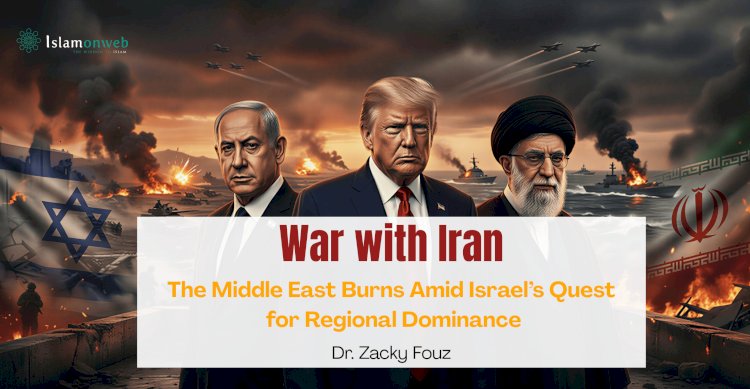
The escalating aggression by Israel, supported by the United States, against Iran may well mark the beginning of a new and far more dangerous phase in Middle Eastern geo-politics. What appears on the surface as a campaign to curb Iran’s nuclear ambitions could, in reality, be part of a much larger struggle over the future balance of power in the Middle East. Washington and Tel Aviv have justified the attacks as necessary measures aimed at degrading Iran’s nuclear and missile capabilities. Yet many observers argue that this is less a war of necessity than a war of choice. In fact, the dynamics of the conflict suggest that the United States did not initially seek such a confrontation on its own. Rather, it appears to have been gradually drawn into a conflict that Israel had long considered inevitable. The shifting and sometimes ambiguous objectives articulated by Washington, where the goals of the campaign seem to evolve over time, stand in sharp contrast to Israel’s far clearer strategic outlook.
The Geopolitical Context
For Israel, the stakes appear to go well beyond simply weakening Iran’s military capabilities. The broader objective seems to be the removal of Iran as a formidable actor in regional politics. Such an outcome would significantly alter the balance of power across the Middle East and could pave the way for Israel to consolidate its position as the region’s most dominant military and strategic power. In such a scenario, Tel Aviv would function as the central node of a new regional order, capable of projecting military power and strategic influence across the region. Israel would effectively assume the role of a regional ‘hegemon’ able to strike ‘perceived threats’ when it chooses, while other states would be forced to operate within a security framework largely shaped by Israeli strategic priorities.
Seen from this perspective, Iran may only be the first target in a broader regional struggle for dominance. Once Iran’s power is contained or weakened, attention could gradually shift toward other influential regional actors. Countries such as Turkey, Saudi Arabia, and Egypt, which represent major centres of political and strategic influence in the region, could increasingly come under scrutiny within Israeli strategic thinking. In recent political discourse, even Benjamin Netanyahu has alluded to what he describes as a ‘Sunni axis of resistance,’ suggesting that beyond Iran, a number of powerful regional states may eventually be viewed as obstacles to Israel’s ambition to shape a new regional order in the Middle East.
Regime Resilience
Moving from this broader regional geopolitical reading of the war to its evolving dynamics, one can observe that Washington, under the strong influence of pro-Israel lobbying networks, appeared to assume that the conflict might unfold in a manner similar to previous regime-pressure strategies pursued by the United States. One frequently cited precedent is the case of Nicolás Maduro in Venezuela. Following a U.S. military operation in early 2026, Maduro was captured and removed from power, after which Vice President Delcy Rodríguez assumed the presidency and signalled a willingness to cooperate with Washington and reorient aspects of the country’s policies toward U.S. interests.
Within this strategic mindset, policymakers appeared to believe that a similar model could be applied to Iran. The assumption was that targeted military strikes eliminating key political and military figures, what strategists often describe as ‘decapitation’, would destabilize the leadership structure. Once a few senior figures were removed, the expectation was that the regime would either collapse internally, be forced into negotiations from a weakened position, or face a popular uprising that could pave the way for a new political order.
However, as the war unfolded, it became increasingly clear, particularly to Washington, that Iran is fundamentally different from Venezuela. Iran’s political and military establishment is layered, institutionalized, and deeply decentralized. Power is distributed across multiple networks within the state apparatus, meaning that the removal of individual leaders does not necessarily cripple the system as a whole. The architecture of the Islamic Republic was, in many ways, designed from the very beginning with survival in mind. In practical terms, any meaningful attempt at regime change would likely require boots on the ground, an option that remains politically and militarily costly. Moreover, Iran is not merely a conventional state but an ideological one. This creates an additional layer of resilience that reduces the likelihood of rapid regime fragmentation. Consequently, the strategy of bombing infrastructure or assassinating senior military and political figures has not produced the anticipated collapse. In this context, decapitation strikes have done little to force surrender.
Iran’s Grand Strategy
U.S.-Israeli strikes have inflicted significant damage on Iran’s military and civilian infrastructure, weakening the country’s offensive capabilities to a considerable degree. Reports of deep intelligence penetration by Israeli and U.S. agencies into sensitive military and security networks have further constrained the Iranian establishment’s ability to coordinate an effective response. At the same time, Tehran has been grappling with mounting domestic pressures. Rising living costs, worsening economic hardship, and the government’s heavy-handed efforts to suppress dissent have triggered sporadic public protests, exposing internal vulnerabilities at a moment of external confrontation.
Faced with dual pressures, military escalation from abroad and socio-economic unrest at home, Iran’s leadership has shifted into what can best be described as survival mode. Unlike the brief twelve-day confrontation with Israel last year, the current conflict is perceived in Tehran as far more existential. For the leadership of the Islamic Republic, the stakes are no longer limited to strategic signalling or calibrated retaliation; they are directly tied to the regime’s survival. Consequently, Tehran appears determined to show the U.S.-Israeli alliance that another war on Iran would carry immense and potentially uncontrollable costs.
Beyond targeting Israeli sites with long-range ballistic missiles, Iran has now expanded its strikes to include Gulf countries. The rationale seems aimed at maximizing disruption, as the Gulf serves not only as a hub for American bases but also as a centre of global trade. By threatening these strategic economic arteries, Iran signals its willingness to inflict broader damage, making global economic disruption a potential last-resort strategy. It is a high-stakes gamble, but when a state faces existential threats, it appears prepared to take extreme measures to ensure the survival of the regime.
What’s Next?
Heading into the next phase, Israel appears prepared to withstand the crisis, enduring turmoil and temporary attacks in its pursuit of regional dominance. The United States, meanwhile, seems ready to move on, balancing its interests against pressure from Gulf states, global partners, and domestic electoral considerations, especially if Iranian actions threaten trade and supply chains. So far, Iranian strikes have fallen short of causing major disruption. For the Gulf states, the situation is a precarious balancing act. They cannot simply watch the conflict unfold, as doing so risks making them collateral damage. Any decision to engage in retaliatory action would likely require a regime change in Tehran; if the Islamic Republic survives, it would continue to challenge the Gulf’s positioning as a safe haven for global commerce. From Iran’s perspective, the Islamic Republic is designed to survive. Tehran is likely exploring ways to maintain state integrity, even if it means sidelining theological leadership in favour of military dominance. The regime faces little to lose if it nears collapse, making its actions increasingly unpredictable.
In short, the Middle East is burning in Israel’s quest for regional hegemony.
About the author:
Dr. Zacky Fouz
Department of Political Science and Madani Studies
International Islamic University Malaysia
zackyfouz@iium.edu.my
Disclaimer
The views expressed in this article are the author’s own and do not necessarily mirror Islamonweb’s editorial stance.


Related Posts

















Leave A Comment