
Digital Asceticism: Reclaiming the Heart from the Algorithm through Zuhd
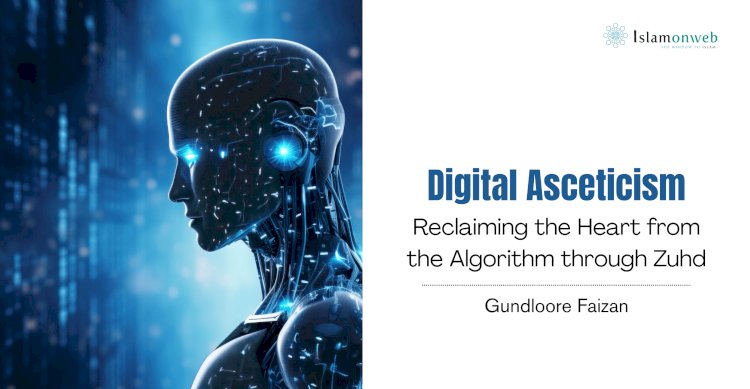
In the quiet spaces of our daily lives, waiting in a queue, pausing at a traffic light, or in the fleeting moments before sleep, there used to be silence. Today, that silence has been replaced by a reflex. At the slightest hint of stillness, our hands instinctively reach for our phones. We pull out glowing screens that promise endless connection, yet so often leave us with a lingering, hollow exhaustion. It is a profound modern paradox: we possess the entirety of human knowledge at our fingertips, yet our attention spans are fragmented, and our inner lives feel increasingly impoverished. Modern psychologists might label this a crisis of focus, but the Islamic tradition diagnoses it as something far deeper: a crisis of the heart. When our first instinct upon waking is to check a newsfeed rather than to remember the Creator, our internal centre of gravity has shifted. This state of perpetual distraction—fuelled by algorithms deliberately designed to exploit our psychological vulnerabilities—is a twenty-first-century manifestation of what classical scholars termed ghaflah(heedlessness). It is the silent, gradual process by which the heart becomes so entangled in the immediate noise of the world that it becomes numb to the eternal.
Redefining Zuhd
When we hear the word 'asceticism' or its Islamic equivalent, Zuhd, our minds often conjure images of severe isolation, a hermit retreating to a mountain cave, or a person actively seeking poverty and rejecting all worldly progress. Because of this common misconception, many modern Muslims assume that Zuhd is entirely incompatible with contemporary, technology-driven life. However, true Zuhd was never merely an external aesthetic of poverty; rather, it is a profound internal state of freedom.
The classical masters understood that the dunya (worldly life) is not inherently evil; the danger lies solely in our heart’s attachment to it. Imām Aḥmad ibn Ḥanbal explained that the highest level of Zuhd is to empty the heart of everything that distracts it from Allah. Similarly, our Fourth caliph, Ali Razi, Allahu Anhu, beautifully clarified that Zuhd does not mean owning nothing, but rather that nothing should own you. When applied to the twenty-first century, the principle is clear: you may own a smartphone, but the smartphone must not own your attention, your emotional state, or your time.
This mindset of internal detachment is deeply rooted in the Prophetic tradition. ʿAbdullāh ibn ʿUmar reported that the Messenger of Allah (ﷺ) took hold of his shoulders and imparted a timeless rule: "Be in this world as if you were a stranger or a traveller along a path." A traveller uses the tools available to navigate the journey efficiently, but they do not build a permanent house on the road. Today, our screens and networks are meant to be tools for the journey—mechanisms for seeking beneficial knowledge, maintaining ties of kinship, and managing our affairs. Yet, the algorithms behind them are designed to make us build our mental and emotional homes inside them. Practising Zuhd today means reclaiming our status as travellers.
The Anatomy of Digital Addiction
To understand why our devices can be so spiritually destructive, we must examine what they are designed to feed: the nafs (the lower ego). Social media platforms are not neutral tools; they operate on algorithms meticulously engineered to exploit our inherent psychological vulnerabilities. In Islamic terminology, these platforms are effectively nafs-amplifiers. They thrive by keeping us engaged through two primary spiritual diseases: the insatiable desire for validation and the silent poison of ḥasad (envy). When we scroll through curated feeds of perfectly staged holidays, professional milestones, and flawless appearances, our hearts naturally lean towards comparison. This constant exposure breeds a subtle ḥasad, leaving us ungrateful for our own divinely apportioned blessings (rizq). Furthermore, the currency of the digital world—likes, shares, and follower counts—feeds our vanity and the desire to be seen and praised by others, bordering on minor ostentation (riyāʾ).
The Qur’ān diagnosed this human condition with perfect precision over fourteen centuries ago. Allah says: "Know that the life of this world is but amusement and diversion and adornment and boasting to one another and competition in increase of wealth and children..." If we critically examine the architecture of modern social media, it is essentially a digital replication of this exact verse. It is 'amusement and diversion' (the endless, mindless scroll), 'adornment' (digital filters and curated lifestyles), and 'boasting and competition' (competing for viral metrics and status). The algorithm succeeds precisely when we forget the eternal reality and become entirely consumed by this digitised dunya. It traps the heart in a cycle of temporary dopamine spikes, ensuring we never reach the stillness required for true spiritual reflection.
The Illusion of Connection: Virtual Networking vs. True Ukhuwwah
One of the greatest paradoxes of the digital age is that we use platforms marketed as 'social' networks, yet we are simultaneously experiencing unprecedented levels of societal loneliness. The algorithms promise us community, but they often deliver isolation masquerading as connection. For Muslims, this poses a subtle yet deep danger to the Islamic concepts of ukhuwwah (brotherhood) and ṣilat al-raḥim (maintaining ties of kinship). In the Islamic paradigm, relationships are deeply rooted in physical presence, genuine empathy, and shared spiritual spaces—such as standing shoulder to shoulder in congregational ṣalāh. True ukhuwwah requires emotional investment, patience, and the willingness to bear others' burdens. Digital platforms, however, reduce these profound, complex human bonds to passive 'likes', automated birthday reminders, and fleeting text messages.
The Messenger of Allah (ﷺ) described the reality of the Ummah with profound physical intimacy: "The believers, in their mutual love, compassion, and sympathy, are like a single body; if one of its organs suffers, the whole body responds to it with wakefulness and fever." A glowing screen cannot transmit the spiritual weight of a genuine handshake, which the Prophet (ﷺ) taught causes minor sins to fall away between two believers. An emoji cannot replace the profound, required etiquette of physically visiting the sick, attending a funeral (janāzah), or sitting in the presence of a scholar. Applying Zuhd to our social lives means recognising this illusion. It requires us to detach from the cheap, artificial dopamine of virtual networking and reinvest our energy in the demanding yet spiritually enriching reality of physical human relationships.
The Practice of Digital Muḥāsabah
Recognising the spiritual harm of our digital habits is only the first step. The classical tradition teaches us that knowledge must be followed by action, specifically through the practice of muḥāsabah (spiritual self-accounting). Applying Zuhd to our digital lives does not require us to smash our screens, but it does require us to set rigorous internal and external boundaries. Here is what a modern, digital muḥāsabah looks like in practice:
- The Zuhd of Time: Recognising the Theft Social media is designed to consume time seamlessly. True Zuhd starts with treating time as our most precious capital, rather than something to merely 'kill'. The great ascetic Ḥasan al-Baṣrī captured this urgency perfectly when he said, "O son of Adam, you are but a collection of days. Whenever a day passes, a part of you passes away." If a part of us passes away with every hour spent mindlessly scrolling, we must ask what we are exchanging our lives for. The practical step is to implement strict, non-negotiable time limits on applications that do not serve our worldly responsibilities or our ākhirah.
- Leaving the Unbeneficial (Mā lā yaʿnīh) The internet bombards us with a relentless stream of irrelevant information, celebrity controversies, and endless arguments. Our Prophet (ﷺ) provided a golden rule for navigating this noise: "Part of the perfection of a person's Islam is his leaving that which does not concern him." This necessitates a ruthless 'digital unfollow'. We must actively curate our feeds, unsubscribing from channels, influencers, and pages that provoke negative emotions or offer no tangible benefit to our spiritual or intellectual growth.
- Zuhd of the Keyboard: The Audit of Intentions. The urge to constantly post, comment, or win online arguments is often driven by the nafs' need for validation. Before our fingers move to type, we must pause for tajdīd al-niyyah (renewal of intention). Imām al-Shāfiʿī famously advised: "If you wish to speak, then think before you speak. If you think there is good in it, then speak. If you doubt it, then do not speak." Applying this classical wisdom to the keyboard means asking ourselves before every interaction: Is this comment pleasing to Allah, or is it merely to satisfy my ego?
- The Digital Khalwah (Seclusion) and Fasting of the Senses The heart cannot hear itself if it is constantly subjected to external noise. Ibn al-Qayyim noted in Al-Fawā’id that the heart gets sick just as the body gets sick, and its ruin is caused by "security and heedlessness (ghaflah)." To cure this, we must establish specific device-free zones and times. This could mean leaving the phone out of the bedroom entirely or instituting a 'digital fast' an hour before Fajr, replacing the glowing screen with the muṣḥaf (physical Qur'an) or the silent remembrance of Allah.
Conclusion
Ultimately, digital asceticism is not an anti-technology manifesto. Islam does not demand that we retreat from the complexities of the modern world or abandon the tools of our era. The digital landscape, like any other worldly frontier, is neutral; it is our engagement with it that determines its spiritual weight. By reviving the classical discipline of Zuhd, we are not rejecting the smartphone, but rather rejecting its mastery over us. We are reclaiming the sovereignty of our attention and ensuring that our internal centre of gravity remains anchored in the ākhirah. When we train ourselves to navigate the digital world as 'travellers', taking only what is beneficial and leaving the rest, we silence the algorithmic noise. In that reclaimed silence, the heart is finally free to remember its Creator.
About the author
Gundloore Faizan, a second-year degree student at Darul Huda, is pursuing studies in classical Islamic sciences. With a keen interest in academic writing, Islamic ethics, and structured debate, the author focuses on translating traditional seminary wisdom into practical guidance for the contemporary era.
Disclaimer
The views expressed in this article are the author’s own and do not necessarily mirror Islamonweb’s editorial stance.
146 Comments
-

In our work and study-filled afternoons, it's easy to lose track of time while bouncing between apps. The Dhuhr prayer reminds us to step back. Tools that introduce a mindful pause before app access - like needing to read a short Islamic reminder - can help align our digital habits with our spiritual intentions during the busiest part of the day.
-
The midday Dhuhr prayer offers a natural checkpoint to pause, reset, and reconnect with our spiritual priorities amidst a busy day. Often, lunch breaks become unintentional extended scrolling sessions. Having a barrier like DeenGuard - which requires engaging with Islamic content (such as a hadith) before accessing social media or games - helps ensure that our 'break' time truly serves as a break from distraction, not a continuation of it. You can try DeenGuard on the App Store: https://apps.apple.com/us/app/deen-guard-hadith-prayer-lock/id6758766559 and HalalProof to scan your lunch ingredients: https://apps.apple.com/us/app/halalproof-ingredient-scanner/id6761026763 In our work and study-filled afternoons, it's easy to lose track of time while bouncing between apps. The Dhuhr prayer reminds us to step back. Tools that introduce a mindful pause before app access - like needing to read a short Islamic reminder - can help align our digital habits with our spiritual intentions during the busiest part of the day.
-
The midday Dhuhr prayer offers a natural checkpoint to pause, reset, and reconnect with our spiritual priorities amidst a busy day. Often, lunch breaks become unintentional extended scrolling sessions. Having a barrier like DeenGuard - which requires engaging with Islamic content (such as a hadith) before accessing social media or games - helps ensure that our 'break' time truly serves as a break from distraction, not a continuation of it. You can try DeenGuard on the App Store: https://apps.apple.com/us/app/deen-guard-hadith-prayer-lock/id6758766559 and HalalProof to scan your lunch ingredients: https://apps.apple.com/us/app/halalproof-ingredient-scanner/id6761026763 In our work and study-filled afternoons, it's easy to lose track of time while bouncing between apps. The Dhuhr prayer reminds us to step back. Tools that introduce a mindful pause before app access - like needing to read a short Islamic reminder - can help align our digital habits with our spiritual intentions during the busiest part of the day.
-
In our work and study-filled afternoons, it's easy to lose track of time while bouncing between apps. The Dhuhr prayer reminds us to step back. Tools that introduce a mindful pause before app access - like needing to read a short Islamic reminder - can help align our digital habits with our spiritual intentions during the busiest part of the day.
-
In our work and study-filled afternoons, it's easy to lose track of time while bouncing between apps. The Dhuhr prayer reminds us to step back. Tools that introduce a mindful pause before app access - like needing to read a short Islamic reminder - can help align our digital habits with our spiritual intentions during the busiest part of the day.


Related Posts














Leave A Comment